
Commercial Taipei 商業台北
The earliest commercial landscape developed around rivers, settlements and migrant communities. During the Qing period, markets connected producers and consumers across the Taipei Basin.
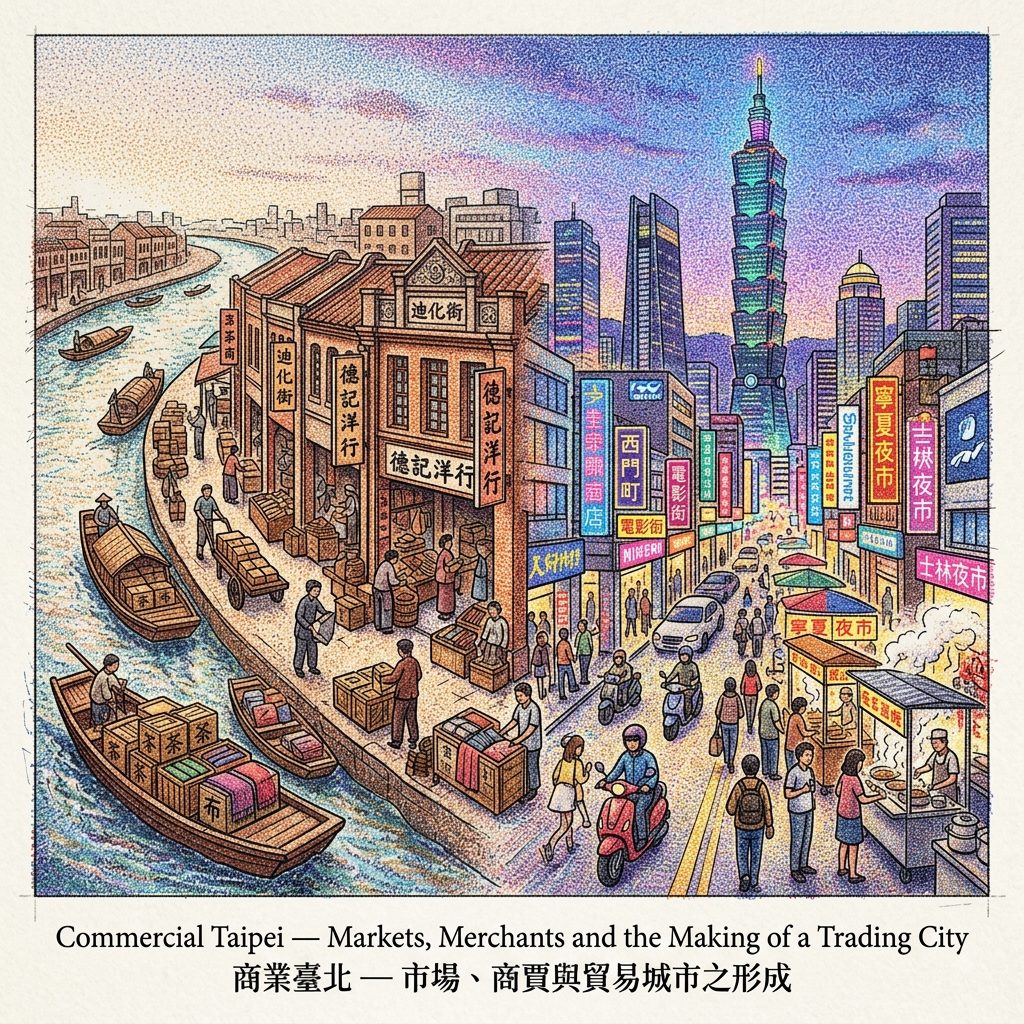
Taipei's commercial identity developed through rivers, migration, tea, traditional markets, wholesale networks and, later, modern consumer culture.
Commercial Taipei — From River Trade to Modern Consumer Culture
How Trade, Markets and Migration Built Taipei
Taipei is now known for department stores, night markets, technology companies and dense commercial districts.
But commerce in Taipei began long before the modern shopping city.
The earliest commercial landscape developed around rivers, settlements and migrant communities. During the Qing period, markets connected producers and consumers across the Taipei Basin. Dadaocheng grew into a major commercial centre, while tea, textiles and other goods connected Taipei to regional and international trade.
Under Japanese colonial rule, railways, modern administration and new infrastructure transformed the movement of goods and people.
After 1945, new waves of migration reshaped the city's markets, neighbourhoods and food culture.
Today, Taipei's traditional markets exist alongside department stores, shopping streets, technology districts and global brands.
Commercial Taipei is therefore not simply about shopping.
It is the history of how people, goods, money and ideas moved through the city.
1. Taipei Before the Shopping City
Rivers Were Taipei's First Commercial Highways
Before modern roads and railways, waterways were essential to Taipei's development.
The Tamsui River system connected the Taipei Basin with larger regional trade networks, allowing goods and people to move between settlements and ports.
This helped early commercial settlements emerge along strategic locations.
The geography mattered.
Where boats could stop, markets could develop.
Where markets developed, communities followed.
And where communities became prosperous, temples, warehouses and commercial streets appeared.
This relationship between water, trade and settlement is fundamental to understanding Taipei's commercial geography.
Explore further:
→ Colonial Taipei Theme Pillar
→ Hidden Taipei Theme Pillar
→ Taipei river and settlement stories
2. Dadaocheng — The Commercial City Before Modern Taipei
Tea, Merchants and the Rise of a Trading District
No place illustrates Commercial Taipei better than Dadaocheng.
During the nineteenth century, Dadaocheng developed into an important commercial centre as trade shifted and merchants moved into the area.
Tea became particularly important.
Taipei's tea trade connected local production with international markets, and Dadaocheng became a meeting point for merchants, wholesalers, transport networks and financial activity.
The district developed its own commercial landscape:
- Wholesale businesses
- Merchant houses
- Warehouses
- Tea firms
- Traditional shops
- Temples serving commercial communities
Dihua Street remains one of the most visible surviving expressions of this history.
But the real significance of Dadaocheng is not its old architecture.
It is the fact that a commercial ecosystem developed here long before Taipei became a modern consumer city.
Explore further:
→ Your Dadaocheng historical story
→ Dihua Street history
→ Sacred Taipei Theme Pillar
→ Colonial Taipei Theme Pillar
3. The Tea Trade — Taipei's Connection to the World
When a Local Product Became an International Business
Tea was one of the commodities that helped connect Taipei to international commerce.
Tea merchants, processors, transporters and exporters created networks stretching far beyond the Taipei Basin.
The commercial history of tea reveals something important about Taipei:
The city did not have to produce every commodity itself to become economically important.
It could become the place where products were:
- Collected
- Processed
- Financed
- Stored
- Traded
- Exported
This model helped establish Taipei as an intermediary between regional production and wider markets.
The legacy survives in Dadaocheng's historic tea businesses and in Taipei's continuing tea culture.
Explore further:
→ Dadaocheng article
→ Living Taipei Theme Pillar
→ Maokong tea culture story
4. Markets as the Infrastructure of Everyday Life
Where Commerce Became Community
Traditional markets are among the most revealing places to study Taipei.
Markets were not simply places to buy food.
They organized neighbourhood life.
People met vendors they knew.
Businesses passed from one generation to another.
Prices reflected supply, season and local demand.
Food traditions moved through the market system.
Markets therefore created social relationships as well as economic ones.
This can still be experienced in places such as:
- Ningxia Night Market
- Shilin Market
- Nanmen Market
- Traditional neighbourhood markets
The form of commerce has changed, but the basic principle remains:
markets connect people as much as they connect goods.
Explore further:
→ Living Taipei Theme Pillar
→ Traditional market stories
→ Hidden Taipei Theme Pillar
5. Wanhua — Religion, Trade and the Commercial City
When a Temple Became Part of an Economic Ecosystem
Wanhua provides another example of Taipei's commercial geography.
Longshan Temple became a major community institution in Bangka, one of the city's earliest settlement areas.
Commerce developed around it.
Traditional medicine, food businesses and local markets became part of the wider neighbourhood economy.
The relationship between religion and commerce is particularly visible around the Herbal Medicine Lane near Longshan Temple, where traditional businesses developed alongside the temple community. (travel.taipei)
This is why Commercial Taipei cannot be studied separately from Sacred Taipei.
A temple attracted people.
People created demand.
Demand supported businesses.
Businesses helped sustain the neighbourhood.
The result was a commercial ecosystem built around social and spiritual life.
Explore further:
→ Sacred Taipei Theme Pillar
→ Longshan Temple historical story
→ Wanhua historical stories
6. Ximending — The Birth of a Modern Commercial District
From Public Market to Entertainment and Consumer Culture
Ximending illustrates a later stage of Taipei's commercial development.
The Red House was built in 1908 as a public market during the Japanese colonial period. It later became associated with entertainment and cultural activity and today functions as a major heritage and creative space. (culture.gov.taipei)
Around it developed a commercial district whose function changed repeatedly.
Market.
Entertainment centre.
Cinema district.
Shopping area.
Youth culture hub.
Creative district.
This is characteristic of Taipei's commercial history.
Commercial spaces survive by changing what they sell and how people use them.
Explore further:
→ Ximending historical story
→ Colonial Taipei Theme Pillar
→ Modern Taipei Theme Pillar
7. Japanese Colonial Modernization — When Commerce Became Infrastructure
Railways, Streets and the New Commercial City
Japanese rule introduced new forms of transportation and urban infrastructure that transformed how Taipei functioned commercially.
Railways allowed goods and people to travel more efficiently across Taiwan.
Taipei Main Station became a major transportation node.
Post and telecommunication systems improved commercial communication.
Modern streets and public institutions reorganized the urban landscape.
Commerce therefore became increasingly dependent on infrastructure.
The lesson is important:
modern commercial cities are built not only by shops, but by transportation systems, communication networks and urban planning.
Taipei's later economic development depended heavily on these foundations.
Explore further:
→ Colonial Taipei Theme Pillar
→ Taipei Railway Station story
→ Modern Taipei Theme Pillar
8. The Wholesale City
The Businesses Most Tourists Never See
Retail shops are only the visible end of commerce.
Behind them are:
- Wholesalers
- Importers
- Distributors
- Warehouses
- Food suppliers
- Logistics companies
Historic Taipei developed specialized commercial streets and neighbourhoods around these functions.
This is one reason places such as Dadaocheng remain so important.
Their importance was not simply that consumers went shopping there.
They helped goods move through the city.
This distinction gives Commercial Taipei greater depth:
retail tells us what people buy; wholesale tells us how the city functions.
9. Postwar Taipei — Migration Changes the Commercial City
New People, New Food, New Markets
After 1945, Taipei changed rapidly.
Population growth, migration and economic development created new consumer demands.
New communities brought:
- Regional cuisines
- Different food traditions
- New businesses
- New social networks
- New forms of popular culture
Taipei's commercial identity consequently became more diverse.
Markets became places where different regional traditions encountered one another.
Restaurants became carriers of migration history.
Food became a form of cultural memory.
This is one reason Taipei's contemporary food culture cannot be separated from twentieth-century migration.
Explore further:
→ Modern Taipei Theme Pillar
→ Living Taipei Theme Pillar
→ Taipei migration stories
10. Night Markets — Commerce After Dark
When Shopping Became Entertainment
Taipei's night markets represent another important transformation.
They combine:
- Food
- Retail
- Leisure
- Social interaction
- Street culture
Shilin, Ningxia and other night markets have different histories and identities, but together they reveal how Taipei adapted commerce to a changing urban lifestyle.
The night market is not simply a tourist attraction.
It is a form of urban infrastructure.
It creates economic opportunities for small businesses while turning food and shopping into social experience.
This is commercial Taipei at its most accessible.
Explore further:
→ Shilin Night Market story
→ Ningxia Night Market story
→ Living Taipei Theme Pillar
11. From Traditional Shops to Department Stores
The Rise of Consumer Taipei
As Taipei modernized, commercial life moved beyond traditional streets and markets.
Department stores introduced:
- New forms of display
- Branded consumption
- Imported products
- Air-conditioned shopping
- New ideas about leisure
Shopping became an experience in itself.
This transformation accelerated the development of districts such as Zhongshan, Ximen and later Xinyi.
Commercial Taipei therefore shifted from:
trade → retail → consumption → experience
12. Xinyi — Taipei's Modern Commercial Landscape
From Urban Development to Global Consumer City
Few places symbolize contemporary Commercial Taipei more clearly than Xinyi District.
The district contains:
- Taipei 101
- Luxury shopping
- Corporate offices
- Hotels
- Entertainment
- Financial services
But the area also contains historical layers that predate the modern skyline.
Four Four South Village, for example, survives close to Taipei 101 and preserves the memory of postwar migration and military dependents' villages.
The contrast is revealing.
Within a short walk, you can move from:
postwar community → modern corporation → global consumer culture
That is Taipei's commercial transformation in miniature.
Explore further:
→ Taipei 101 story
→ Four Four South Village story
→ Modern Taipei Theme Pillar
→ Hidden Taipei Theme Pillar
13. Commercial Taipei Today
Technology, Creativity and the New Urban Economy
Taipei's economy is no longer based primarily on traditional trade.
The contemporary commercial city includes:
- Technology
- Finance
- Creative industries
- Tourism
- Retail
- Food culture
- Digital commerce
Yet many older commercial patterns remain.
Family businesses still operate.
Traditional markets remain active.
Old commercial streets continue to specialize.
Historic buildings are reused for creative businesses.
This coexistence between old and new is one of Taipei's defining characteristics.
14. The Commercial Geography of Taipei
Commercial Taipei can be understood as a series of connected economic landscapes.
Dadaocheng
Trade and merchant culture
Tea, wholesale commerce and river-linked trade.
Wanhua
Settlement and neighbourhood commerce
Markets, temple-based commerce and traditional businesses.
Ximending
Entertainment and consumer culture
Retail, cinema, youth culture and creative industries.
Zhongshan
Retail, hospitality and contemporary urban culture
A bridge between older commercial streets and modern consumption.
Xinyi
Corporate and global consumer economy
Skyscrapers, finance, luxury retail and international business.
Together they reveal Taipei's transition:
River trade → merchant commerce → colonial infrastructure → mass consumption → global city economy
15. Commercial Taipei Walking Routes
Route 1: The Merchant City
Dadaocheng → Dihua Street → Xiahai City God Temple
Historical focus:
tea trade, migrant merchants, religion and commercial networks.
→ Related pillars: Sacred Taipei, Colonial Taipei
Route 2: Old Commerce and Popular Culture
Longshan Temple → Wanhua markets → Bopiliao → Ximending
Historical focus:
settlement, community commerce, heritage and modern consumer culture.
→ Related pillars: Sacred Taipei, Hidden Taipei
Route 3: From Colonial Modernity to Global Commerce
Taipei Main Station → North Gate → Zhongshan → Xinyi
Historical focus:
railways, modernization, commercial expansion and contemporary Taipei.
→ Related pillars: Colonial Taipei, Modern Taipei
16. Commercial Taipei and the Authority Graph
Commercial Taipei should connect directly to every other Taipei theme.
Commercial + Colonial Taipei
Japanese infrastructure transformed the movement of goods and people.
→ Colonial Taipei Theme Pillar
Commercial + Sacred Taipei
Temples and commercial neighbourhoods developed together.
Commercial + Modern Taipei
Postwar economic growth transformed Taipei's commercial geography.
Commercial + Hidden Taipei
Old markets, warehouses and disappearing commercial streets preserve overlooked economic histories.
Commercial + Living Taipei
Food, tea, night markets and traditional businesses demonstrate how commerce remains part of everyday culture.
This cross-linking makes Commercial Taipei a major economic node rather than a standalone article.
17. Why Commercial Taipei Matters
Commerce is often treated as the background of a city.
But in Taipei, commerce helped determine where people lived, where communities formed and how the city connected with the outside world.
Trade shaped Dadaocheng.
Markets shaped neighbourhood life.
Railways reshaped distribution.
Night markets transformed leisure.
Department stores changed consumption.
Technology transformed the modern economy.
Commercial Taipei therefore reveals something fundamental:
A city's economic history is also its social history.
Final Reflection — The City That Learned to Trade, Adapt and Reinvent
Taipei's commercial story did not begin with shopping malls.
It began with rivers.
Then markets.
Then merchants.
Then tea.
Then railways.
Then factories and wholesale networks.
Then department stores.
Then night markets.
Then technology and global commerce.
Each generation changed what commerce meant.
Yet the underlying principle remained remarkably consistent:
Taipei has always been a city of exchange.
Goods move through it.
People move through it.
Ideas move through it.
Cultures meet through it.
And the city changes because of those encounters.
To understand Commercial Taipei is therefore not merely to understand where people shop.
It is to understand how Taipei became a city at all.
Historical Sources & Further Reading
For deeper research, prioritize institutional and archival sources such as:
- Taipei City Department of Cultural Affairs — historic commercial districts and heritage buildings
- Department of Information and Tourism, Taipei City Government — Dadaocheng, Wanhua, Ximending and market histories
- National Taiwan Museum — economic and social history collections
- National Archives Administration, Taiwan — historical administrative and commercial records
- Academic research on Dadaocheng, Taiwan's tea trade and urban commerce
- Local merchant archives and community oral histories
For Lawrence Travel Stories, major claims should ideally be supported by contextual links to the relevant institutional source inside the article, with a concise Historical Sources & Further Reading section at the end.
Continue Exploring Taipei
Taipei History & Culture — The Complete Authority Guide
→ Colonial Taipei — Empire, infrastructure and the foundations of the modern city
→ Sacred Taipei — Temples, belief and the spiritual landscape
→ Commercial Taipei — Markets, merchants and the evolution of trade
→ Modern Taipei — Migration, technology, democracy and reinvention
→ Hidden Taipei — Forgotten places and surviving communities
→ Living Taipei — Food, tea, markets, festivals and everyday culture
Commercial Taipei is where Taipei's history of movement, exchange and transformation becomes visible.
 Lawrence
 Lawrence