
Modern Taipei 現代台北
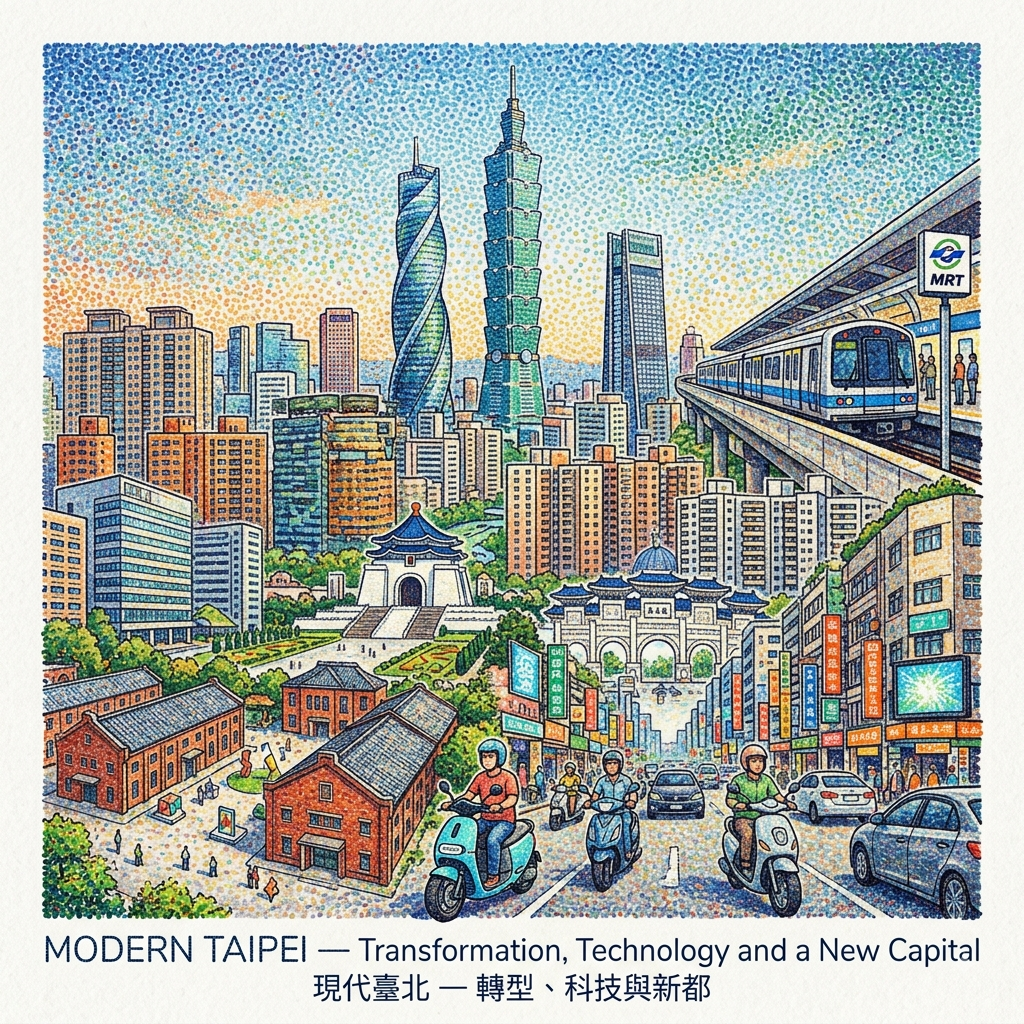
Taipei is a city that repeatedly reinvented itself — from colonial capital, to post-war refuge, to manufacturing centre, to democratic capital, and finally to a global technology and creative city.
Absolutely. For Modern Taipei, I would make the central thesis:
Taipei is a city that repeatedly reinvented itself — from colonial capital, to post-war refuge, to manufacturing centre, to democratic capital, and finally to a global technology and creative city.
That gives the pillar a strong historical narrative rather than becoming another “modern Taipei attractions” article.
Modern Taipei — From Postwar City to Global Capital
How Taipei Reinvented Itself Through Migration, Development, Democracy and Technology
Taipei today is a city of extraordinary contrasts.
Traditional temples stand beside technology companies.
Japanese-era buildings coexist with glass towers.
Night markets operate beneath modern commercial districts.
An old military settlement can survive beside Taipei 101.
The Taipei MRT carries millions of people through neighbourhoods whose histories stretch back centuries.
This apparent contradiction is not accidental.
It is the product of repeated transformation.
Modern Taipei was shaped by the end of Japanese colonial rule, postwar migration, rapid industrialization, authoritarian government, democratization, economic restructuring and the rise of Taiwan's technology industries.
The modern city therefore cannot be understood simply through its skyline.
It must be understood as a series of transformations:
colonial capital → postwar city → industrial economy → democratic capital → technology metropolis
This is the story of Modern Taipei.
1. 1945 — The End of Empire, the Beginning of a New Taipei
When the City Changed Political Identity
Japanese colonial rule ended in 1945.
Taipei entered a completely different political era.
Institutions were reorganized.
Japanese administrators and residents left.
Government buildings acquired new functions.
The city that had been designed as the administrative centre of the Japanese colonial government became the political centre of a new postwar regime.
But the physical city did not disappear.
Railways remained.
Government buildings remained.
Roads remained.
Neighbourhoods remained.
This created one of the defining characteristics of modern Taipei:
political transformation occurred on top of an inherited urban landscape.
Many of the structures created during the colonial era therefore continued to influence the development of Taipei long after 1945.
Explore Further
→ Colonial Taipei Theme Pillar
→ Taipei Railway Station history
→ North Gate and colonial Taipei
2. 1949 — Migration and the Transformation of Taipei
When a Regional City Became a National Capital
One of the most important turning points in modern Taipei came after 1949.
The relocation of the Republic of China government to Taiwan brought large numbers of people from different parts of China to the island.
Taipei experienced enormous population growth.
New communities emerged.
Housing became a major problem.
Temporary and improvised settlements developed.
Military dependents' villages became an important part of the city's social landscape.
Four Four South Village is one surviving example of this transformation.
Today it sits beside Taipei 101.
The physical contrast is extraordinary:
a postwar migrant community beside one of Asia's most recognizable skyscrapers.
That relationship provides a powerful way to understand modern Taipei.
The city's contemporary prosperity cannot be separated from the postwar migration that transformed its population and institutions.
Explore Further
→ Four Four South Village
→ Hidden Taipei Theme Pillar
→ Taipei migration stories
3. The Housing City — Taipei Builds Upward
From Low-Rise Settlements to High-Density Urban Life
Rapid population growth forced Taipei to rethink housing.
The city expanded through:
- Public housing
- Apartment buildings
- Military communities
- Informal settlements
- High-density residential development
Neighbourhoods became denser.
Buildings became taller.
Land became increasingly valuable.
The urban landscape gradually shifted from low-rise communities toward the vertical city associated with Taipei today.
This transformation explains something visitors often notice immediately:
Taipei feels dense, but its density has a history.
The city's verticality was not created overnight.
It was produced by decades of population growth, economic development, infrastructure investment and land pressure.
4. Industrial Taipei — The Economic Transformation
From Traditional Commerce to Manufacturing
Postwar Taipei did not remain primarily a trading city.
Industrialization changed the economy.
Factories and small businesses expanded.
Manufacturing became increasingly important.
Taiwan's export-oriented economy created new employment opportunities and supported rapid urban development.
Taipei became the administrative, financial and commercial centre of a much larger industrial system.
This period helped create the economic foundation for the later rise of Taiwan's technology industries.
The city's modern skyline therefore has an industrial history behind it.
Explore Further
→ Commercial Taipei Theme Pillar
→ Working-class Taipei stories
→ Taiwan industrial history
5. The Taipei MRT — The Infrastructure That Reorganized the City
How Public Transport Changed Urban Life
Few modern projects transformed Taipei as profoundly as the MRT.
The first major MRT services opened in 1996, beginning a new era of urban mobility.
The system changed:
- Where people lived
- Where they worked
- How neighbourhoods developed
- How far people could travel
- How commercial centres interacted
Stations became new urban nodes.
Neighbourhoods that were once relatively disconnected became integrated into the metropolitan system.
For visitors, the MRT is simply a convenient way to travel.
Historically, however, it represents something much larger:
the transformation of Taipei into an integrated metropolitan system.
Explore Further
→ Taipei MRT history
→ Commercial Taipei Theme Pillar
→ Hidden Taipei Theme Pillar
6. The Economic Miracle — When Taipei Became a Globalising City
From Manufacturing to High-Value Industry
During the second half of the twentieth century, Taiwan experienced rapid economic growth.
Taipei benefited directly.
Corporate headquarters expanded.
Financial services grew.
Commercial districts developed.
Consumer culture accelerated.
New shopping districts emerged.
The city increasingly connected itself to international markets.
This period also transformed Taipei's relationship with the rest of Taiwan.
Rather than functioning simply as a political capital, Taipei became the country's dominant urban centre for:
- Finance
- Media
- Government
- Education
- Technology
- Professional services
7. Democratization — A Different Kind of Modern Taipei
When the City Became a Political Laboratory
Modern Taipei was transformed not only by economics.
It was also transformed by politics.
Taiwan underwent a remarkable process of democratization during the late twentieth century.
The lifting of martial law in 1987 opened a new political era.
Political parties, civil society organizations, newspapers, student movements and social campaigns gained greater space.
Public squares and streets became places of political expression.
Taipei increasingly became a city where political identity was visible in everyday urban life.
Places associated with government and public protest therefore have another layer of meaning.
They are not merely architectural landmarks.
They are part of the history of Taiwan's democratic transformation.
Explore Further
→ Chiang Kai-shek Memorial Hall history
→ Modern political Taipei stories
→ Colonial Taipei Theme Pillar
8. Xinyi and Taipei 101 — The Symbol of a New Taipei
From Urban Development to Global Identity
Nothing symbolizes contemporary Taipei more dramatically than Taipei 101.
When it opened in 2004, it became an architectural symbol of Taiwan's economic ambitions and Taipei's emergence as a global business city.
Around it developed:
- Corporate offices
- Luxury retail
- Hotels
- Restaurants
- Financial services
- International events
Yet Xinyi's history is deeper than the skyline suggests.
Four Four South Village survives nearby, preserving memories of postwar migration and military community life.
The juxtaposition is extraordinary.
It places two generations of Taipei side by side:
postwar survival and global prosperity.
That is Modern Taipei in a single landscape.
Explore Further
→ Taipei 101 historical story
→ Four Four South Village
→ Commercial Taipei Theme Pillar
→ Hidden Taipei Theme Pillar
9. Creative Taipei — When Old Industrial Spaces Found New Lives
Cultural Transformation Through Adaptive Reuse
Modern Taipei's transformation did not always mean demolition.
Some older industrial and institutional spaces were given new functions.
The development of places such as Huashan 1914 Creative Park and Songshan Cultural and Creative Park illustrates this process.
Former industrial or institutional spaces became:
- Art venues
- Design centres
- Exhibition spaces
- Cultural markets
- Creative communities
This represents a new phase of urban development:
industrial heritage → cultural heritage → creative economy
The city began to treat selected parts of its industrial past not as obstacles to modernization, but as resources for reinvention.
Explore Further
→ Huashan 1914 Creative Park
→ Songshan Cultural and Creative Park
→ Hidden Taipei Theme Pillar
→ Living Taipei Theme Pillar
10. Technology Taipei — The Capital of a New Economy
From Industrialization to the Digital Age
Taipei's modern identity is increasingly connected with technology.
The wider Taiwan economy became globally important through electronics, semiconductors, information technology and advanced manufacturing.
Taipei emerged as an important centre for:
- Technology companies
- Research
- Venture capital
- Start-ups
- Media
- Digital culture
This changed the meaning of the city.
Taipei was no longer simply an administrative capital or manufacturing-support centre.
It became part of one of the world's most important technology ecosystems.
Yet the older city did not disappear.
Technology companies operate in a landscape still structured by old markets, temples, railway corridors and historic neighbourhoods.
11. The Night-Time City — A New Kind of Urban Culture
Markets, Food and Entertainment in Modern Taipei
Modern Taipei also transformed how people experience the city after dark.
Night markets became major urban institutions.
Street food became part of both local identity and international tourism.
Shopping districts developed new forms of nightlife.
Cafés, bars, independent shops and creative spaces expanded the city's after-hours economy.
This creates another important transformation:
Taipei's commercial life moved from necessity to experience.
People do not simply shop for goods.
They consume atmosphere, food, culture and social interaction.
Explore Further
→ Living Taipei Theme Pillar
→ Shilin Night Market
→ Ningxia Night Market
→ Ximending
12. Modern Taipei and the Survival of Older Layers
The Modern City Never Fully Replaced the Old One
Taipei's modernization is often described as a process of replacement.
But the reality is more complicated.
Old neighbourhoods remain.
Historic temples continue operating.
Traditional markets survive.
Colonial-era buildings have been restored.
Military villages have been preserved.
Old commercial streets continue to function.
Modern Taipei therefore behaves less like a clean replacement of the past and more like a process of accumulation.
New layers are added.
Older layers are modified.
Some disappear.
Some survive unexpectedly.
Some acquire completely new meanings.
This is one of the most important ideas in understanding Taipei.
13. Modern Taipei's Social Contrasts
A Global City With Very Local Neighbourhoods
Modern Taipei contains striking contrasts.
A global technology company may occupy a modern tower.
A traditional market may operate a few streets away.
A century-old temple may stand beside a new residential complex.
A former military village may survive beneath a contemporary skyline.
These contrasts are not signs of a city that failed to modernize.
They are evidence of a city that modernized without completely erasing its historical layers.
14. Modern Taipei Through Five Transformations
Modern Taipei can be understood through five major transitions:
Political Transformation
Colonial capital → postwar government centre → democratic capital
Demographic Transformation
Local settlement → mass migration → diverse metropolitan society
Economic Transformation
Traditional commerce → manufacturing → technology and services
Spatial Transformation
Low-rise city → high-density metropolis → transit-connected urban system
Cultural Transformation
Traditional institutions → mass consumer culture → creative and global city
Together, these transitions explain much of the Taipei visitors experience today.
15. Modern Taipei Walking Routes
Route 1: From Old Taipei to New Taipei
North Gate → Taipei Main Station → Zhongshan → Xinyi → Taipei 101
Historical focus:
colonial infrastructure, postwar development, commercial expansion and global Taipei.
Route 2: Migration and Modernization
Four Four South Village → Xinyi → Taipei 101
Historical focus:
postwar migration, housing, urban redevelopment and global capital.
Route 3: Industrial Past to Creative City
Songshan Cultural and Creative Park → Huashan 1914 → surrounding modern districts
Historical focus:
industrial heritage, adaptive reuse and the creative economy.
Route 4: Political Taipei
Chiang Kai-shek Memorial Hall → government district → civic spaces
Historical focus:
authoritarian rule, democratization and the political transformation of modern Taiwan.
16. Modern Taipei Across the Authority System
Modern Taipei should connect directly to the other Taipei pillars.
Modern + Colonial Taipei
Modern infrastructure and institutions inherited much from the Japanese colonial city.
→ Colonial Taipei Theme Pillar
Modern + Sacred Taipei
Temples and religious communities continue to operate within the modern metropolis.
Modern + Commercial Taipei
Economic growth transformed traditional commercial districts into a sophisticated consumer and financial city.
→ Commercial Taipei Theme Pillar
Modern + Hidden Taipei
Postwar communities, former industrial areas and surviving neighbourhoods reveal the social costs and unexpected survivals of modernization.
Modern + Living Taipei
Food, nightlife, creative culture and everyday urban life show how modernization changed the way Taipei is experienced.
17. Why Modern Taipei Matters
Modern Taipei is more than a story of economic success.
It is a story of adaptation.
The city absorbed:
- Political change
- Large-scale migration
- Industrialization
- Rapid population growth
- Democratization
- Globalization
- Technological transformation
Yet it repeatedly incorporated older layers rather than simply destroying them.
That makes Taipei particularly valuable as a city to study.
It is not frozen history.
It is history in motion.
Final Reflection — The City That Kept Reinventing Itself
Taipei has changed dramatically within a remarkably short period.
A colonial capital became a postwar refuge.
A crowded migrant city became an industrial centre.
An industrial economy became part of a global technology network.
An authoritarian capital became a vibrant democracy.
Old factories became creative spaces.
Military villages became heritage sites.
Traditional markets survived beside global corporations.
And a postwar community now sits in the shadow of Taipei 101.
This is the paradox of Modern Taipei.
The city has never stopped changing.
Yet it has never completely abandoned what came before.
Modern Taipei is therefore not the opposite of historic Taipei.
It is the latest layer of it.
To understand the Taipei of today, you need to see not only the skyline, but the decades of transformation beneath it.
Historical Sources & Further Reading
For deeper research, prioritize institutional and archival sources such as:
- Taipei City Government — urban development, transportation and cultural heritage records
- Department of Information and Tourism, Taipei City Government — historic districts and landmarks
- Taipei City Department of Cultural Affairs — adaptive reuse and cultural heritage
- National Archives Administration, Taiwan
- National Taiwan Museum
- National Taiwan University historical archives
- Academic research on postwar migration, democratization and Taipei urban development
- Community oral histories and military dependents' village archives
For Lawrence Travel Stories, major historical claims should be supported by contextual citations within the relevant sections, while the Historical Sources & Further Reading section provides readers with a clear research trail.
Continue Exploring Taipei
Taipei History & Culture — The Complete Authority Guide
→ Colonial Taipei — Empire, infrastructure and the foundations of the modern city
→ Sacred Taipei — Temples, belief and the spiritual landscape
→ Commercial Taipei — Markets, merchants and the evolution of trade
→ Modern Taipei — Migration, technology, democracy and reinvention
→ Hidden Taipei — Forgotten places and surviving communities
→ Living Taipei — Food, tea, markets, festivals and everyday culture
Modern Taipei is the layer where Taipei's historical inheritance becomes contemporary life.
 Lawrence
 Lawrence