
Living Taipei 活色生香的台北
Living Taipei explores the everyday cultural practices that have survived, adapted and evolved through migration, modernization and urban change. This is Taipei not as a museum, but as a living cultural landscape.
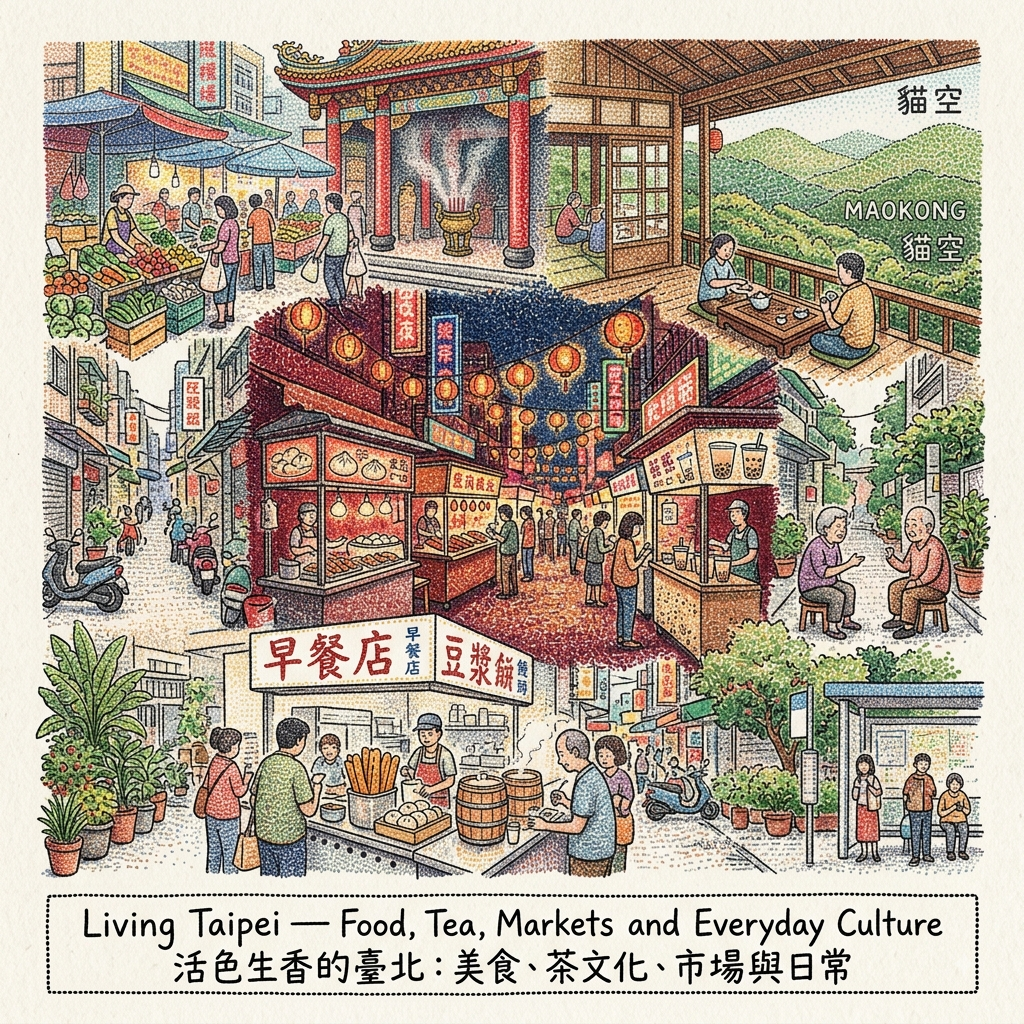
Taipei's history remains alive through food, tea, markets, festivals, neighbourhood rituals, street culture and everyday habits.
Living Taipei — Food, Tea, Markets and the Everyday Culture of the City
Where Taipei's History Is Still Being Lived
Taipei is often introduced through its landmarks.
Taipei 101.
Longshan Temple.
Dihua Street.
The National Palace Museum.
But some of the most important parts of Taipei's identity are not monumental at all.
They are ordinary.
A breakfast shop opening before sunrise.
A market vendor who has worked in the same neighbourhood for decades.
A tea house where an old Taiwanese tradition survives in a modern city.
A night market where food, commerce and social life continue late into the evening.
A temple festival that temporarily turns an ordinary street into a sacred space.
These experiences are not merely lifestyle attractions.
They are evidence of history.
Living Taipei explores the everyday cultural practices that have survived, adapted and evolved through migration, modernization and urban change.
This is Taipei not as a museum, but as a living cultural landscape.
1. Food as Historical Memory
Why Eating Taipei Is Also Reading Taipei
Food is one of the clearest ways to understand a city's history.
Taipei's cuisine reflects multiple waves of migration, trade and cultural exchange.
Traditional Taiwanese dishes coexist with foods brought by different migrant communities after 1945.
Breakfast shops, noodle restaurants, bakeries, tea houses and street stalls all tell parts of this story.
A food tradition may reveal:
- Where people came from
- How ingredients travelled
- How businesses adapted
- How families preserved regional traditions
- How old foods became part of modern urban culture
This makes Taipei's food culture more than a culinary attraction.
It is a form of historical evidence.
Explore Further
→ Your Taipei food-history stories
→ Commercial Taipei Theme Pillar
→ Modern Taipei Theme Pillar
2. Taipei Breakfast Culture
The City That Starts Eating Early
One of the most distinctive aspects of everyday Taipei is its breakfast culture.
Traditional breakfast shops are often small, fast-moving neighbourhood businesses.
Soy milk.
You tiao.
Dan bing.
Fan tuan.
Shaobing.
These foods are part of a deeply established urban rhythm.
Breakfast shops also reveal how migration, family businesses and working life shaped modern Taipei.
The morning meal became an institution because the modern city required people to eat quickly, affordably and locally before work or school.
The result is a food culture that is simultaneously:
traditional + practical + urban.
Explore Further
→ Traditional Taipei breakfast story
→ Modern Taipei Theme Pillar
→ Commercial Taipei Theme Pillar
3. Night Markets — The City Comes Alive After Dark
Food, Commerce and Social Life
Taipei's night markets are among the city's best-known cultural experiences.
But their significance goes beyond tourism.
Night markets bring together:
- Small businesses
- Street food
- Informal commerce
- Entertainment
- Social interaction
- Local neighbourhood life
Shilin, Ningxia and other markets developed different identities, but together they demonstrate how Taipei adapted commercial life to the rhythms of the modern city.
The night market transformed shopping into entertainment.
Food became spectacle.
Street commerce became cultural identity.
Explore Further
→ Shilin Night Market historical story
→ Ningxia Night Market historical story
→ Commercial Taipei Theme Pillar
→ Hidden Taipei Theme Pillar
4. Traditional Markets — Where Neighbourhood History Remains Visible
The Everyday City Behind the Tourist City
Traditional markets may seem ordinary.
That is precisely why they are historically valuable.
Markets preserve:
- Local food networks
- Long-standing businesses
- Neighbour relationships
- Traditional occupations
- Seasonal customs
- Everyday patterns of consumption
Unlike a preserved historical building, a functioning market continues to evolve.
A stall may change owners.
A product may disappear.
A new generation may introduce something different.
Yet the underlying relationship between neighbourhood, vendor and customer survives.
This is living heritage rather than static heritage.
Explore Further
→ Taipei traditional market stories
→ Commercial Taipei Theme Pillar
→ Hidden Taipei Theme Pillar
5. Tea Culture — From Export Commodity to Living Tradition
The Journey From Trade to Everyday Ritual
Taipei's tea culture has deep commercial and cultural roots.
Tea was once an important export commodity and a major part of Taipei's trading economy, particularly through Dadaocheng.
But tea did not remain simply an economic product.
It became part of everyday life.
Tea houses, tea merchants, mountain tea-growing areas and modern specialty shops reveal different stages of this transformation.
The relationship between Taipei and tea therefore connects two seemingly different subjects:
Commercial Taipei and Living Taipei.
One explains how tea generated wealth.
The other explains how tea became culture.
Explore Further
→ Dadaocheng tea trade story
→ Maokong tea culture story
→ Commercial Taipei Theme Pillar
6. Maokong — The Mountain Behind the City
Tea, Landscape and Urban Escape
Maokong offers a different perspective on Taipei's relationship with tea.
Located within the Taipei metropolitan area but surrounded by hills and tea-growing landscapes, Maokong demonstrates how agricultural traditions can survive alongside an expanding metropolis.
Tea houses and plantations create a distinctive cultural landscape combining:
- Agriculture
- Hospitality
- Tea production
- Mountain ecology
- Urban leisure
It reminds visitors that Taipei is not only a dense urban core.
The metropolitan area contains landscapes where older production traditions remain part of contemporary life.
Explore Further
→ Maokong tea history
→ Commercial Taipei Theme Pillar
→ Hidden Taipei Theme Pillar
7. Temples as Living Community Institutions
Where Religion Becomes Everyday Culture
A temple should not be understood only as a historic building.
In Taipei, many temples remain active community institutions.
People visit them to:
- Pray
- Ask for protection
- Celebrate festivals
- Seek advice
- Give thanks
- Meet members of their community
This means religious tradition is continuously reproduced.
Sacred Taipei and Living Taipei therefore overlap.
Longshan Temple, Bao'an Temple and Xiahai City God Temple all illustrate how religion continues to influence neighbourhood life. Taipei's official tourism resources document their continuing community and cultural functions. (travel.taipei)
Explore Further
→ Sacred Taipei Theme Pillar
→ Longshan Temple story
→ Bao'an Temple story
→ Xiahai City God Temple story
8. Festivals — When the Streets Become the Stage
Tradition That Temporarily Rewrites the City
One of Taipei's most powerful forms of living culture is the festival.
During temple processions and traditional celebrations, ordinary streets can become:
- Sacred routes
- Performance spaces
- Community gathering places
- Temporary markets
- Places of collective memory
Festivals are important because they transform historical traditions into experiences that involve people directly.
The past does not simply get remembered.
It gets performed.
Explore Further
→ Taipei temple festival stories
→ Sacred Taipei Theme Pillar
→ Commercial Taipei Theme Pillar
9. Street Culture — The Unplanned Character of Taipei
The City Between the Buildings
Taipei's cultural identity is often created outside formal institutions.
It appears in:
- Street food
- Side-street cafés
- Small shops
- Barber shops
- Food stalls
- Neighbourhood parks
- Informal gatherings
This street-level culture gives Taipei much of its distinctive character.
It also reveals the relationship between the formal city and the lived city.
Official planning creates roads and buildings.
Residents create habits.
Together, they create urban culture.
10. Parks and Public Spaces
Where Taipei's Everyday Social Life Happens
Taipei's public parks are more than green spaces.
They provide places for:
- Exercise
- Dance
- Tai chi
- Conversation
- Family activities
- Community events
These spaces reveal another aspect of Living Taipei: public life.
Modern urban development can produce increasingly dense cities, but public spaces allow communities to maintain social interaction.
Taipei's parks therefore belong within the history of urban life just as much as its buildings do.
Explore Further
→ Modern Taipei Theme Pillar
→ Taipei urban development stories
11. Café Culture and the Reinvention of Old Neighbourhoods
When History Becomes Contemporary Lifestyle
Taipei's café culture provides an interesting example of cultural transformation.
Old houses, former workshops and historic commercial buildings are increasingly reused as:
- Cafés
- Bookshops
- Design studios
- Independent shops
- Creative spaces
This process connects Living Taipei with Hidden Taipei.
An old neighbourhood does not necessarily survive by remaining unchanged.
It can survive by finding a new economic purpose.
This raises an important question:
When does adaptive reuse preserve history, and when does it turn history into a lifestyle product?
That tension is part of contemporary Taipei.
12. Food Streets and Neighbourhood Identity
Why a Street Can Become a Cultural Institution
Certain streets become strongly associated with particular foods or businesses.
That association develops through repetition.
A group of vendors establishes a reputation.
Customers return.
New businesses move into the area.
The food becomes part of neighbourhood identity.
Over time, the street itself becomes a cultural reference point.
This process can be seen in:
- Yongkang Street
- Dihua Street
- Wanhua food districts
- Traditional market areas
- Night-market neighbourhoods
These places demonstrate how food can create geography.
Explore Further
→ Commercial Taipei Theme Pillar
→ Dihua Street
→ Wanhua
→ Hidden Taipei Theme Pillar
13. Living Heritage vs. Museum Heritage
What Makes a Culture Truly “Alive”?
There is an important distinction between preserving something and keeping it alive.
A museum can preserve an object indefinitely.
A living tradition depends on people continuing to use it.
That means living culture can change.
A recipe changes.
A festival changes.
A business changes hands.
A temple adapts.
A traditional craft discovers new customers.
This flexibility is not necessarily cultural loss.
Sometimes it is the reason a tradition survives.
Living Taipei therefore focuses not on preserving a perfect version of the past, but on understanding how culture survives through adaptation.
14. Migration and the Everyday Culture of Taipei
A City Made From Many Regional Traditions
Modern Taipei's everyday culture has been shaped by migration.
After 1945, people arrived from different parts of China, bringing regional cuisines, dialects, religious traditions and memories.
Later generations added new cultural influences.
The result is a city where identity is constantly negotiated.
A restaurant may preserve one regional tradition.
A family business may combine several.
A festival may contain layers of cultural borrowing.
Food becomes one of the clearest ways to observe these transformations.
Living Taipei is therefore closely connected to the demographic history of Modern Taipei.
Explore Further
→ Modern Taipei Theme Pillar
→ Migration stories
→ Food history stories
15. Living Taipei and the Five Other Historical Layers
Living Taipei is the most interconnected of your Taipei pillars.
Living + Colonial Taipei
Colonial-era institutions, markets, architecture and transportation still influence everyday life.
→ Colonial Taipei Theme Pillar
Living + Sacred Taipei
Temples, festivals and rituals remain part of ordinary neighbourhood life.
Living + Commercial Taipei
Markets, food businesses, tea houses and night markets represent the continuing commercial life of the city.
→ Commercial Taipei Theme Pillar
Living + Modern Taipei
Urbanization, technology and changing lifestyles continuously reshape everyday culture.
Living + Hidden Taipei
Old neighbourhoods, traditional shops and surviving communities preserve cultural practices outside the mainstream tourist landscape.
This makes Living Taipei an important cross-regional thematic layer rather than simply another category.
16. Living Taipei Walking Routes
Route 1: Food and Old Taipei
Longshan Temple → Wanhua streets → traditional markets → Bopiliao
Historical focus:
settlement, religion, food and neighbourhood commerce.
Route 2: Tea and Trade
Dadaocheng → Dihua Street → tea merchants → historic commercial streets
Historical focus:
tea trade, migration and commercial culture.
Route 3: Market Taipei
Ningxia Night Market → Dadaocheng → traditional market areas
Historical focus:
urban commerce, food culture and neighbourhood life.
Route 4: Contemporary Taipei
Zhongshan → creative spaces → cafés → independent shops
Historical focus:
adaptive reuse, youth culture and the reinvention of older urban districts.
Route 5: Mountain and City
Maokong → tea plantations → tea houses
Historical focus:
agriculture, tea culture, landscape and the relationship between Taipei and its surrounding hills.
17. Why Living Taipei Matters
A city's history does not survive only in monuments.
It survives when people continue to:
- Cook
- Pray
- Trade
- Celebrate
- Drink tea
- Gather
- Teach
- Remember
That is what makes Taipei different from a historical museum.
The city is constantly producing its own cultural memory.
Every generation adds another layer.
Final Reflection — The Taipei That Lives
Taipei's history can be found in its grandest buildings.
But it can also be found in much smaller places.
A breakfast shop opening before sunrise.
A tea house on a mountain road.
An old woman buying vegetables at a market.
A temple procession moving through a busy street.
A family business continuing into its third generation.
A night market filling a street with light, sound and food.
These experiences may seem ordinary.
But ordinary life is where culture becomes durable.
A monument tells us what a city once built.
Living culture tells us what a city continues to be.
Taipei's strength lies in this continuity.
It modernizes without completely abandoning its habits.
It absorbs new influences without entirely losing older ones.
It turns history into daily practice.
And that may be the most fascinating thing about Taipei.
The past is not simply preserved here.
It is still being lived.
Historical Sources & Further Reading
For deeper research, prioritize institutional and scholarly sources such as:
- Department of Information and Tourism, Taipei City Government
- Taipei City Department of Cultural Affairs
- National Taiwan Museum
- Taipei-based cultural heritage institutions
- Academic studies of Taiwanese food culture, tea culture and folk religion
- Research on migration and postwar Taipei
- Local market histories and community oral histories
- Individual temple and festival archives
For Lawrence Travel Stories, major historical claims should ideally be supported with contextual citations to authoritative sources within the relevant sections, while this final section provides a broader research trail.
Continue Exploring Taipei
Taipei History & Culture — The Complete Authority Guide
→ Colonial Taipei — Empire, infrastructure and the foundations of the modern city
→ Sacred Taipei — Temples, belief and the spiritual landscape
→ Commercial Taipei — Markets, merchants and the evolution of trade
→ Modern Taipei — Migration, technology, democracy and reinvention
→ Hidden Taipei — Forgotten places and surviving communities
→ Living Taipei — Food, tea, markets, festivals and everyday culture
Living Taipei is where Taipei's history stops being something you visit—and becomes something you experience.
 Lawrence
 Lawrence