Sacred Taipei 神聖台北
This is Sacred Taipei. But Sacred Taipei is not simply a collection of temples. It is the story of how religion, migration, commerce, community and urban identity became intertwined.
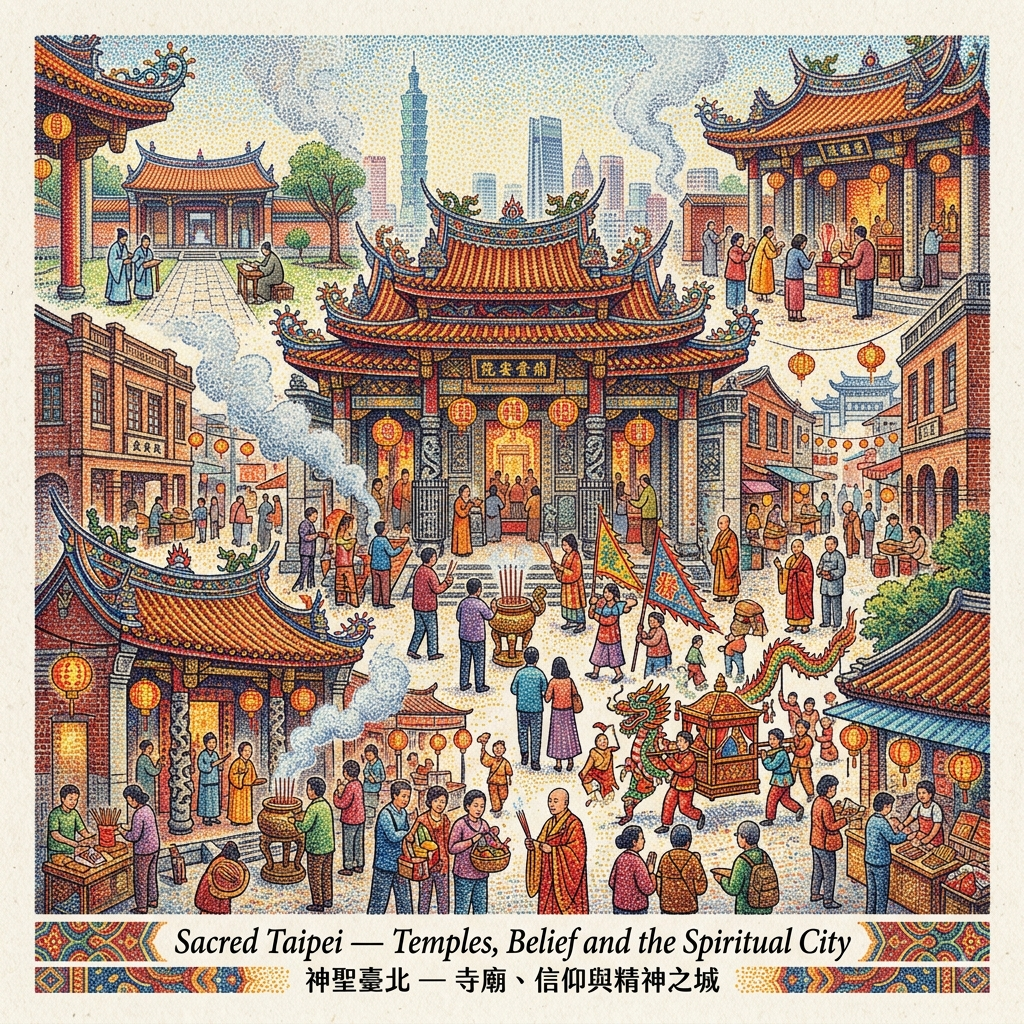
Sacred Taipei — Temples, Belief and the Spiritual Architecture of the City
The Spiritual City Beneath Modern Taipei
Taipei is often described as a modern Asian capital of technology, commerce and dense urban life.
Yet beneath the traffic, shopping streets and high-rise buildings lies another city.
A spiritual city.
Temples stand beside markets. Festivals transform ordinary streets into sacred spaces. Worshippers visit the same neighbourhood temples that their families have visited for generations. Merchants pray for prosperity. Students seek success. Families ask for protection. Communities gather around religious institutions that have survived political change, war, redevelopment and modernization.
This is Sacred Taipei.
But Sacred Taipei is not simply a collection of temples.
It is the story of how religion, migration, commerce, community and urban identity became intertwined.
To understand Taipei's spiritual landscape, you have to look beyond the architecture and ask why these temples were built, who brought the gods here, what communities they served, and how their roles changed as the city evolved.
1. The Spiritual Foundations of Taipei
Temples Before the Modern Metropolis
Taipei's religious landscape developed alongside settlement.
As communities established themselves in the Taipei Basin, temples became places where people sought protection, healing, prosperity and social solidarity.
Many important temples were closely connected to migration from Fujian and other parts of southern China. Religious traditions travelled with people, and temples became anchors for newly established communities.
This relationship between migration and religion is crucial.
A temple was not simply a building where a deity was worshipped.
It could also function as:
- A community meeting place
- A centre for festivals
- A place to resolve disputes
- A source of mutual support
- A marker of local identity
In this sense, Taipei's temples are also community archives.
They preserve memories of the people who built the city.
2. Longshan Temple — The Spiritual Heart of Old Bangka
Where Religion, Migration and Urban Life Meet
Among Taipei's temples, Longshan Temple is perhaps the clearest example of how religion shaped an entire urban district.
Longshan Temple was founded in 1738 in Bangka, now Wanhua, one of the earliest areas of Han settlement in Taipei. Taipei's official tourism authority describes the temple as a historic gathering place where residents prayed, held events and sought help with everyday concerns.
The temple's religious landscape is unusually diverse.
Its halls contain Buddhist, Taoist and Confucian deities, reflecting the syncretic character of popular religious practice in Taiwan. Its architecture combines traditional courtyard planning with elaborate Chinese palace-style decoration.
But its historical importance goes beyond the building.
Around Longshan Temple developed a wider ecosystem of:
- Traditional medicine
- Markets
- Food businesses
- Religious services
- Neighbourhood commerce
The nearby Herbal Medicine Lane, for example, developed in connection with people seeking traditional remedies after visiting the temple. Taipei Travel notes that many herbal businesses in the lane have been passed through generations.
Longshan Temple therefore illustrates one of Sacred Taipei's central principles:
Religion helped create the city around it.
Explore further:
→ Your Longshan Temple historical story
→ Hidden Taipei Theme Pillar
→ Commercial Taipei Theme Pillar
→ Wanhua historical stories
3. Bao'an Temple — Medicine, Migration and Community Protection
When a Migrant Community Brought Its Deity to Taipei
Dalongdong Bao'an Temple offers a different window into Taipei's religious history.
The temple is associated with migrants from Tongan in Fujian and is dedicated to Baosheng Dadi, a deity strongly associated with medicine and healing. Taipei Travel records that immigrants sought the deity's spiritual protection during epidemics and later rebuilt the temple in the eighteenth century.
The history of Bao'an Temple therefore connects three subjects that are often studied separately:
migration + disease + religion
For a newly established community, epidemics were not simply medical crises.
They were social crises.
A temple offered a framework through which people could interpret danger, seek protection and strengthen community solidarity.
Bao'an Temple also demonstrates that religious traditions were not passively transferred from mainland China.
They were adapted to the conditions of Taipei.
Its long history of reconstruction and conservation illustrates another dimension of Sacred Taipei: religious heritage can evolve while remaining culturally meaningful.
Taipei's official cultural sources note that Bao'an Temple's major restoration project in the 1990s became an important example of heritage conservation and received the UNESCO Asia-Pacific Heritage Award for Culture Heritage Conservation in 2003.
Explore further:
→ Your Bao'an Temple story
→ Colonial Taipei Theme Pillar
→ Hidden Taipei Theme Pillar
4. Xiahai City God Temple — Where Religion and Commerce Became One
The Spiritual Centre of Dadaocheng
If Longshan Temple demonstrates the relationship between religion and settlement, Taipei Xiahai City God Temple shows how religion became embedded in commerce.
The temple was established on Dihua Street in 1856 and became closely associated with the development of Dadaocheng. Taipei Travel describes it as a long-standing religious centre of the district and an important part of its commercial and community history.
The City God is traditionally associated with the protection and administration of a city.
That makes the temple particularly interesting in a commercial district.
Merchants were not simply asking for personal blessings.
They were participating in a religious system connected to:
- Protection
- Prosperity
- Social order
- Community identity
The temple's famous matchmaking deity later gave it another layer of popular religious meaning, attracting visitors seeking relationships and good fortune. Taipei's current tourism materials continue to identify the temple as one of Taipei's major places for this form of devotion.
The annual City God procession demonstrates how religion can temporarily transform urban space.
A commercial street becomes:
- Ritual route
- Performance space
- Community gathering place
- Historical stage
The 2026 Taipei City God Cultural Festival continues this tradition, illustrating how an old religious practice can coexist with contemporary social and cultural themes.
Explore further:
→ Your Dadaocheng / Xiahai City God Temple story
→ Commercial Taipei Theme Pillar
→ Colonial Taipei Theme Pillar
5. Taipei Confucius Temple — Religion, Education and the Ideal Citizen
A Different Kind of Sacred Space
Not every sacred place in Taipei is designed around popular folk worship.
The Taipei Confucius Temple represents another tradition: Confucian ritual and the cultural importance of education.
The temple is deliberately more restrained architecturally than many folk temples. Taipei Travel notes its comparatively simple design and its annual Confucius memorial ceremony, traditionally held on September 28.
This difference matters.
Sacred Taipei is not one religious system.
It contains distinct traditions serving different social purposes.
The Confucius Temple connects spirituality with:
- Education
- Scholarship
- Ritual order
- Ethics
- Social ideals
Its relationship with the neighbouring Bao'an Temple also reveals how different religious and ritual traditions could coexist within the same urban environment.
This makes the Dalongdong area one of the best places to understand Taipei's diverse spiritual geography.
Explore further:
→ Your Taipei Confucius Temple story
→ Bao'an Temple story
→ Colonial Taipei Theme Pillar
6. Taipei's City God Tradition — Governing the Invisible City
When Religious Ideas Reflected Administrative Ideas
The City God tradition is particularly useful for understanding Chinese urban culture.
The City God was imagined as a supernatural counterpart to earthly administration.
The divine city had:
- Officials
- Courts
- Records
- Hierarchies
- Rules
The idea mirrored the bureaucratic structures of the human city.
In Taipei, this relationship became particularly visible through temples such as the Xiahai City God Temple and the Taipei City City God Temple.
The latter has a particularly revealing history: the temple was established after Taipei Prefecture was created in 1875, but it was demolished during Japanese colonial rule and rebuilt after 1945. Taipei Travel's official history records this institutional transformation.
The temple therefore becomes more than a religious site.
It becomes a physical record of:
- Qing administration
- Japanese colonial restructuring
- Postwar reconstruction
- Continuing local worship
This is precisely the kind of layered historical story that defines Lawrence Travel Stories.
7. Religion and Migration — The Gods Came With the People
Taipei's Spiritual Geography Is Also a Migration Map
One of the most powerful ways to understand Taipei's religious landscape is to ask:
Who brought these gods here?
Different communities brought different religious traditions, dialects, rituals and local deities.
Temples became geographical markers of migration.
A deity could travel across the Taiwan Strait.
A community could rebuild its temple in a new settlement.
Over generations, that imported tradition could become completely local.
This means Taipei's temples preserve another kind of map:
a map of human movement.
Look closely at the history of individual temples and you repeatedly encounter:
- Fujian migration
- Settlement
- Trade
- Family networks
- Community associations
- Maritime connections
Sacred Taipei is therefore inseparable from the history of migration.
Explore further:
→ Colonial Taipei Theme Pillar
→ Commercial Taipei Theme Pillar
→ Dadaocheng and Wanhua stories
8. Temples and the Business of Everyday Life
Religion Was Never Separate From Commerce
A common modern assumption is that religious spaces belong to the private sphere while markets belong to the economic sphere.
Historic Taipei does not fit that distinction neatly.
Temples attracted people.
People created markets.
Markets supported neighbourhoods.
Neighbourhoods sustained temples.
This cycle can still be observed around major religious institutions.
Longshan Temple developed alongside herbal medicine businesses and neighbourhood commerce. Xiahai City God Temple became deeply connected to Dadaocheng's commercial life. Taipei's current temple districts continue to support restaurants, traditional shops, markets and cultural activity.
The result is a city in which spirituality and commerce frequently occupy the same streets.
That is one of Taipei's most distinctive cultural characteristics.
9. Rituals That Turn Streets Into Sacred Space
When the City Itself Becomes Part of the Ceremony
A temple does not stop at its entrance.
Festivals expand its spiritual territory into the surrounding neighbourhood.
Processions move through streets.
Offerings appear outside shops.
Music and performance transform public space.
Residents participate even when they do not enter the temple itself.
The Xiahai City God procession is one of the clearest examples. The annual celebration has long been associated with Dadaocheng's community life, and contemporary cultural programming continues to preserve the ritual while adapting it to present-day concerns.
This suggests an important way to travel Taipei:
Do not only visit temples.
Follow what happens around them.
The streets surrounding a temple may reveal more about its social role than the temple architecture alone.
10. Sacred Taipei Under Japanese Colonial Rule
Religion in a Changing Political System
The Japanese colonial period introduced another major layer to Taipei's religious history.
Colonial authorities reorganized institutions, public space and religious practice.
Some traditional religious institutions continued.
Others experienced regulation, transformation or disruption.
The history of Taipei City City God Temple, which was demolished during Japanese rule and rebuilt after 1945, demonstrates how religious institutions could be affected by changing political structures.
This is where Sacred Taipei intersects directly with Colonial Taipei.
Religion was not outside politics.
Religious buildings, rituals and communities existed within changing systems of political authority.
Explore further:
→ Colonial Taipei Theme Pillar
→ Modern Taipei Theme Pillar
11. Sacred Taipei After 1945
Modernization Did Not Eliminate Traditional Belief
Taipei became increasingly modern after the Second World War.
New roads appeared.
High-rise buildings transformed neighbourhoods.
The MRT reshaped movement.
Shopping districts expanded.
Yet temples remained part of everyday urban life.
They adapted rather than disappearing.
Some were restored.
Some became cultural heritage sites.
Others continued functioning primarily as places of worship.
This coexistence is important.
Taipei demonstrates that modernization does not necessarily mean the removal of traditional culture.
Sometimes modernization creates new environments in which old traditions acquire new meanings.
12. Hidden Sacred Taipei — The Temples Beyond the Famous Names
Looking Beyond Longshan and Bao'an
The best-known temples tell only part of Taipei's spiritual story.
Across the city are smaller neighbourhood shrines and temples connected to:
- Local communities
- Village origins
- Migrant groups
- Occupations
- Family networks
- Mountain and river landscapes
Some are architecturally modest.
Some are nearly invisible from major roads.
Their historical value often lies precisely in their lack of fame.
They show how religion operates at neighbourhood scale.
This is where Sacred Taipei connects directly with Hidden Taipei.
Explore further:
→ Hidden Taipei Theme Pillar
→ Your neighbourhood temple stories
13. Sacred Geography — Reading Taipei Through Its Temples
One of the most useful ways to understand Sacred Taipei is geographically.
Wanhua
Longshan Temple
Historical focus:
Early settlement, migration, community life and the relationship between religion and commerce.
Dalongdong
Bao'an Temple + Taipei Confucius Temple
Historical focus:
Migration, medicine, education, ritual and community identity.
Dadaocheng
Xiahai City God Temple
Historical focus:
Commerce, social order, prosperity and merchant culture.
Central Taipei
Taipei City City God Temple
Historical focus:
Qing administration, colonial transformation and postwar rebuilding.
These places are not isolated religious landmarks.
Together they form a map of Taipei's social history.
14. Sacred Taipei Walking Routes
Route 1: Old Taipei Spiritual Core
Longshan Temple → Bangka streets → herbal medicine area → traditional markets
Historical focus:
settlement, migration, religion and everyday commerce.
Route 2: Dalongdong Cultural Axis
Bao'an Temple → Taipei Confucius Temple → surrounding historic streets
Historical focus:
medicine, education, ritual and community development.
Route 3: Dadaocheng and Merchant Faith
Xiahai City God Temple → Dihua Street → old commercial streets
Historical focus:
trade, merchant culture, prosperity and religious identity.
Route 4: The Changing Sacred City
Taipei City City God Temple → North Gate area → colonial Taipei
Historical focus:
Qing administration, Japanese transformation and postwar reconstruction.
15. Sacred Taipei Across the Authority System
Sacred Taipei should not exist as an isolated pillar.
It connects directly to every other major Taipei theme.
Sacred + Colonial Taipei
Temples and religious institutions reveal how communities adapted to changing political authority.
→ Colonial Taipei Theme Pillar
Sacred + Commercial Taipei
Markets and temples evolved together, particularly in Wanhua and Dadaocheng.
→ Commercial Taipei Theme Pillar
Sacred + Modern Taipei
Modern Taipei continues to incorporate temples into a rapidly changing urban environment.
Sacred + Hidden Taipei
Smaller neighbourhood temples preserve local histories that can easily disappear from the mainstream city narrative.
Sacred + Living Taipei
Festivals, food, rituals and everyday worship show that religious culture remains a living part of contemporary Taipei.
16. Why Sacred Taipei Matters
Taipei's temples should not be treated simply as beautiful buildings.
They reveal:
- Where communities settled
- Where migrants came from
- What people feared
- What people hoped for
- How merchants understood prosperity
- How communities responded to illness
- How political change affected local institutions
- How traditions survived modernization
In other words:
Temples are historical documents made of stone, wood, ritual and memory.
And unlike documents sitting in an archive, they remain part of everyday life.
Final Reflection — The City That Still Prays
Taipei is one of Asia's most technologically connected cities.
Yet its inhabitants still light incense.
They visit temples before important events.
They seek blessings for health.
They pray for prosperity.
They ask for academic success.
They participate in processions that have continued across generations.
This is not simply a contradiction between modernity and tradition.
It is one of Taipei's defining characteristics.
The city has modernized without completely severing its spiritual foundations.
Walk through Wanhua and you encounter a temple that grew with one of Taipei's earliest communities.
Walk through Dadaocheng and you find a deity whose story is intertwined with commerce.
Walk through Dalongdong and medicine, education and religion stand within the same historical landscape.
Look more carefully, and the spiritual city is everywhere.
Sacred Taipei is not a city hidden from modern Taipei.
It is the invisible layer that continues to live inside it.
Historical Sources & Further Reading
For further research, prioritize institutional, heritage and archival sources such as:
- Department of Information and Tourism, Taipei City Government — historical sites and temple documentation
- Taipei City Department of Cultural Affairs — heritage records and historical research
- National cultural heritage and temple archives
- Individual temple historical records and inscriptions
- Academic research on Taiwanese folk religion, migration and urban history
- Oral histories and community archives
Particularly useful institutional starting points include Taipei Travel's documentation of Longshan Temple, Bao'an Temple, Xiahai City God Temple and Taipei Confucius Temple.
For your Historical Travel Stories articles, I recommend placing contextual citations within the relevant historical sections rather than relying exclusively on a bibliography at the end. This makes each major historical claim traceable and strengthens the research-driven identity of the site.
Continue Exploring Taipei
Taipei History & Culture — The Complete Authority Guide
→ Colonial Taipei — Empire, urban transformation and the foundations of the modern city
→ Sacred Taipei — Temples, belief and the spiritual architecture of Taipei
→ Commercial Taipei — Markets, merchants and the evolution of trade
→ Modern Taipei — Migration, technology, democracy and reinvention
→ Hidden Taipei — Forgotten places and surviving communities
→ Living Taipei — Food, tea, markets, festivals and everyday culture
Sacred Taipei sits at the intersection of history, migration, commerce and everyday life.
 Lawrence
 Lawrence