
Colonial Taipei 殖民時期的台北
That is why Colonial Taipei is best understood as a story of urban layering. It is not simply the history of Japanese buildings. It is the story of how political power, infrastructure, commerce, education and culture.
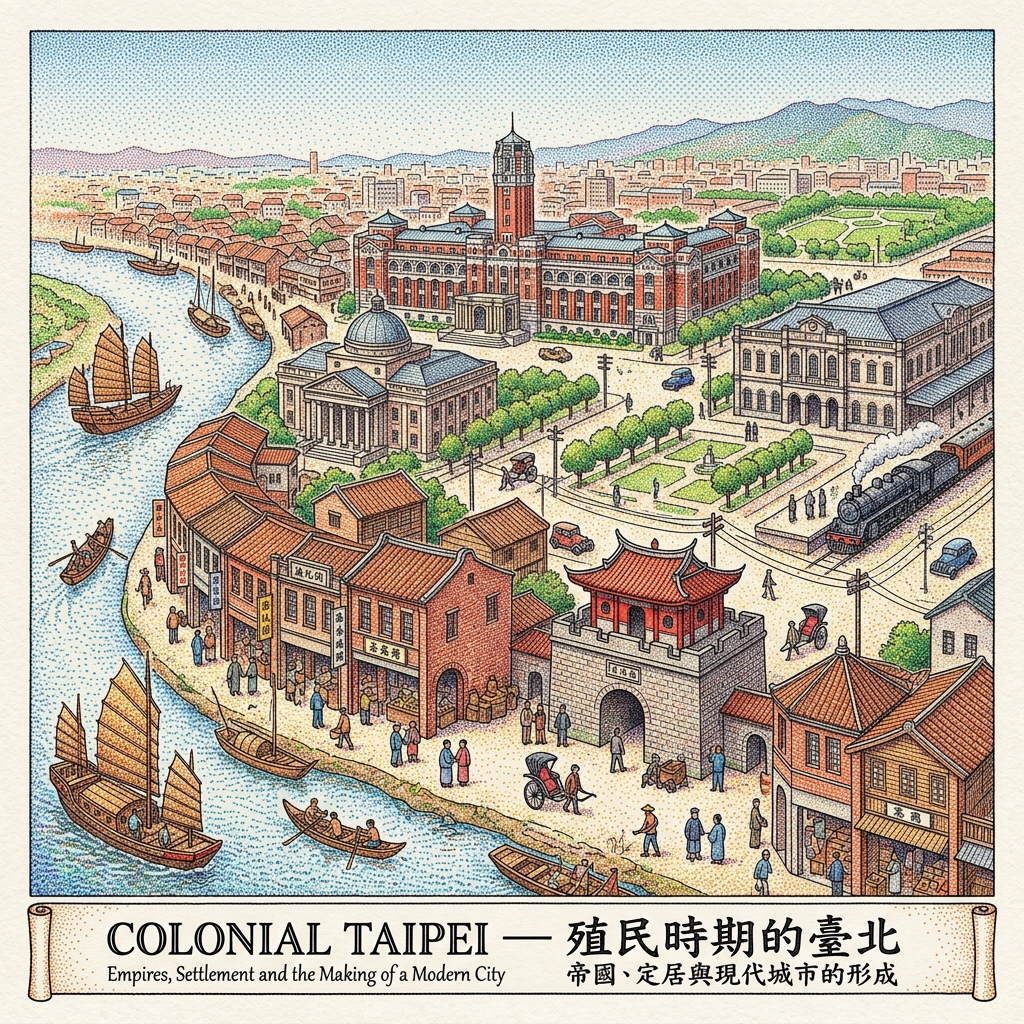
Colonial Taipei: From Qing Settlement to Japanese Imperial Capital
Colonial Taipei — How Empire Transformed the City
Taipei did not begin as a modern capital.
Before Japanese rule, the Taipei Basin was already a landscape of Indigenous communities, Qing settlement, temples, waterways and emerging commercial districts. The Japanese colonial period, beginning in 1895, then transformed Taipei into an administrative capital of a modernizing empire.
The result was not a completely new city.
It was a city rebuilt on top of an older one.
Old gates remained while city walls disappeared. Traditional markets continued alongside railway stations. Qing-era commercial districts were reorganized within a Japanese administrative system. New schools, museums, government offices and transportation networks changed the physical and social geography of Taipei.
That is why Colonial Taipei is best understood as a story of urban layering.
It is not simply the history of Japanese buildings.
It is the story of how political power, infrastructure, commerce, education and culture were used to reshape a city — and how traces of those decisions remain visible today.
I. Before the Empire: The Qing Foundations of Taipei
The City Japan Inherited
The Japanese did not arrive in an empty landscape.
During the Qing period, Taipei developed through migration, settlement and commerce. The three historic settlements of Mengjia (Bangka/Wanhua), Dadaocheng and Dalongdong became important centres of urban life.
Dadaocheng in particular developed into a major commercial district, while Mengjia grew around river trade and religious institutions.
The Qing administration also constructed Taipei's city walls and gates in the nineteenth century.
The North Gate, or Cheng'en Gate, completed in 1884, is especially important because it remains the only surviving Taipei city gate retaining its original Qing appearance. (Department of Cultural Affairs)
This creates a crucial starting point for understanding Colonial Taipei:
Japanese modernity was imposed upon a pre-existing Chinese urban landscape.
The colonial city therefore contained older layers from the beginning.
Explore Further
→ Your Taipei history / Qing settlement article
→ Commercial Taipei Theme Pillar
→ Hidden Taipei Theme Pillar
→ Taipei North Gate story
II. 1895: Taipei Becomes a Colonial Capital
From Qing City to Imperial Administrative Centre
Taiwan came under Japanese rule in 1895 following the Treaty of Shimonoseki.
Taipei quickly became the centre of Japanese colonial administration.
The city was reorganized around new governmental functions, communications infrastructure and modern urban planning.
This transformation introduced a different concept of what a city should be:
- Administrative efficiency
- Centralized government
- Modern transportation
- Public sanitation
- New educational institutions
- Monumental architecture
The result was a fundamental change in Taipei's spatial identity.
The city was no longer simply a regional commercial centre.
It became the capital of Taiwan under the Japanese Empire.
III. The Railway: How Transportation Changed Taipei
The Making of a Connected Colonial City
One of the most important instruments of Japanese modernization was transportation.
Railways connected Taipei with other parts of Taiwan and strengthened the city's role as the island's administrative and commercial centre.
Taipei Main Station became a critical node in this new network.
Around it developed a growing concentration of:
- Government institutions
- Post and telecommunications
- Hotels
- Commercial businesses
- Warehouses
- Financial activity
The railway therefore did much more than move passengers.
It reorganized the geography of the city.
The modern traveller may see Taipei Main Station simply as a transportation hub.
Historically, however, it represents something much larger:
the integration of Taipei into a modern colonial infrastructure system.
Explore Further
→ Taipei Railway Station history
→ Commercial Taipei Theme Pillar
→ Modern Taipei Theme Pillar
IV. North Gate and the Disappearance of the Qing City
When Modernization Meant Demolition
One of Colonial Taipei's most revealing stories is not what was built, but what was removed.
The Japanese colonial authorities demolished much of the old Taipei city wall and removed the West Gate. The North Gate survived, making it an unusually important physical link between Qing Taipei and later urban development. (Department of Cultural Affairs)
This tells us something fundamental about modernization.
The colonial city did not simply add new buildings.
It changed the meaning of existing space.
Walls that once defined the limits of a Qing city became obstacles to a modern colonial metropolis.
The surviving North Gate therefore represents more than architectural heritage.
It is a physical reminder of a moment when one urban order was being dismantled to make room for another.
V. Dadaocheng: When Traditional Commerce Met Colonial Capitalism
The Old Commercial City That Survived the New One
Dadaocheng is one of the best places to understand the relationship between older Chinese commerce and Japanese colonial modernization.
Its commercial traditions predated Japanese rule, particularly in tea, goods distribution and river-based trade.
Rather than replacing this commercial culture entirely, the colonial administration incorporated Taipei's existing economic networks into a wider imperial economy.
Today, Dihua Street and its surrounding historic buildings preserve traces of that layered development.
Taipei's official historic-site listings continue to identify old Dihua Street storefronts, Dadaocheng temples, tea institutions and other surviving structures as important parts of the district's heritage. (台北旅遊)
Dadaocheng therefore offers an important lesson:
Colonial cities are rarely built from nothing. They adapt, redirect and reorganize existing commercial systems.
Explore Further
→ Dadaocheng historical story
→ Dihua Street history
→ Commercial Taipei Theme Pillar
→ Sacred Taipei Theme Pillar
VI. Japanese Architecture: Building a New Image of Taipei
Government, Power and Monumental Space
Colonial architecture was one of the most visible expressions of Japanese rule.
Government offices, museums, schools, banks, post offices and railway infrastructure introduced architectural forms that differed sharply from the older Chinese city.
The objective was not simply practical.
Architecture communicated political authority.
Large administrative buildings could visually express:
- Permanence
- Modernity
- Institutional power
- Imperial authority
One of the best surviving examples is the building now known as the National Taiwan Museum.
Its history can be traced to a showroom established by the colonial Bureau of Productive Industries in 1899. The museum itself developed through successive institutional transformations during the Japanese period and after 1945. (台北旅遊)
Today, visitors experience the building as a museum.
Historically, it also represents how colonial knowledge institutions were used to classify, display and interpret Taiwan.
VII. Education: Building a Modern Colonial Society
Schools as Instruments of Transformation
Colonial rule was not maintained through government offices alone.
Education was equally important.
Japanese authorities developed new educational institutions and systems that transformed the city's intellectual environment.
The establishment of Taihoku Imperial University, now National Taiwan University, illustrates the scale of this transformation.
Its original main gate survives today and remains a reminder of the colonial-era development of higher education in Taipei. Taipei's Department of Cultural Affairs describes the gate as a landmark associated with Japan's colonial expansion and the history of higher education in Taiwan. (Department of Cultural Affairs)
Education created a new generation of:
- Administrators
- Professionals
- Teachers
- Researchers
- Intellectuals
But education also created spaces in which new political and cultural ideas could circulate.
The colonial education system therefore had a more complicated legacy than simple modernization.
VIII. The Taiwan New Cultural Movement
When Colonial Taipei Became a Place of Cultural Debate
Modern colonial cities are not passive.
People living within them interpret, negotiate and sometimes resist the systems imposed upon them.
Taipei became a centre of cultural and political activity during the Taiwan New Cultural Movement.
The movement encouraged debates around:
- Language
- Literature
- Education
- Social reform
- Cultural identity
The former Taipei Police Department, now home to the Taiwan New Cultural Movement Memorial Museum, preserves this history. The museum explicitly documents the social and political movements associated with the Taiwan Cultural Association during the Japanese colonial period. (台北旅遊)
This is an essential counterweight to the familiar story of colonial modernization.
Railways and public buildings tell one story.
Political and cultural movements tell another.
Together they reveal a much more complicated Taipei.
IX. The Colonial City and the Politics of Knowledge
Museums, Surveys and the Mapping of Taiwan
Colonial administration depended on information.
Governments needed to know:
- Who lived where
- What resources existed
- How land was used
- Which industries could be developed
- How transportation could be organized
Museums, surveys, educational institutions and administrative offices therefore became part of a wider system of knowledge production.
The colonial-era museum that eventually became the National Taiwan Museum is one example of this process. Its original institutional purpose was connected to the collection and display of Taiwan's resources and products. (台北旅遊)
This raises a deeper historical question:
Who has the power to define a place by deciding what should be measured, collected and displayed?
Colonial Taipei can therefore be read not only through buildings, but through systems of knowledge.
X. Taipei's Colonial Economy: Camphor, Tea, Timber and Trade
From Local Commerce to Imperial Networks
Taipei's commercial development did not take place in isolation.
During Japanese rule, industries and commodities from across Taiwan became increasingly connected to wider imperial markets.
Tea, camphor and timber were particularly important parts of this story.
The surviving Mitsui Warehouse near North Gate provides an unusually tangible connection to this economic history. Taipei's Department of Cultural Affairs notes that the former Mitsui & Co. warehouse dealt with commodities including camphor, timber and tea and also illustrates the relationship between natural resources, communities and industrial transportation. (Department of Cultural Affairs)
This is why the area around North Gate is exceptionally valuable for historical travel.
Within a relatively small walk, you can encounter:
- Qing city walls
- Japanese colonial administration
- Railway development
- Imperial commerce
- Postwar transformation
It is almost a condensed history of Taipei.
XI. Colonial Taipei and the Everyday City
History Was Not Only Made in Government Buildings
It is easy to study colonial history through monumental architecture.
But ordinary life changed as well.
People encountered colonial modernization through:
- Schools
- Railway stations
- Markets
- Police systems
- Postal services
- Street improvements
- Commercial buildings
- New forms of employment
These everyday changes gradually altered how people moved through and understood the city.
Colonial Taipei therefore existed simultaneously at several scales.
There was the empire visible in government architecture.
And there was the empire experienced through everyday life.
XII. What Happened to the Colonial City After 1945?
Why Colonial Taipei Did Not Disappear
Japanese rule ended in 1945.
But the physical city remained.
Buildings were renamed.
Institutions were reorganized.
Political symbols changed.
Yet railway lines, streets, schools, government buildings and commercial structures continued to shape Taipei.
This is one of the most important principles for understanding modern Taipei:
Political regimes can change more quickly than cities.
The urban infrastructure inherited from the Japanese colonial period became part of postwar Taipei.
Some buildings acquired completely different meanings.
Others were demolished.
Still others survived long enough to become heritage sites.
The colonial city therefore remains embedded within the modern capital.
XIII. Colonial Taipei Walking Route
You can experience much of this history on foot.
Route 1: The North Gate and Colonial Gateway
North Gate → Taipei Post Office → Mitsui Warehouse / Taipei Info Hub → Taipei Main Station
Historical focus:
Qing city walls, colonial transportation, communications and commercial modernization. Taipei's current heritage resources identify these sites as part of a connected historical landscape spanning Qing, Japanese colonial, postwar and modern development. (Department of Cultural Affairs)
Route 2: Dadaocheng and the Commercial City
Dihua Street → Xiahai City God Temple → old storefronts → Taiwan New Cultural Movement Memorial Museum
Historical focus:
Qing commerce, religious communities, colonial-era social change and the survival of traditional commercial culture.
Route 3: Knowledge and Colonial Modernity
National Taiwan Museum → Presidential Office area → former government district → National Taiwan University
Historical focus:
colonial administration, museums, education and the creation of a modern capital.
XIV. Colonial Taipei and Your Other Taipei Pillars
Colonial Taipei should not operate as a standalone topic.
It intersects directly with the other four major Taipei themes.
Colonial Taipei + Sacred Taipei
Japanese rule reorganized religious and cultural institutions while older temples continued to serve local communities.
→ Link to Sacred Taipei Theme Pillar
Colonial Taipei + Commercial Taipei
Dadaocheng, tea, transport, warehouses and markets demonstrate the relationship between older Chinese commerce and the colonial economy.
→ Link to Commercial Taipei Theme Pillar
Colonial Taipei + Modern Taipei
Railways, public buildings, education and infrastructure established foundations that continued into postwar Taipei.
→ Link to Modern Taipei Theme Pillar
Colonial Taipei + Hidden Taipei
Surviving streets, old buildings and forgotten institutions reveal colonial history outside Taipei's most famous landmarks.
→ Link to Hidden Taipei Theme Pillar
This cross-linking is particularly important for the authority structure of your Taipei Master Hub.
XV. Why Colonial Taipei Matters
Colonial Taipei should not be understood through a simple formula of:
colonialism = modernization.
The historical reality is more complicated.
Japanese rule introduced major changes to:
- Transportation
- Public administration
- Education
- Architecture
- Urban planning
- Industry
- Public institutions
But these changes took place within an existing society with its own communities, traditions, commercial networks and cultural identities.
The result was neither a completely Japanese city nor an unchanged Qing city.
It was a new Taipei.
And much of today's capital still carries its imprint.
Final Reflection — The City Beneath the City
Walk through Taipei today and you may see a modern Asian capital.
Look more carefully and another city begins to appear.
The North Gate recalls the Qing city.
The railway recalls Japanese modernization.
Dadaocheng recalls older commercial networks.
Colonial government buildings reveal the architecture of imperial authority.
Old schools and universities reveal the transformation of education.
Museums reveal how knowledge about Taiwan was collected and presented.
And the survival of these places demonstrates something larger:
Cities do not forget when political regimes change.
They carry the past forward in their streets, buildings, institutions and patterns of movement.
Colonial Taipei is therefore not simply a chapter that ended in 1945.
It remains one of the layers through which modern Taipei can still be read.
To understand today's Taipei, you must learn to see the city that came before it.
Historical Sources & Further Reading
For further research, prioritize primary and institutional sources, particularly:
- Taipei City Department of Cultural Affairs — historic buildings, North Gate, colonial heritage and urban history
- Department of Information and Tourism, Taipei City Government — historical sites and visitor context
- National Taiwan Museum — institutional history and colonial-era collections
- Taiwan New Cultural Movement Memorial Museum — political and cultural movements during Japanese rule
- National Taiwan University — history of its development from Taihoku Imperial University
- Taipei City historical and cultural heritage records
- Archival research on Japanese colonial administration and Taiwan's urban development
The North Gate, National Taiwan Museum, Taiwan New Cultural Movement Memorial Museum, and former Mitsui Warehouse provide particularly useful institutional entry points for researching the physical transformation of Taipei. (Department of Cultural Affairs)
Continue Exploring Taipei
Taipei History & Culture — The Complete Authority Guide
→ Colonial Taipei — Empire, urban transformation and the foundations of the modern city
→ Sacred Taipei — Temples, belief and the spiritual landscape
→ Commercial Taipei — Markets, merchants and the evolution of trade
→ Modern Taipei — Migration, technology, democracy and reinvention
→ Hidden Taipei — Forgotten places and surviving communities
→ Living Taipei — Food, tea, markets and everyday culture
Colonial Taipei sits at the historical intersection of all these themes.
 Lawrence
 Lawrence