Yangmingshan: The Mountain That Keeps Getting Renamed
From Ketagalan sulfur trade to a 1950 rebranding ordered by a defeated government, every attempt to master this mountain has left a scar where the ground pushed back.

💡 Join a community of discerning travelers. Simply enter your email to instantly unlock audio guides and one-day itineraries, and carry our exclusive historical walking maps with you on your journey.
 Lawrence
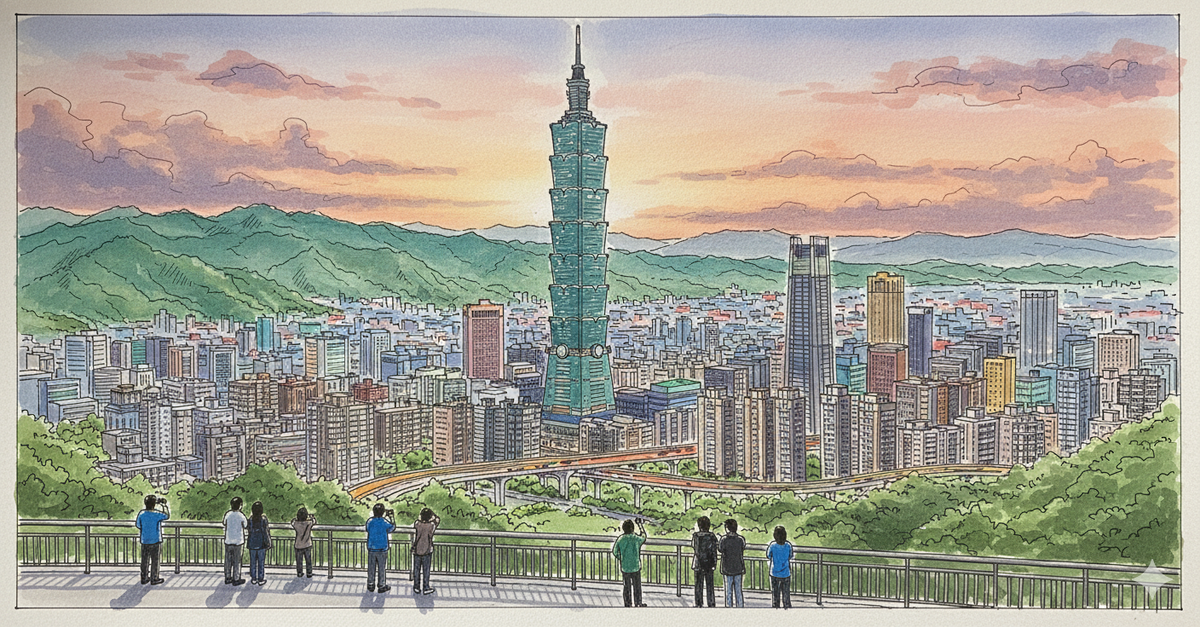
The mountain has had three names, and each time, it was because someone couldn't tolerate what it actually was.
First it was burned down to bare silvergrass, because an empire feared bandits hiding in its forests to steal sulfur. Later, a government that had just lost a civil war found the mountain's old name too embarrassing to keep, and renamed the entire range — smoking vents and all — after a Ming-dynasty philosopher. Visitors today come for cherry blossoms and hot springs. Few stop to notice that this mountain has never actually been tamed by anyone. It has only ever been renamed, and kept breathing.
The Forbidden Mountain
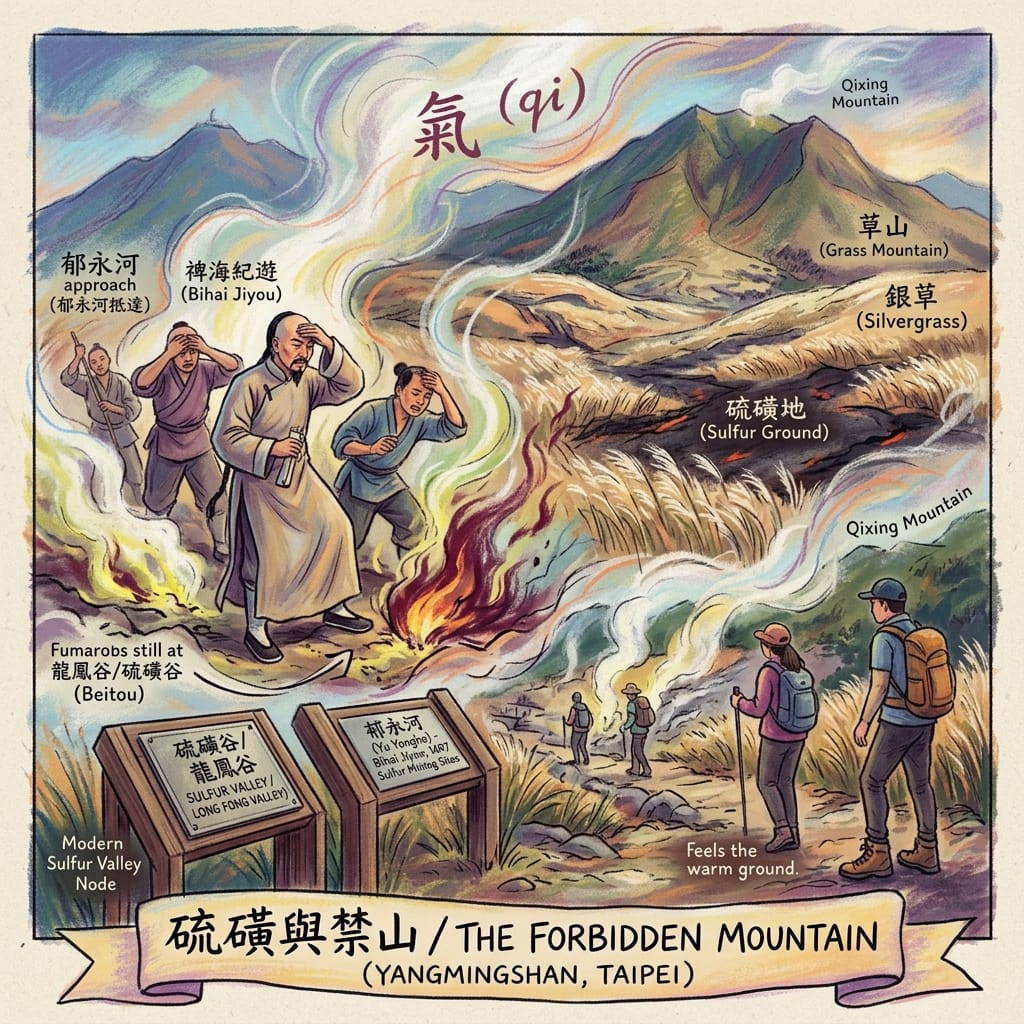
Spanish and Dutch records from the early 1600s already describe the Ketagalan settlement here — the Baotauw people — trading sulfur, and living better than their neighbors for it. In 1697, after Fuzhou's gunpowder magazine exploded, Qing scholar Yu Yonghe volunteered to cross the strait and mine sulfur to replace what was lost. He walked to what is now Sulfur Valley and wrote the first real travel account of the island: fifty-odd columns of white vapor surging from the earth... the poisoned flame struck the face, blinding, splitting the skull. It is the first time anyone wrote down how this mountain breathes.
Burning Down Grass Mountain
The Qing court, worried sulfur would end up in the wrong hands as gunpowder, banned mining outright and periodically set the mountainside on fire — for nearly two centuries. Only tough silvergrass could survive the repeated burning. Grass Mountain was not a poetic name. It was scar tissue left by two hundred years of state arson.
In the geomantic vocabulary later applied to this range, a mountain's qi is meant to be read and honored. Here, the qi was literal sulfur vapor, and the empire's answer wasn't to read it — it was to burn it into silence. A mountain that should have been treated as a dragon vein had its breathing criminalized instead. That inversion is the real anomaly worth studying here.
Renaming the Mountain
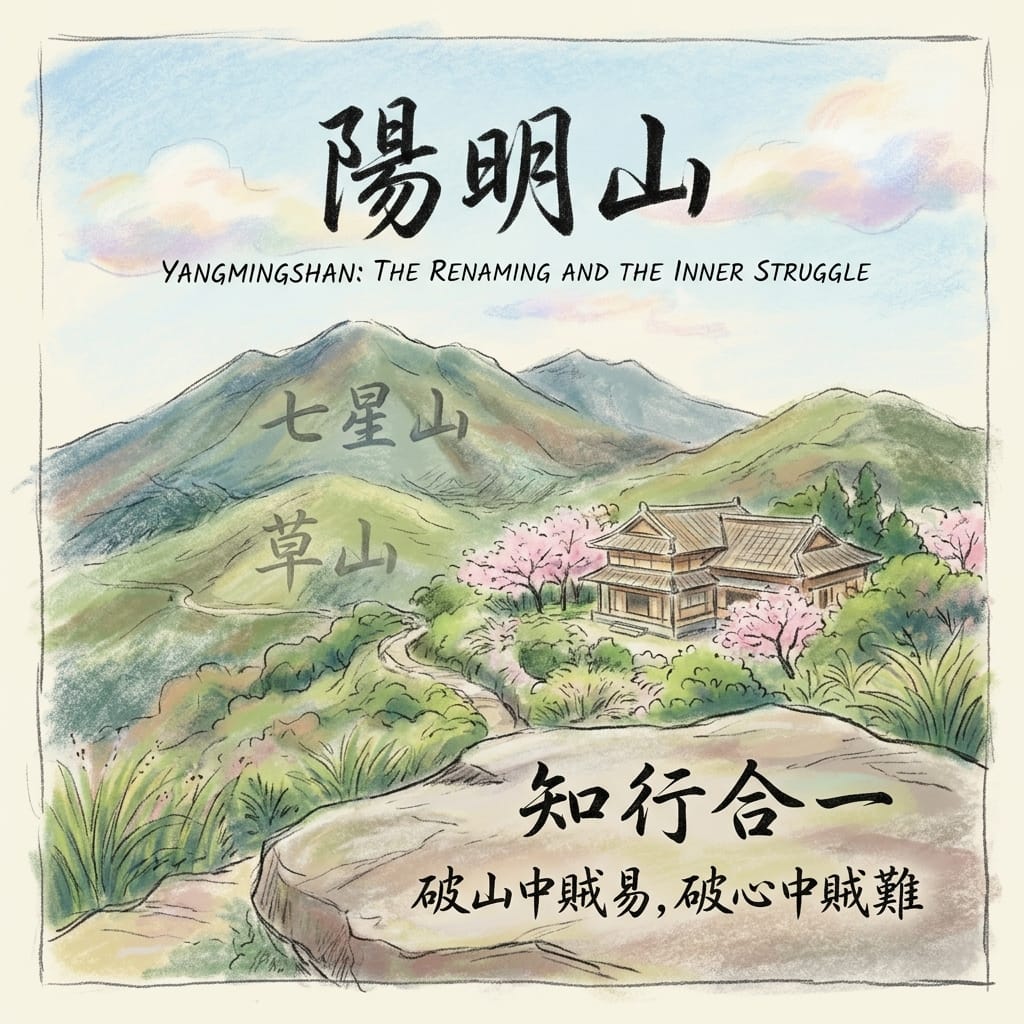
In December 1949, as the Republic of China's government collapsed onto Taiwan, Chiang Kai-shek made Grass Mountain his first seat of power — a requisitioned Japanese-era guesthouse. But the mountain's name carried an old idiom: to take to the grass meant to become an outlaw. For a regime that had just been driven off the mainland, that pun was unbearable. In March 1950, the mountain was renamed Yangmingshan, after Ming philosopher Wang Yangming, whose teaching of the "unity of knowledge and action" Chiang had studied since he was eighteen. Chiang later wrote that he had read and reread Wang's writings for fifty years without tiring, and adopted as his own motto Wang's line: it is easy to defeat the bandits in the mountains; it is hard to defeat the bandit in one's own heart.
The_Ashes_of_Grass_Mountain
The mountain didn't change. Only the interior war it was made to symbolize changed. Older residents of Beitou and Shilin still say "Grass Mountain" without thinking — a fossil sitting just under the official name, never quite erased.
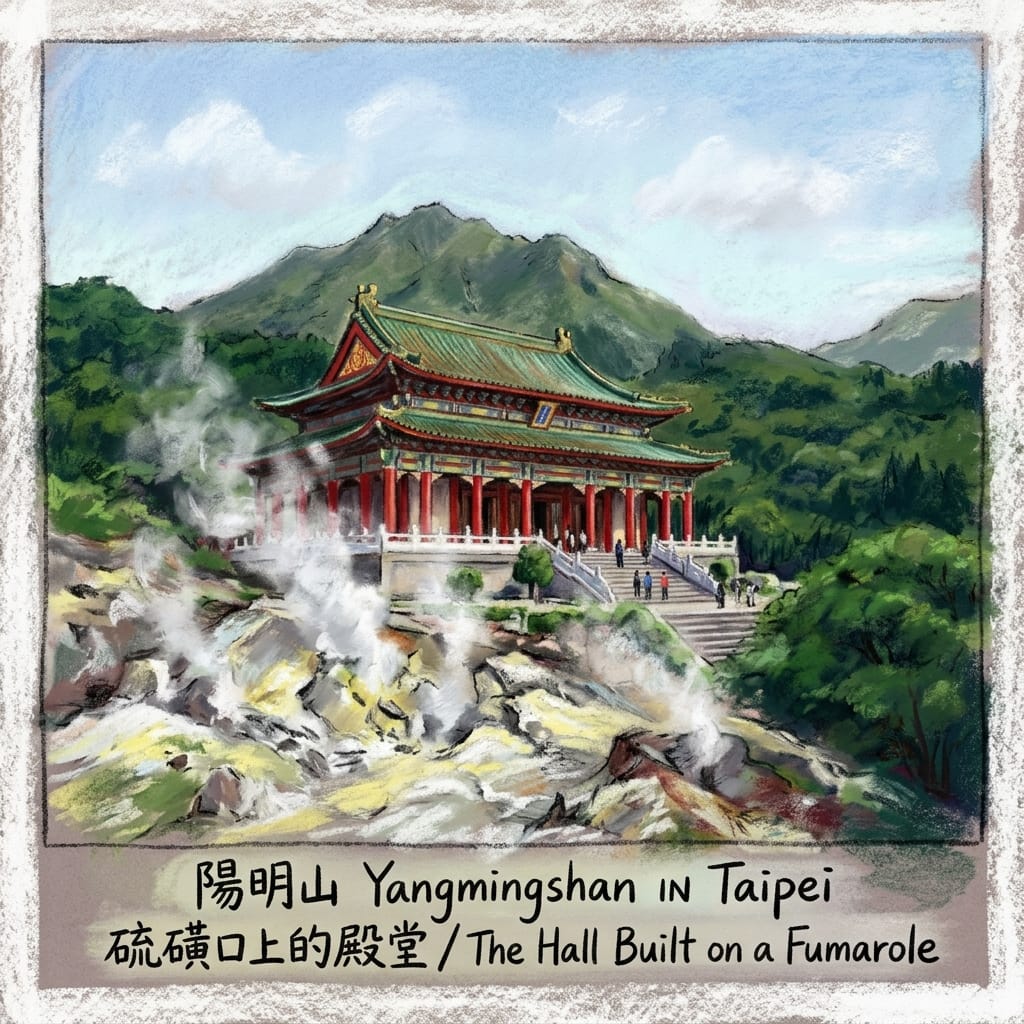
The Hall Built on a Fumarole
In 1965, to mark Sun Yat-sen's centenary, Chiang commissioned Chungshan Hall — a palace-style building that would, for decades, host the National Assembly that selected presidents without a direct popular vote. Architect Hsiu Tse-lan was handed a site laced with sulfur, where rain pooled milky-white and steam vented two to three meters high. Engineers had to drill boreholes to map the heat and vent the gas before laying any foundation; the building was split into two independently engineered halves because its front and back sat on entirely different ground. It was finished in just over thirteen months.
The Palace On The Volcano
The site wasn't arbitrary. Chiang insisted on this exact spot because its axis aligns with the Qing-era geomantic orientation used to found old walled Taipei, its back set against Seven-Star Mountain's peak. Local guides describe it as a dragon's lair — green dragon left, white tiger right, Gauze-Cap Mountain out front shaped like a dragon spitting its pearl. In classical feng shui, it may be the most potent site in Taipei for legitimizing state power. But the dragon's breath here wasn't metaphor. It was scalding gas that had to be mechanically vented before a single beam went up — an engineering triumph, laid over a geomantic ambition, laid over a volcano's indifference.
Holographic Sensory Cue: Chungshan Hall, a few weeks after its November 1966 completion — marble cold underfoot, but a faint warmth rising through dress shoes from below; the smell of new lacquer laced with something sulfurous that won't quite go away; two thousand seats hushed before a state banquet, and beneath that hush, inaudible but constant, gas still finding its way out through some seam in the stone.
The Fire and the Return
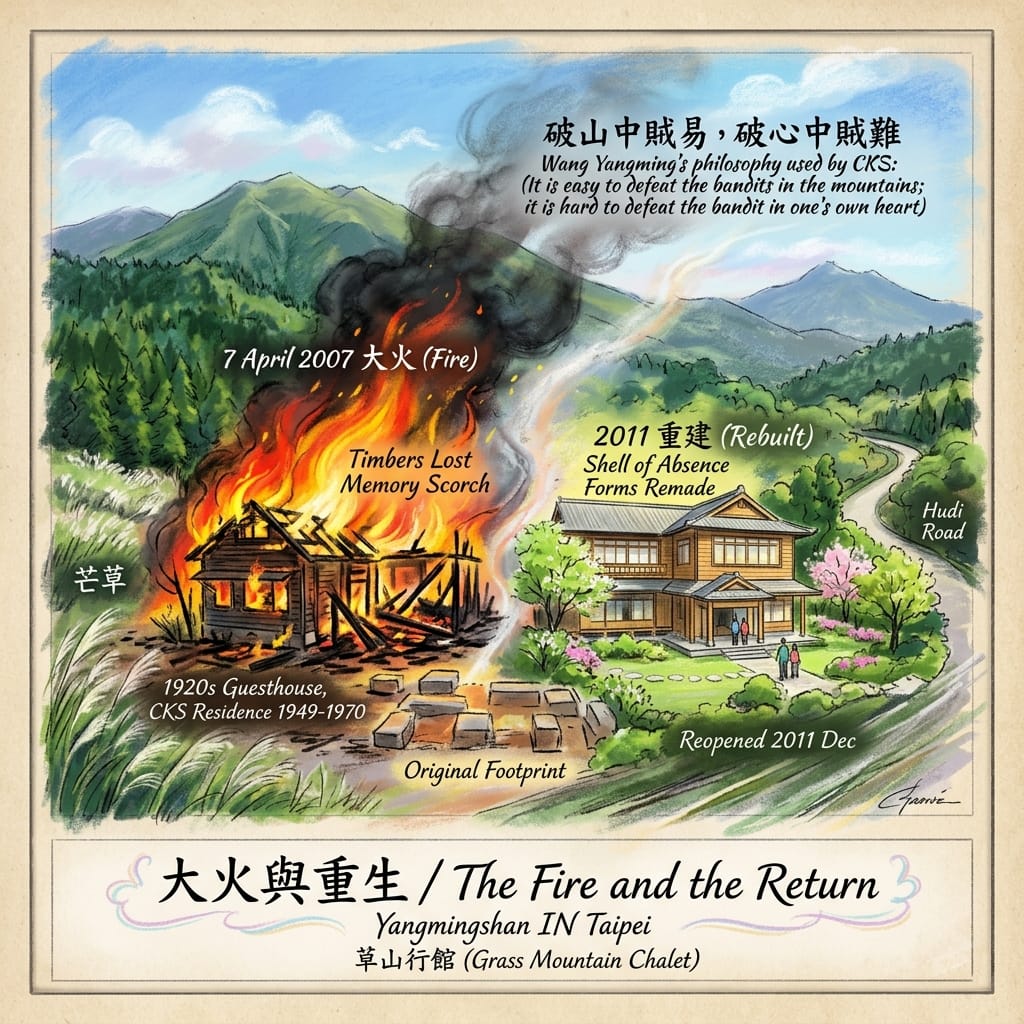
Grass Mountain Chalet began in the 1920s as a Japanese-era sugar-company guesthouse. In December 1949 it became Chiang's first residence on Taiwan — his actual home, before the Shilin Residence was finished in May 1950, after which it became a summer retreat, used until 1970. On the night of April 7, 2007, it burned to the ground. It reopened, rebuilt, in December 2011.
燃燒的權力起點
A wooden house that sheltered a government-in-exile's most fragile early months — before the mountain even had its new name — burned completely fifty-seven years later. What was rebuilt wasn't the original frame. It was a shell built around an absence.
The Lake That Left, and the Lake That Stayed
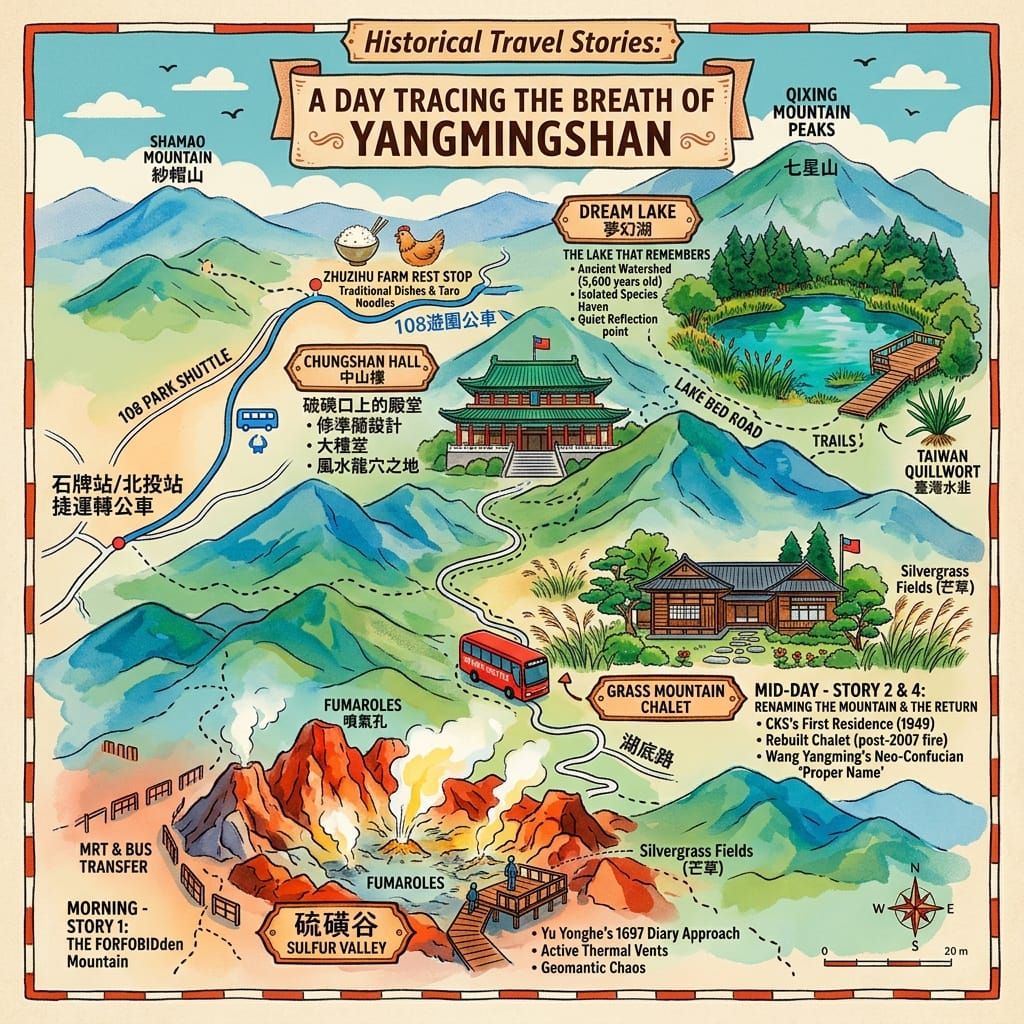
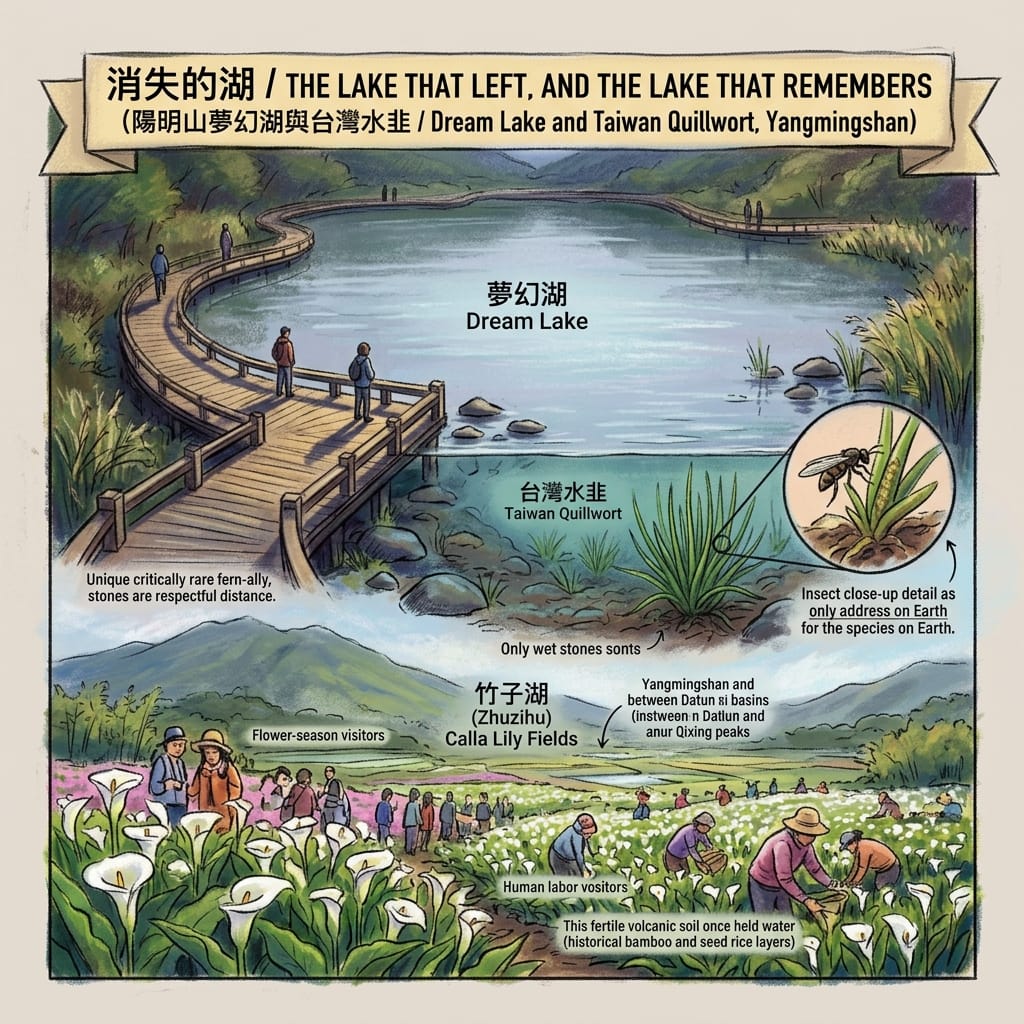
Zhuzihu sits in a saddle between Datun and Qixing peaks — a basin once dammed by lava into a real lake. The water eventually cut through the basin's lower edge and drained away, leaving fertile volcanic soil where bamboo, then Japanese-era seed rice, then today's calla lilies have grown. One ridge over, Dream Lake — formed by a landslide roughly 5,600 years ago — never fully drained. It's now one of the only places on the planet where the critically rare Taiwan quillwort survives. This fern-ally exists nowhere else on Earth.
How One Puddle Saved A Species
Two hollows, two outcomes: one lake left and made room for farming; the other stayed, and became a single species' entire last address.
Resonance Node — the Dream Lake boardwalk, an hour before closing. While the crowds fill Zhuzihu's calla-lily fields below, this small drowned hollow one ridge over is usually nearly empty. The water is flat, still, and older than every name this mountain has worn. Grass Mountain, Yangmingshan — both younger than this water by five thousand years. Somewhere beneath the surface, a plant found nowhere else on Earth is doing nothing more dramatic than surviving.
The Philosophical Anchor
A mountain burned to grass, then renamed for a philosopher. A hall built on breath it couldn't quite silence. A wooden house burned and rebuilt. One lake leaving, another staying to guard the last address of a species. What defines Yangmingshan isn't some abstract energy — it's three centuries of political language trying to out-argue geology, and losing just enough each time to leave a visible scar: a name, a corroded roofline, a rebuilt house, a fern that lives in exactly one pond. The mountain has never really resisted power. It has simply kept breathing underneath it.
Historical memory may be the one asset technology never obsoletes. If you'd like more of these place-remembered stories, our newsletter carries them further.
Accessing the Physical Node
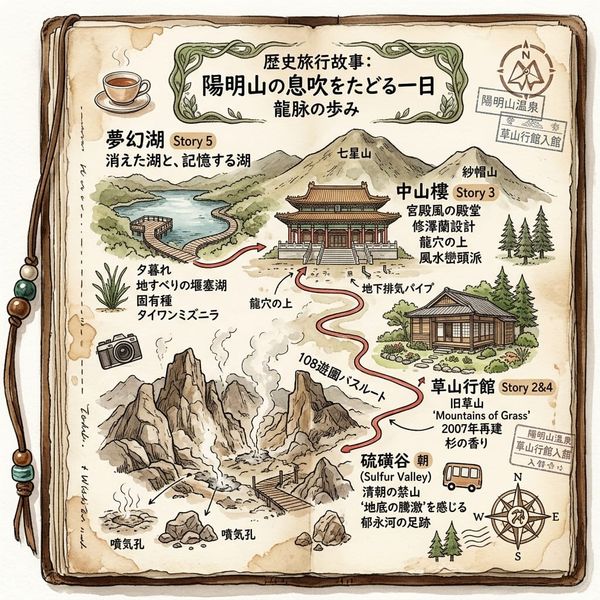
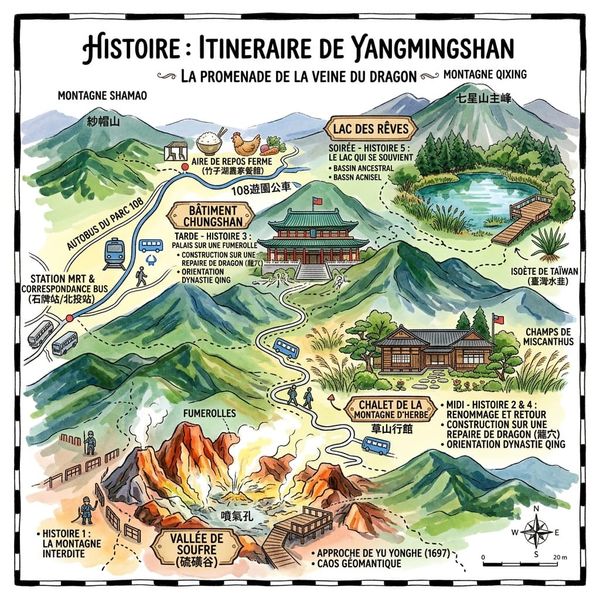
Yangmingshan National Park straddles Taipei's Beitou and Shilin districts. Take the MRT to Jiantan or Beitou Station, then a 260 or Red 5 bus directly into the park. Sulfur Valley is reachable on foot or by local shuttle from Xinbeitou Station; Chungshan Hall, Grass Mountain Chalet, Zhuzihu, and Dream Lake sit along the park's main loop road — a full day by bus or rental car covers them comfortably. Temperatures swing sharply between day and night at elevation, and the sulfur trails carry strong odor and geothermal ground, so sturdy, grip-soled shoes are worth it. Hot-spring inns cluster around Beitou and Shilin for an overnight soak; local guides also run history-focused walking tours for travelers who want the full story behind the mountain's names.
💡Q&A
Q1 | Why was Yangmingshan originally called "Grass Mountain"? Why did the Qing imperial court repeatedly burn it for nearly two centuries? (Grass Mountain Toponymy & Qing Dynasty Sulfur Ban)
答:In the 17th century, the indigenous Ketagalan (Baotauw) people traded sulfur from the area. In 1697, Qing scholar Yu Yonghe documented the roaring fumaroles of Sulfur Valley while acquiring sulfur for gunpowder. Fearing that sulfur would be exploited by anti-Qing rebels to manufacture explosives, the imperial court banned sulfur mining and systematically set fire to the mountainside for nearly 200 years. This continuous state arson destroyed forest cover and left only resilient silvergrass, giving rise to the descriptive name "Grass Mountain."
Q2 | Why was Grass Mountain renamed "Yangmingshan" in 1950? What was the political and psychological motivation behind Chiang Kai-shek's decree? (1950 Rebranding of Yangmingshan & Wang Yangming Philosophy)
答:In March 1950, following the retreat of the Republic of China government to Taiwan, Chiang Kai-shek officially renamed the area "Yangmingshan" in honor of Ming Dynasty philosopher Wang Yangming. The original name, "Grass Mountain," shared a phonetic pun in Chinese with the idiom "to take to the grass," meaning to become an outlaw or bandit—an intolerable connotation for a defeated government seeking political legitimacy. Chiang embraced Wang's philosophy, particularly the principle "it is easy to defeat the bandits in the mountains; it is hard to defeat the bandit in one's own heart," using the renaming as a moral anchor.
Q3 | What geopolitical and architectural challenges surrounded the construction of Chungshan Hall on Yangmingshan? (Geothermal Steam Fumaroles, Hsiu Tse-lan Architecture & Political Power)
答:Commissioned in 1965 to mark Sun Yat-sen's centenary, Chungshan Hall was designed by architect Hsiu Tse-lan to serve as the grand ceremonial palace for the National Assembly. Built directly atop an active geothermal vent in Yangmingshan where corrosive sulfur gas and steam rose 2 to 3 meters high, engineers were forced to drill specialized boreholes and adapt structural materials to handle the extreme heat and acidic conditions. Placing the highest organ of state power over an unstable sulfur fumarole stood as a striking historical attempt to exert political authority over an untamed natural landscape.
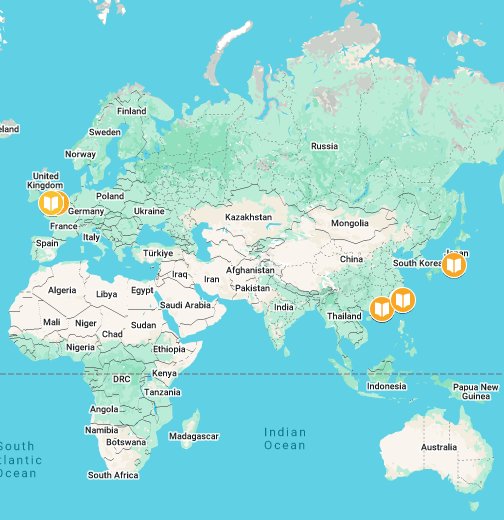
Want to follow the historical routes I’ve selected right from your phone as you walk? Click to join the exclusive Google map of historical tours titled "Historical Travel Stories"—import it to Google Maps on your phone with a single tap and let it guide you as you visit each historical site in person.

📖Reference and Further reading📖
First layer – Main sources of literature and institutions:
- 臺北市北投區公所 official heritage documentation on 硫磺谷/大磺嘴; 陽明山國家公園 official history archive.
- 臺灣省政府 1950 administrative renaming record (國史館/National Archives Administration references).
- 國父紀念館/Chungshan Hall official institutional history (chungshanhall.ntl.edu.tw);
- National Cultural Memory Bank (國家文化記憶庫) entry.
- Taipei City cultural heritage listing for 草山行館.
- 農業部 (Ministry of Agriculture) technical documentation on Taiwan's landslide/lava-dammed lakes, explicitly naming Dream Lake's ~5,600-year formation.
The second layer – secondary academic materials:
- 中央研究院 THCTS digital map essay on Bihai Jiyou's route; StoryStudio historical essay on Yu Yonghe.
- 如是我聞 (udn blog, well-sourced historical essay quoting Chiang's own writings on Wang Yangming);
- Japanese-language historical essay (交流協會/Koryu Kyokai publication) on the renaming's political context.
- StoryStudio long-form history of the building's engineering and feng shui siting.
- Local heritage tourism documentation (funliday.com; municipal park records) corroborating the 1949 occupancy, 1950 transition, and 2007 fire/2011 reopening dates.
- 陽明山國家公園/Wikipedia geological entries on Zhuzihu's east/west lava-damming sequence.
Third layer – Supplementary information:
- Yu Yonghe's own diary text, treated as primary literary-historical testimony, not verified scientific record.
- Oral guide/volunteer commentary on the "dragon lair" reading — presented as living local interpretive tradition, not verified geological fact.
 Lawrence
 Lawrence
 Lawrence

© Historical Travel Stories — Unraveling Strange Tales Across Dimensions and Time