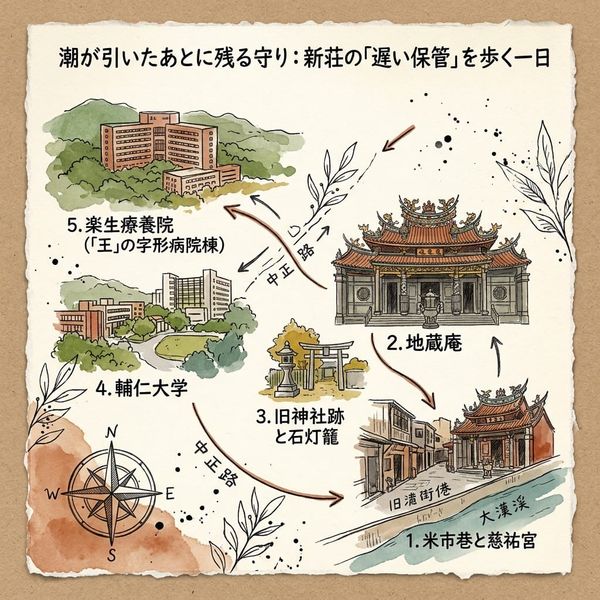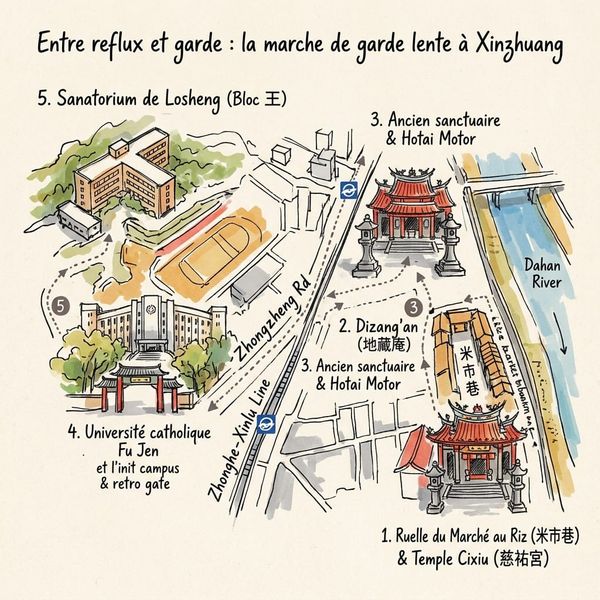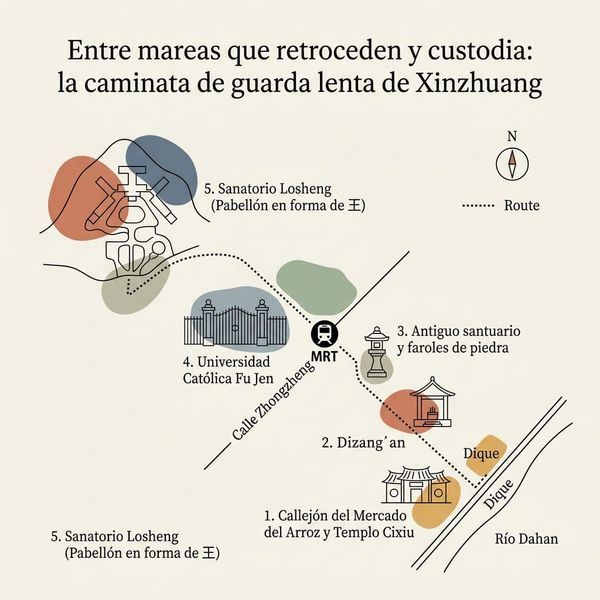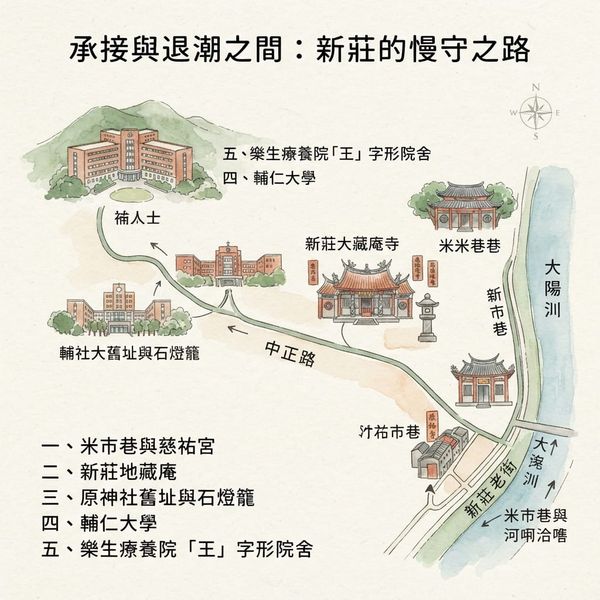
Xinzhuang History: Five Stories of a Town That Kept What Others Left
Xinzhuang was once a river port and an administrative seat. After the river silted and the officials left, the town went on sheltering things that had nowhere else to go: the unclaimed dead, the furnishings of a demolished shrine, a university exiled from Beijing, patients sent away to a hill.
 Lawrence
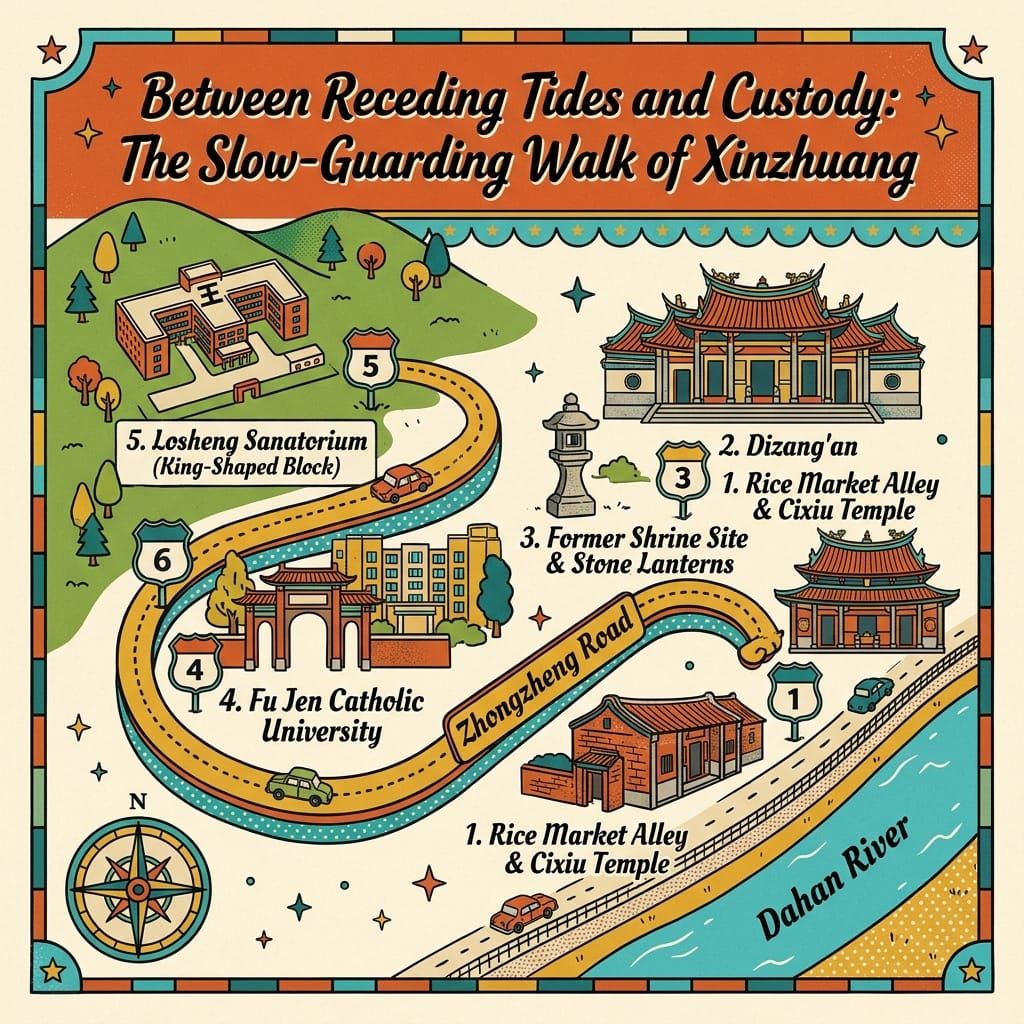
Xinzhuang (新莊) lies on the western side of New Taipei City. In the eighteenth century it was a busy river port with its own patrol officer and magistrate’s assistant; by 1809 the administrative centre had moved downriver to Mengjia (艋舺). This article follows five documented stories in order: the departure of the office and the port; Dizang’an and the cult of the Wen-Wu Dazhong Ye; a Japanese-era Shinto shrine built in a temple’s forecourt; Fu Jen Catholic University, re-founded here after Beijing; and the Losheng Sanatorium on the hill at Huilong. Read together, they suggest an interpretation, not a settled conclusion: that Xinzhuang kept losing its centrality while repeatedly becoming a place of deposit. Legends, disputes and unverified points are marked as such.
💡 Únete a una comunidad de viajeros exigentes. Solo tienes que introducir tu correo electrónico para acceder al instante a audioguías e itinerarios de un día, y llevar contigo nuestros exclusivos mapas históricos para recorridos a pie durante tu viaje.
The lane beside Cixiu Temple (慈祐宮) is still called Rice Market Alley. It is named for grain, and grain once arrived by water. Today the river lies behind an embankment and a road.
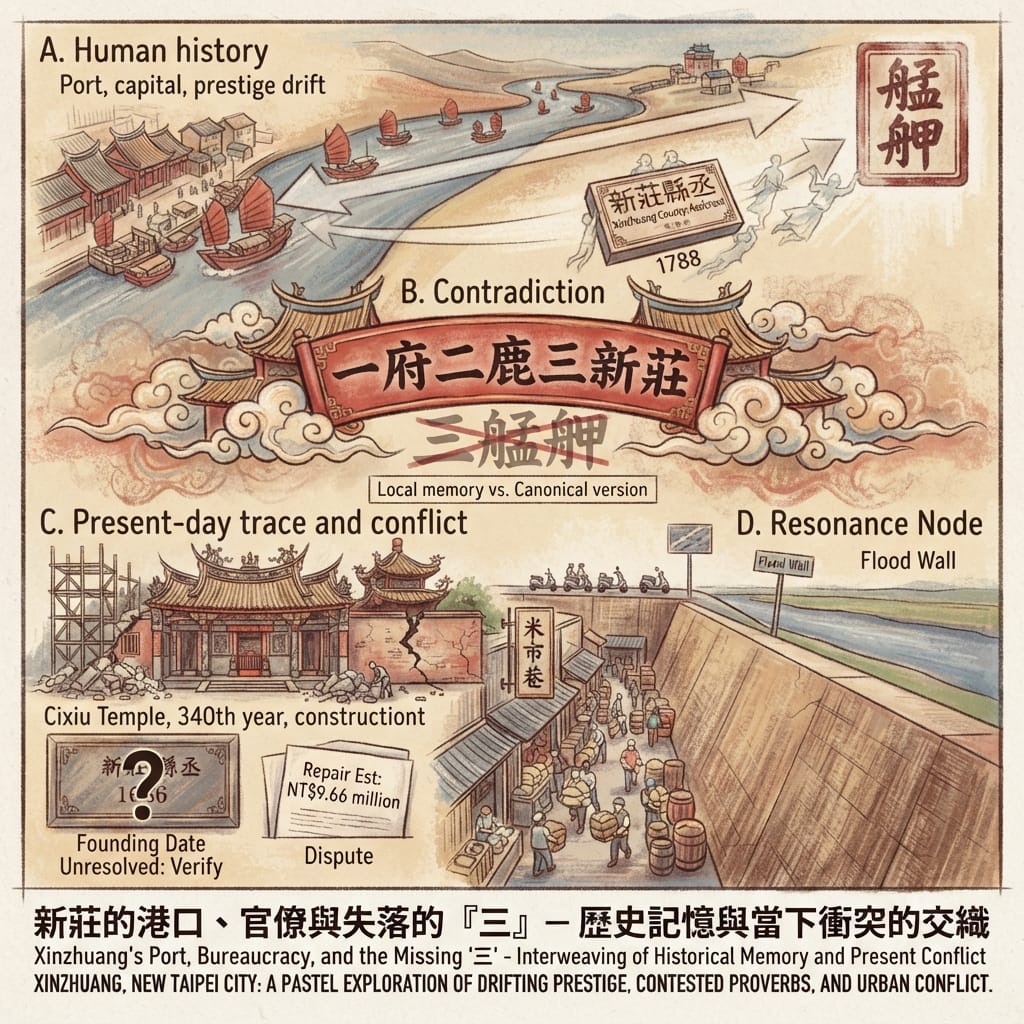
In May 2026 a scaffold collapsed at a redevelopment site beside the temple, and a Vietnamese migrant worker died. A dispute followed over the cost of repairing the damaged monument, put at about NT$9.66 million, and reports said it might end in court. In September the temple marked its 340th anniversary, and twenty-eight deities were brought from other shrines to Xinzhuang for the North Taiwan Mazu Festival.
A temple three centuries old, with a building site at its shoulder, and a river it can no longer see.
I. The Office That Moved Downriver
The record. According to a chronology kept by the Luzhou District Office, a licentiate named Yang Daohong (楊道弘) petitioned in 1727 to reclaim the Xingzhi Plain (興直埔), a tract covering what are now Luzhou, Sanchong, Xinzhuang and Wugu. People of the Pusingwan (武勝灣) community were already living on that land. The surviving texts do not say how they met the petition, and that silence should not be filled by invention.
The Tamsui Gazetteer (《淡水廳志》) records that in 1767 the Bali-fen patrol officer (八里坌巡檢) was moved to Xinzhuang. In 1788 the post became a county magistrate’s assistant (縣丞). A study published by the Taipei City government places the transfer of this office to Mengjia in 1809, which made Mengjia the political centre of the north. Other sources give 1790 and 1808 for the same events, so the original documents need checking.
Local accounts usually blame the river: ships could no longer reach Xinzhuang, and merchants went elsewhere. That is the common explanation, and the details remain thin.
The City Stolen By Mud
The contradiction. Taiwan’s old proverb ranks the island’s great trading towns as “first the prefecture, second Lukang, third Mengjia.” Xinzhuang’s own writers often put their town in the third place. Whether that is stubborn memory or a different way of counting, the evidence cannot yet say.
The framework. The dominant tradition here is the Hokkien-rooted folk religion of Han settlers. Mazu was a protector of travellers on water, so a temple to her at a river port is unsurprising; that is interpretation, not record. I found no documented Pusingwan cosmology attached to specific Xinzhuang sites, and none is supplied here. One further unresolved point: a 340th anniversary implies a founding around 1686, earlier than the documented reclamation, and the gap between temple tradition and official record is untested.
Holographic Sensory Cue (observable today). To reach the river from the old street, one now has to cross an embankment and a road.
Resonance Node. Rice Market Alley beside Cixiu Temple, which was designated a municipal monument in 1985.
II. A Court for the Unclaimed Dead
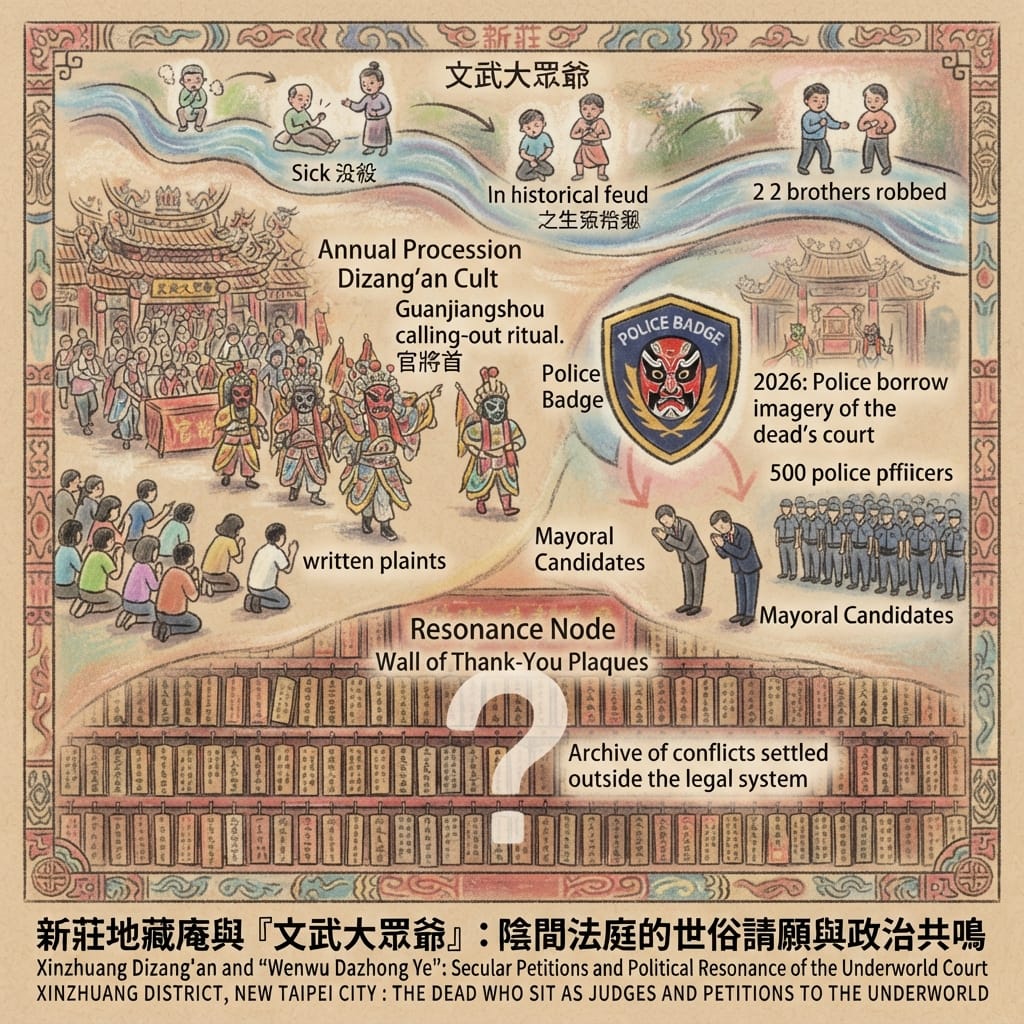
The place. A short walk away is Dizang’an (地藏庵), the temple of Ksitigarbha (Dizang) and of the Wen-Wu Dazhong Ye (文武大眾爺). The troupes known as guanjiangshou (官將首), among the best known processional groups in Taiwan, are generally traced to this temple.
The legends. The origin of the Dazhong Ye is told in several ways, all cultural tradition rather than record. One says the “civil” figure died of illness and the “martial” one in a clan feud. Another speaks of two brothers killed by robbers on their way to the examinations. A third says early settlers fell ill on marshy ground and local donors built the temple. In every version, people with no descendants to honour them need a place to rest, and someone to speak for them.
The Underworld Court That Judges The Living
The practice. Believers bring disputes to the deity for judgment and leave thank-you notices when matters are settled. A former troupe member recalled people kneeling by the roadside during a procession to hand over a written complaint.
The present. The Xinzhuang Great Worship is registered as New Taipei City intangible cultural heritage. In 2026 police deployed around 500 officers and drilled for palanquin-snatching and troupe clashes, and a local station adopted an armband bearing the guanjiangshou image. Candidates from both main camps in the New Taipei mayoral race appeared near the procession. One commentary worried about gang ties among troupes; it is one writer’s view.
The contradiction. The dead of the feuds, or the nameless dead, became a court that ordinary people petition. Two centuries on, the police borrow that court’s imagery to keep order.
Resonance Node. The thank-you notices inside Dizang’an: an archive of conflicts settled outside the law.
III. A Shrine in the Temple’s Forecourt
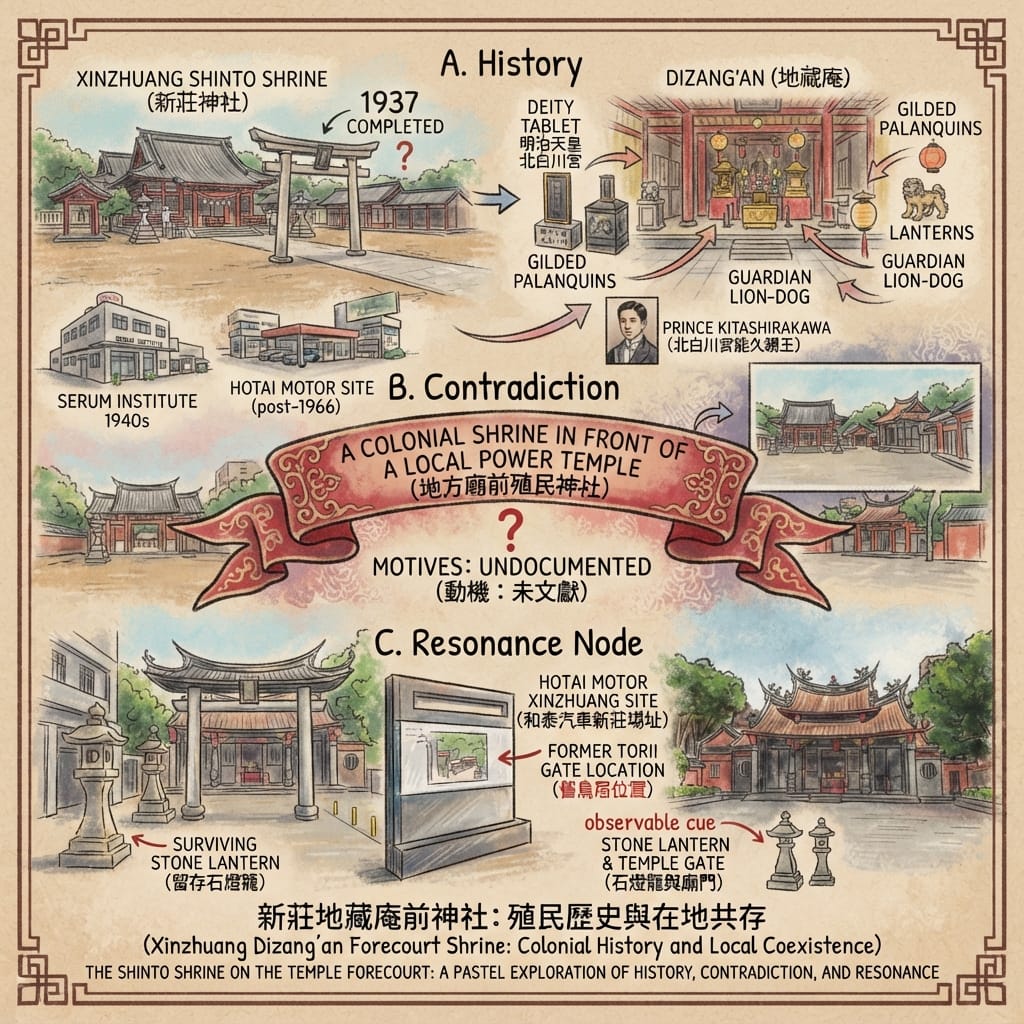
The place. Under Japanese rule, a Shinto shrine was built on the open ground in front of Dizang’an. It was one project of the imperialisation campaign that spread shrines across Taiwan. Its completion is dated to 1937 in one source and 1939 in another. It was raised to village-shrine rank in 1944.
Among those it honoured were Emperor Meiji and Prince Kitashirakawa Yoshihisa (北白川宮能久親王), who died of illness in 1895 during the Japanese takeover of Taiwan.
What happened next. After the war the site was used by a serum institute. The shrine was demolished in 1950. Local people carried stone lanterns, stone guardian lion-dogs, two gilded palanquins and a spirit tablet into Dizang’an, where the tablet and a palanquin are kept. In 1966 the land was sold to Hotai Motor (和泰汽車) and became part of a factory.
The Temple That Swallowed Its Conqueror
The contradiction. A colonial government built its shrine in front of the most powerful local temple. After 1945 the neighbours took its furnishings inside that temple. My sources do not explain why, and I will not guess.
Holographic Sensory Cue (observable today). Stone lanterns stand at Dizang’an’s gate. A sign at the factory entrance marks where the torii once stood.
Resonance Node. Dizang’an and the ground before it, where a colonial rite and a local one share the same plot.
IV. A Beijing University, Refounded
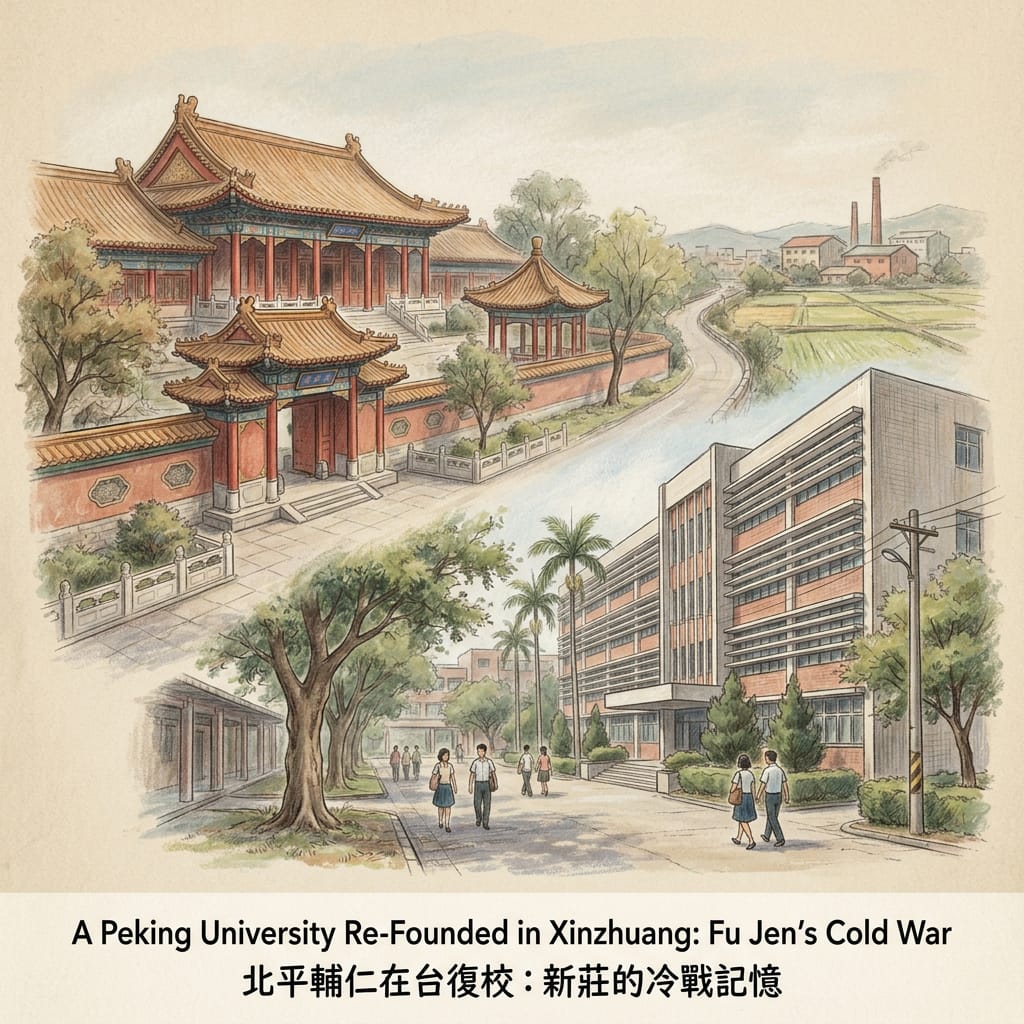
The record. Fu Jen Catholic University (輔仁大學) was founded in Beijing in 1925 by Benedictines. In 1933 the Society of the Divine Word took it over, and in 1952 it was absorbed into Beijing Normal University on the mainland.
In 1959, Chinese bishops, the Divine Word Missionaries and the Jesuits planned a re-founding in Taiwan. The Ministry of Education approved it in 1960; a graduate institute of philosophy opened in 1961; undergraduates began classes in Xinzhuang in 1963. Cardinal Yu Pin (于斌) raised funds, assembled a board and looked for land.
The University That Refused To Die
He served as president until his death in 1978. One commentary sees the project as a fruit of cooperation between the Republic of China and the Holy See, which is an interpretation.
The contradiction. The same name led two lives on either side of the strait. In Beijing the institution was merged out of existence; in Xinzhuang it was rebuilt as itself.
Resonance Node. The earliest buildings of the Taiwan campus. Which ones remain needs checking against the building appendix in the university’s ninety-year history.
V. The Hill at Huilong
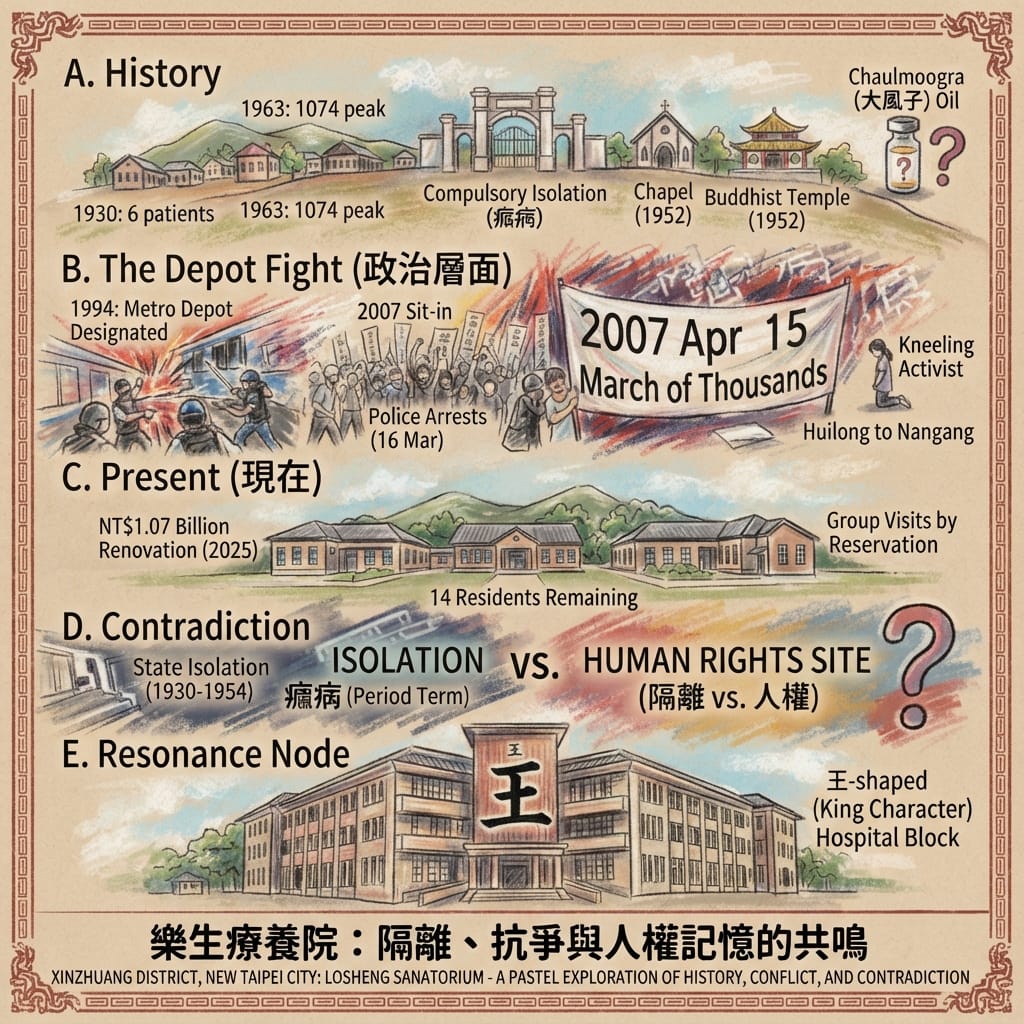
The record. On Xinzhuang’s western edge, at Huilong (迴龍), sits the Losheng Sanatorium (樂生療養院). It opened in 1930 with six patients. In 1945 it held 442; in 1963, at its peak, 1,074; by 1969 it had 61 buildings. Patients were isolated long-term, and the practice continued after the war. Reports say they were allowed to leave from 1954, though many stayed. In 1952 the residents themselves funded a Catholic chapel and a Buddhist temple, and Protestant buildings stand there as well. One resident recalled injections of chaulmoogra oil, believed to be a treatment and later found ineffective.
The conflict. In 1994 the site was chosen for a metro depot, and in 2003 construction forced the demolition of part of the compound. In spring 2007, according to press reports, young activists and residents took to the streets: arrests in March, a march of thousands in April, and in May a decision by the Public Construction Commission to preserve 39 buildings. These details rest on secondary reporting and need verification. Advocates also say the depot was first meant for a site near Fu Jen; I found no reliable source, so that claim stays unproven.
Evicted From Their Own Quarantine
The contradiction. The state ordered these people to live out their lives on a hill, and later restored their houses as heritage. The renovation cost about NT$1.07 billion and was completed at the end of 2025; fourteen residents remain, and group visits require advance booking. “Hansen’s disease” is the modern term; the older word appears only in quotation of the period.
Resonance Node. The surviving cluster of old buildings, including those of three faiths, where the isolated made a life for themselves.
What Xinzhuang Keeps
Put the five stories side by side and a pattern appears. Xinzhuang lost its port, its magistrate’s assistant and its place in the proverb. It also took in what others set down: the dead without heirs, a shrine’s furnishings, a university across the strait, people confined to a hill. Each time the keepers were small: a temple committee, residents, a school.
This is an interpretation. The town also gave things away, the guanjiangshou among them. It is a pattern, not a law.
Today the layers are not easy to see. The river has been pushed back, the shrine is a sign at a factory gate, the university is simply a university, and the hill is open by appointment. The alley’s name, the notices inside the temple and the lanterns at its gate still say it.
At Dizang’an’s gate stand lanterns that belonged to a demolished shrine, now in front of another temple.
Accessing the Physical Node
- Transport. On the Taipei Metro Orange Line, Xinzhuang Station serves the old street (Cixiu Temple, Dizang’an, Wusheng Temple); Fu Jen University Station serves the campus; Huilong Station is near Losheng. Check routes on a map before setting out.
- Temples. Cixiu Temple and Dizang’an are public places of worship. Dates for the Great Worship are announced by the temple each year.
- Hotai Motor entrance. The exact location of the sign, and whether one can approach it, should be confirmed with the company or a local historian.
- Losheng. Group visits only, by reservation; individuals should check New Taipei City notices.
- Fu Jen. Access and opening hours are set by the university.
- Opening information has not been verified with each site.
💡 Q&A (Frequently Asked Questions)
Q1 | Was Xinzhuang really Taiwan’s "third great trading town" before Mengjia, and why did its Qing-era river port and magistrate’s assistant office move downriver? (Xingzhi Plain Reclamation & Tamsui Gazetteer Records)
A: Whether Xinzhuang genuinely held third place in Taiwan’s classic trading proverb—"first the prefecture, second Lukang, third Mengjia"—cannot be settled from surviving evidence, as local writers’ claims reflect either regional memory or a different way of counting. Documented records in the Tamsui Gazetteer show that after Yang Daohong petitioned in 1727 to reclaim the Xingzhi Plain—already home to the Indigenous Pusingwan community—the Bali-fen patrol officer relocated to Xinzhuang in 1767 and became a county magistrate’s assistant in 1788. By 1809 (though some sources cite 1790 and 1808), the office transferred to Mengjia, shifting northern Taiwan’s political center. Local accounts commonly attribute this decline to river siltation blocking ships, though detailed evidence remains thin; today, an embankment and road separate Rice Market Alley beside Cixiu Temple from the river.
Q2 | What is the history and folklore behind Dizang’an and the Wen-Wu Dazhong Ye cult in Xinzhuang? (Ksitigarbha Temple & Guanjiangshou Processional Troupes)
A: Dizang’an in Xinzhuang is a folk temple dedicated to Ksitigarbha (Dizang) and the Wen-Wu Dazhong Ye, and is widely recognized as the origin of Taiwan’s renowned guanjiangshou processional troupes. Rather than stemming from a single verified historical biography, the identities of the Wen-Wu Dazhong Ye are preserved through multiple competing cultural traditions—such as a civilian official who died of illness alongside a military figure killed in armed feuds, two brothers robbed and murdered while traveling for imperial exams, or early settlers who perished from disease in local marshlands before residents funded a shrine. Across all versions, the cult functions as a spiritual court and sanctuary for the unclaimed dead, reflecting how Xinzhuang repeatedly sheltered marginalized souls after losing its administrative centrality.
Q3 | Why is Xinzhuang’s Cixiu Temple (Mazu Temple) 340th anniversary timeline debated against official Qing reclamation records? (Rice Market Alley & 1686 Founding Tradition)
A: Cixiu Temple’s 340th anniversary celebration in September 2026 implies a traditional founding around 1686, which predates the earliest official Qing reclamation records for the Xinzhuang area by over four decades. According to a chronology kept by the Luzhou District Office, licentiate Yang Daohong formally petitioned to reclaim the Xingzhi Plain—encompassing modern Luzhou, Sanchong, Xinzhuang, and Wugu—in 1727, on land already inhabited by the Pusingwan people. While Hokkien maritime culture makes a Mazu temple beside Rice Market Alley historically plausible for a river port, the forty-year discrepancy between local temple tradition and surviving administrative documents remains untested. Designated a municipal monument in 1985, Cixiu Temple continues to anchor Xinzhuang’s layered urban memory alongside modern redevelopment.
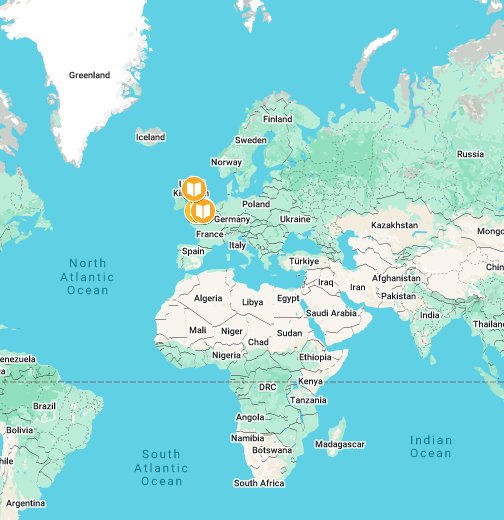
¿Quieres seguir las rutas históricas que he seleccionado directamente desde tu teléfono mientras caminas? Haz clic para unirte al mapa exclusivo de recorridos históricos en Google titulado "Historical Travel Stories": impórtalo a Google Maps en tu teléfono con un solo toque y deja que te guíe mientras visitas cada lugar histórico en persona.

📖Referencias y lecturas adicionales📖
Fuentes primarias (archivos y materiales históricos oficiales)
- 《淡水廳志》卷八 職官表 (Wikisource transcription)
- 蘆洲區大事記 (Luzhou District Office)
- 新北市市定古蹟一覽
- 新北市文化局 新莊微型藝術街區地圖
- 新北市文化局 2025新莊廟會文藝成果報告書
- 淡水區政事志 (Tamsui District Office)
- 輔仁大學 校史簡介 (Fu Jen official)
- 天主教輔仁大學90年史稿 (Fu Jen e-library)
- Ministry of Culture: Losheng Sanatorium
Materiales de nivel 2 (trabajos académicos)
- 城市學: 新莊神社與海山神社
- 天下雜誌: 新莊走讀
- 中國時報: 輔仁大學與于斌樞機
- Wikipedia: Losheng Sanatorium (use cautiously; some claims lack citations)
- 風生活: 樂生院人數與歷史
- 關鍵評論網: 樂生文化園區
- 自由時報: 樂生歷史建築整修 (2026)
- 陽明交大: 樂生在陽明
- 台北市政府文件: 艋舺的興起
- 天下微笑台灣: 走讀南新莊
- nippon.com: 新莊老街
- 聯合報: 慈祐宮都更鄰損 (2026/6/12)
- 聯合報: 慈祐宮修復爭議
- 聯合報: 慈祐宮建廟340周年
- 聯合報: 新莊大拜拜暗訪
- 自由時報: 官將首警察臂章
- 自由時報: 新莊大拜拜與無形文資
- 三立新聞: 新莊大拜拜維安
- 聯合報: 平埔族群認定進度
- 彰化縣教材: 勸和論與咸豐年械鬥
Información de nivel 3 (Información complementaria)
 Lawrence
 Lawrence
 Lawrence
 Lawrence