The Suburb That Kept Building Cages for the Mind: Four Centuries in Nakano, Tokyo
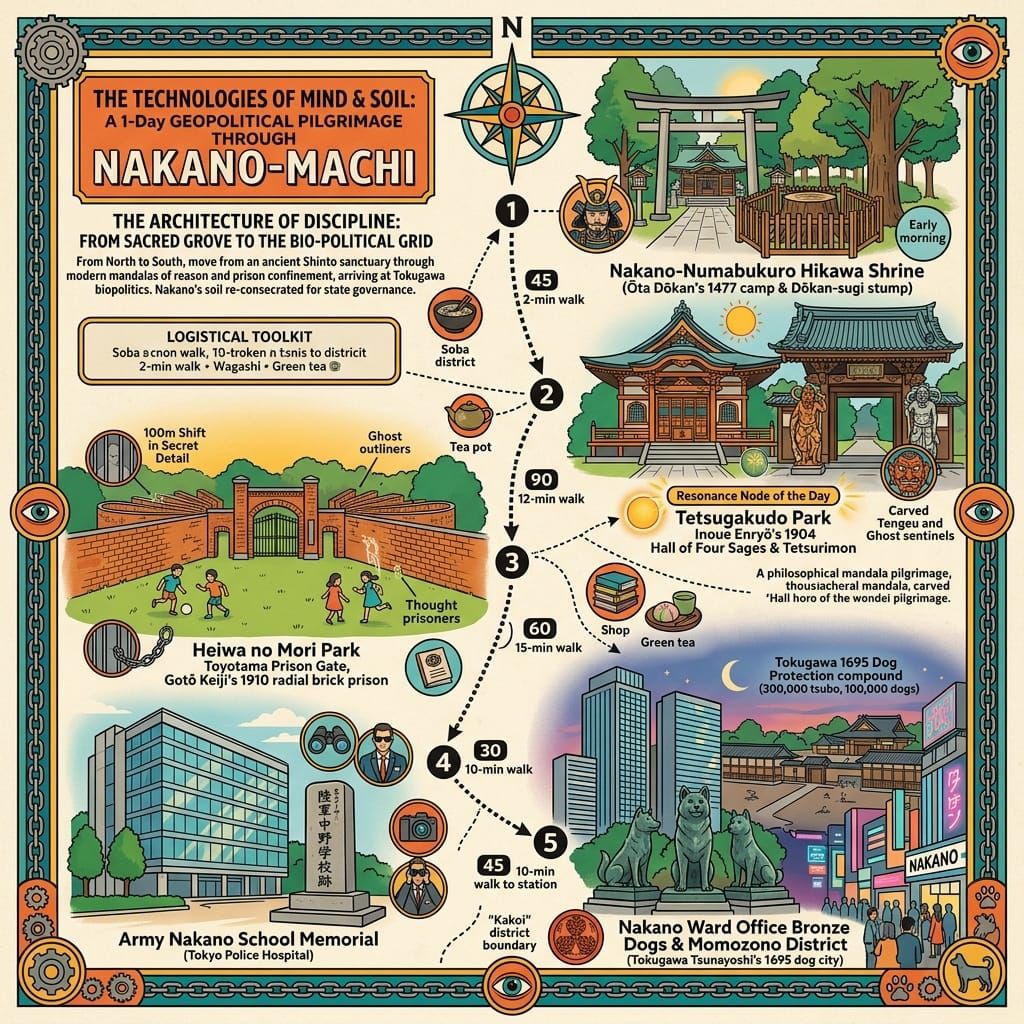
Nakano isn't a shrine to any god. It's a plot of land the state keeps coming back to, century after century, to build its instruments for governing life.

 Lawrence
Most people who pass through Nakano are changing trains, or hunting for a particular back issue of a manga in the fluorescent warren of Nakano Broadway. Almost none of them know they are walking across the buried floor plan of a shogun's dog kennels, past a philosophy park built like a miniature mandala, over the unmarked footprint of a wartime spy academy, and within a few hundred metres of a radial brick prison that once held the country's political dissidents. This is a walking history of five real, documented, and largely forgotten sites — not a checklist, but an argument: that this particular patch of the Musashino plain has spent four hundred years being handed, again and again, to whatever institution needed somewhere to put the bodies and minds a state didn't quite know what to do with. What you'll come away with isn't a photo op. It's a different way of reading an ordinary Tokyo street.
The Ground Remembers, Even When Nothing Is Left Standing
There is a particular kind of silence that settles over a place where something enormous used to be. Nakano has several of them. Under the tarmac outside the ward office, the bones of a hundred thousand dogs are still, presumably, exactly where they were left. A short walk north, a university campus and a police hospital occupy the unmarked ground where an army trained the men who would infiltrate Afghanistan under diplomatic cover. This isn't a place that announces itself. It's a place that has been quietly, repeatedly requisitioned — and the pattern, once you see it, is very hard to unsee.
Listen to the historical stories told in detail (For subscribers only)
What This Land Actually Believes
Before going any further, it's worth being honest about what kind of place this is, cosmologically speaking — because the lazy version of this article would simply reach for a single mystical vocabulary and stretch it over everything, and that's exactly the failure mode worth avoiding. Nakano has no separately documented indigenous tradition of its own beyond the general animist-agrarian substrate common to the whole Kantō region. What it does have, in clearly layered order, is this: a base layer of village Shinto — the ujigami and chinju system of tutelary shrines that organised the rice-farming hamlets of the Musashino uplands; a Buddhist overlay, arriving with the founding of the Arai Yakushi healing temple in the late sixteenth century; a shogunal layer, in which the Edo government converted this land into the stage for a piece of state religious theatre involving several hundred thousand dogs; a single, deliberate, signed act of modern syncretism, in the form of a philosopher's private temple to reason itself; and finally a twentieth-century layer with no gods in it at all — a secular, bureaucratic geography of surveillance and confinement.
So this piece uses three different registers, matched to what each site can actually support: the Shinto language of tutelary shrines and sacred groves, for the one site where that framework genuinely applies; the language of Buddhist-Confucian state ritual, for a shogun's very strange act of policy; and, for the two twentieth-century military and penal sites, no religious framework at all — because none is documented, and inventing one would be exactly the kind of shallow mysticism this project exists to avoid. The philosophy park gets a category of its own, because it doesn't inherit a tradition — it built one, on purpose, in public, with a signature attached.
I. The Shogun Who Built a City for His Dogs
1695, around what is now Nakano Station and the ward office
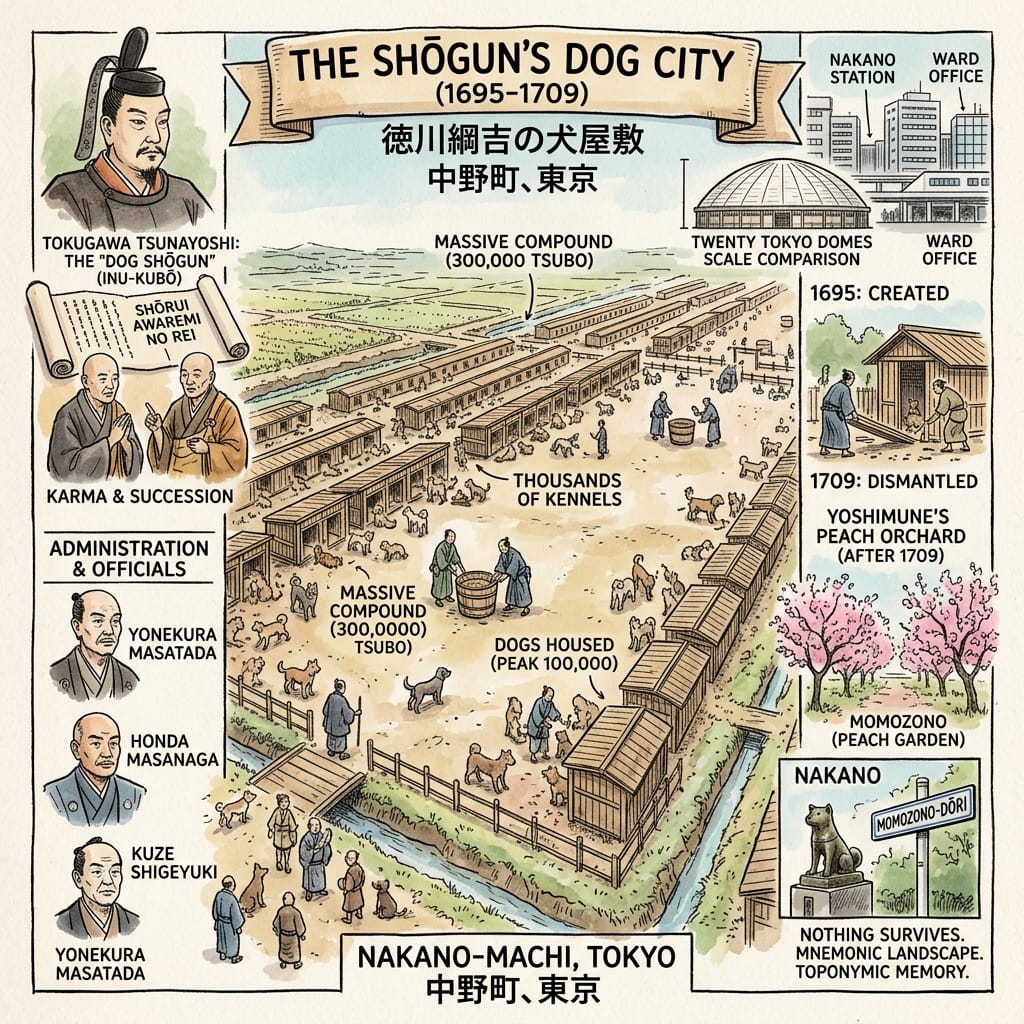
Picture something like ninety-nine hectares of land — roughly twenty baseball stadiums — filled with rows of kennels, sunshades, and puppy-rearing sheds, staffed around the clock by wardens and veterinarians, holding at its peak somewhere between eighty and a hundred thousand dogs. This was not allegory. It was official government infrastructure, ordered into existence in 1695 by the fifth Tokugawa shogun, Tsunayoshi — a man history remembers, not affectionately, as the "Dog Shogun."
Tsunayoshi had no male heir. His advisors, the monks Ryōken and Ryūkō, told him this was the karmic consequence of killing in a former life, compounded by the fact that he himself had been born in the year of the dog and had therefore neglected his own totem animal. The result was the Shōrui Awaremi no Rei — the Laws of Compassion for Living Things — and, in Nakano specifically, an entire administrative city built to house the strays of Edo. When Tsunayoshi died in 1709, the compound was dismantled almost overnight and the land handed back to local farmers. The eighth shogun, Yoshimune, later planted a peach orchard on part of the site — which is why the neighbourhood is still called Momozono, "Peach Garden," three centuries later. A handful of small bronze dog statues outside the ward office are the only physical trace that remains.
Tokyo's Forgotten City Of 100,000 Dogs
It's worth noting, in fairness to Tsunayoshi's much-maligned reputation, that recent scholarship has surfaced petitions from townspeople near Denzū-in temple apparently requesting that local strays be relocated to the compound — evidence that the policy wasn't universally resented in its own time, whatever its later reputation as an act of tyrannical eccentricity.
Reading it through Buddhist-Confucian state ritual: this wasn't folk piety — it was cosmological engineering carried out at the scale of an entire city district. Buddhist doctrine on the sanctity of life, Confucian anxiety over dynastic succession, and folk zodiacal belief were fused into a single instrument of policy, one that reorganised a landscape as though it were an offering. There's no documented astronomical or geometric alignment here. The "sacred geometry," such as it is, lies entirely in scale — an almost liturgical excess of budget, bureaucracy, and land, applied to what was, underneath the paperwork, an act of private religious propitiation.
II. A Temple Built to House Reason Itself
1904 onward, present-day Matsugaoka
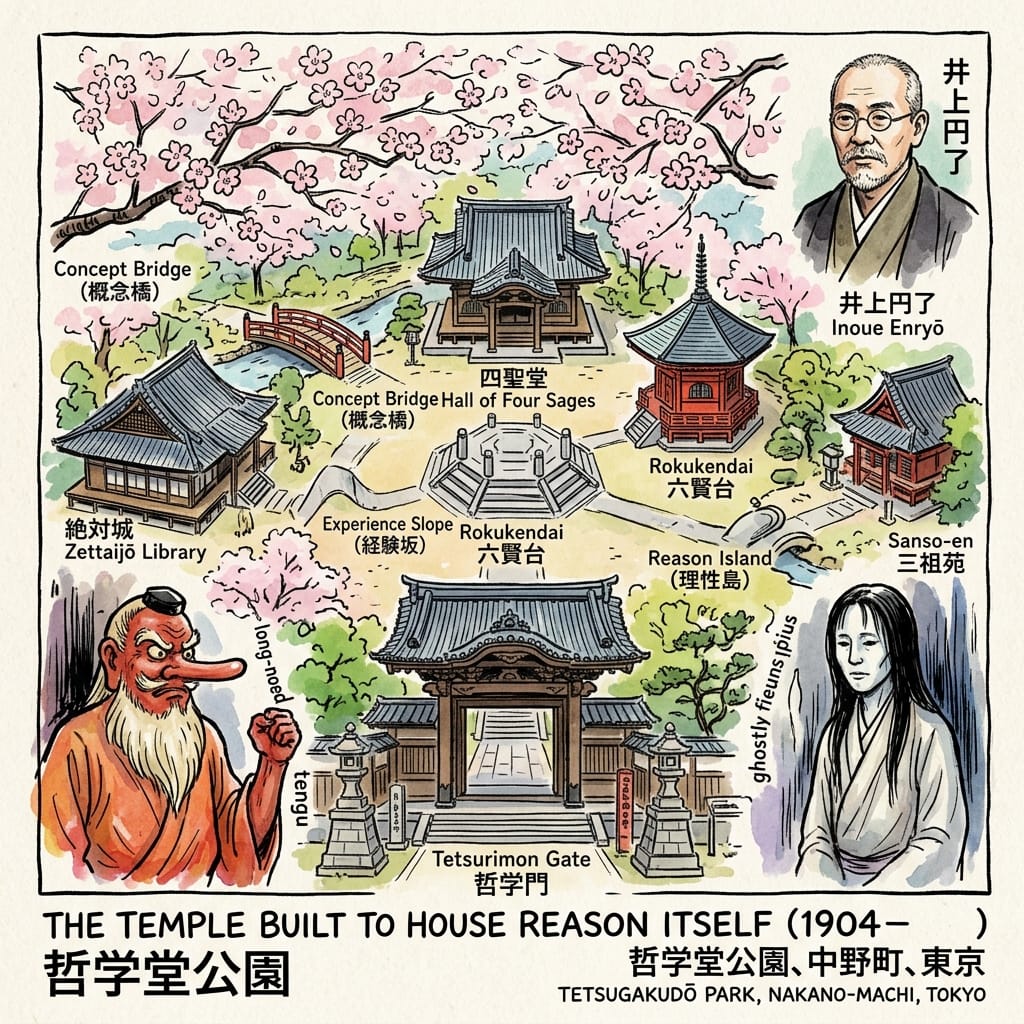
If the dog city was the state building a monument to its own anxiety, Tetsugakudō is one man building a monument to his own certainty. The philosopher Inoue Enryō — founder of the institution that would become Tōyō University — completed the Shiseidō, the "Hall of Four Sages," in 1904, enshrining Socrates, Kant, Confucius, and the Buddha side by side as the four thinkers who had shaped him most. Over the following fifteen years he kept building: a Hall of Six Sages honouring Prince Shōtoku, Sugawara no Michizane, Zhuangzi, Zhu Xi, Nāgārjuna, and Kapila; a gate flanked by carvings of a tengu, representing the material world, and a ghost, representing the spiritual one; a shrine to three founding figures of philosophical inquiry across three civilisations; and a former library he named, without apparent irony, the Castle of the Absolute. Across the grounds, seventy-seven bridges and slopes carry names like Concept Bridge, Experience Slope, and Reason Island. Enryō was, at the same time, a pioneer of yōkai-gaku — the academic study of folklore monsters, conducted largely in order to debunk them scientifically. A rationalist who built a temple. The contradiction is the point.
Tokyo S Godless Temple Of Reason
Reading it as a self-aware modern synthesis: this isn't an inherited cosmology — it's a hand-built one, with a date and a signature on it. The gate's paired tengu and ghost encode an explicit matter/spirit binary, structurally close to a Buddhist mandala's graded path toward ultimate truth, except the figures populating the path are philosophers rather than bodhisattvas, and the scale is a public park rather than a sealed hall. Walking the seventy-seven named stations is, in effect, a secular pilgrimage route — built for the cultivation of reason instead of the worship of a deity. It may be the single most literal piece of Meiji-era East-West syncretism left standing anywhere in Japan.
III. The Spy School Nobody Next Door Knew Existed
1939–1945, present-day Nakano 4-chōme, in the district still called Kakoi-chō
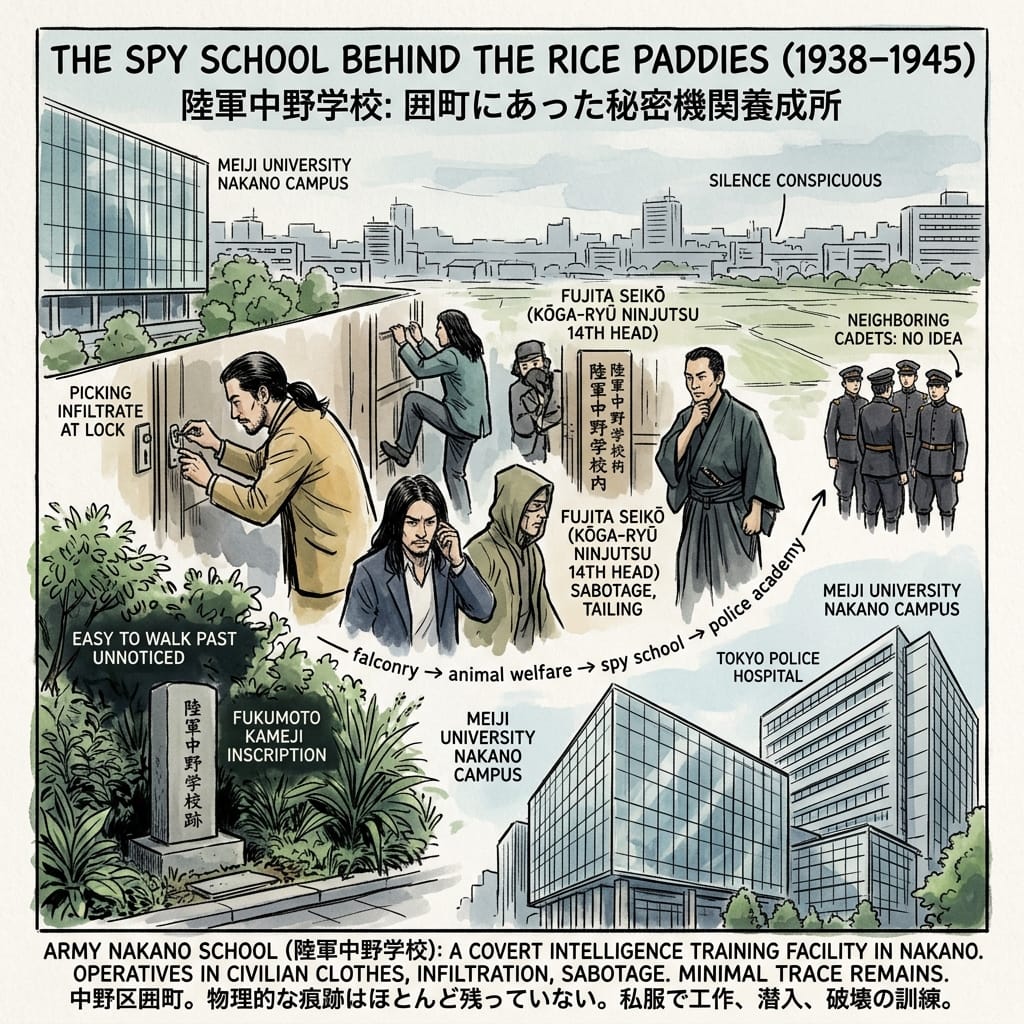
In 1937 the Imperial Japanese Army's General Staff quietly established an intelligence-training school, built around Lieutenant Colonel Iwakuro Hideo — nicknamed "Iwakuro of the Conspiracies" — along with Akikusa Shun, who later ran the wartime "Hoshi Kikan" spy network in Europe and died in Soviet custody after the war, and Fukumoto Kameji. In 1939 the school moved into Nakano's Kakoi-chō district — the word kakoi meaning, simply, "enclosure," the exact same toponym attached to the shogun's dog compound two and a half centuries earlier, on more or less the same ground, for an entirely unrelated purpose of state.
The Army Nakano School trained operatives in disguise, infiltration, tailing, lock-picking, and sabotage. Instructors reportedly included professional pickpockets, locksmiths, and a martial artist who styled himself the fourteenth-generation head of Kōga-style ninjutsu. Secrecy was total, even internally: students grew their hair long, wore civilian clothes, and didn't salute, to the point that cadets at the neighbouring military police academy apparently had no idea what the building next door was for. Graduates were later deployed around the world, some under diplomatic cover into Afghanistan, some in contact with Indian independence activists exiled in wartime Germany.
The Secret Army That Hired Pickpockets
Reading it as psychogeography, not mysticism: no documented religious tradition governs this site as a twentieth-century military installation, and none is invented here for effect. Instead, read it the way an English writer walking London's forgotten industrial edgelands might read a derelict gasworks: as a place organised entirely around concealment, an anti-landmark, the geometric inverse of the pilgrimage logic that structures the district's older religious sites. It's worth flagging — as an observed spatial pattern, not a claimed causal or spiritual link — that this exact ground was requisitioned again and again by the state for a repeating category of project: falconry ground, then animal-welfare compound, then covert intelligence school, then postwar police academy, then university campus. Four centuries of the same soil, chosen over and over for institutions built to order and discipline life.
IV. The Radial Prison, and the Century It Locked Away
1910–1983, present-day Arai 3-chōme and Heiwa no Mori Park
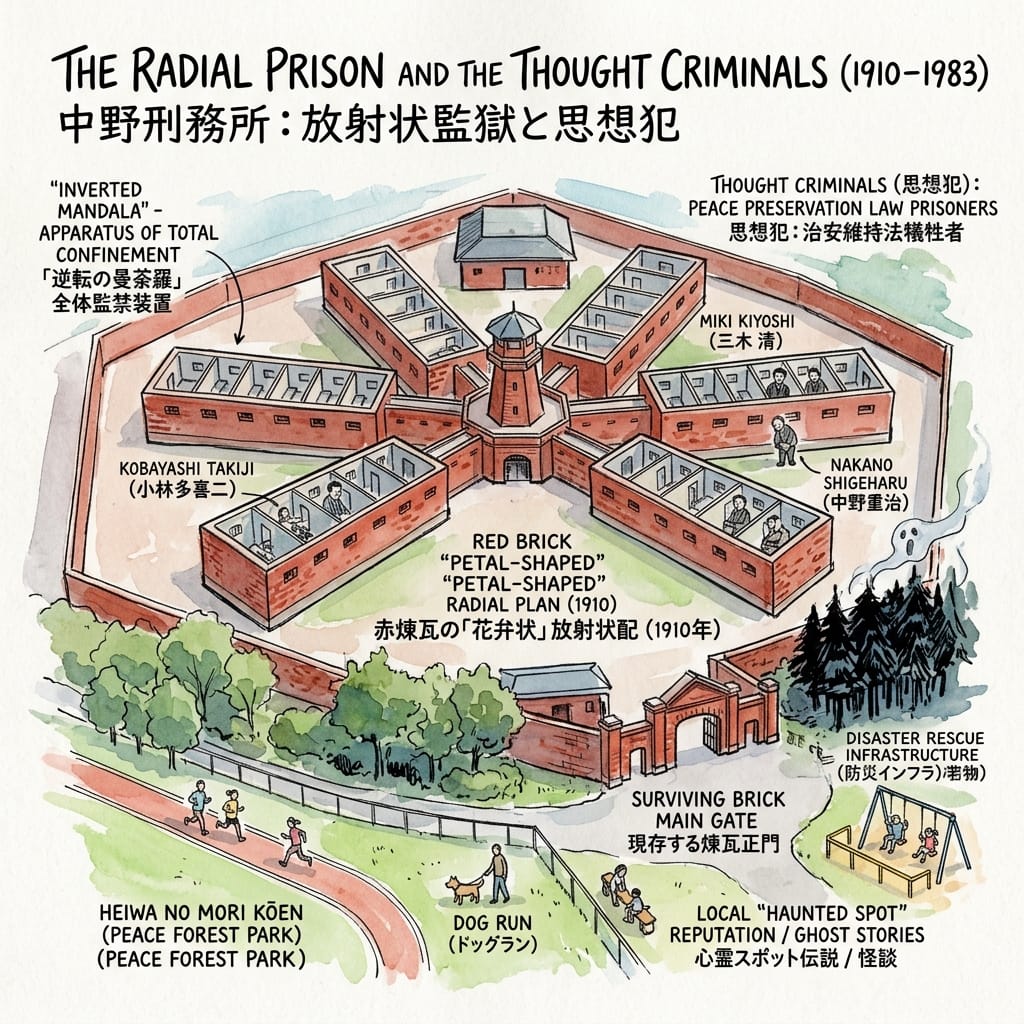
In 1910 a prison relocated from Ichigaya opened here under the name Toyotama Prison, designed by Ministry of Justice architect Gotō Keiji in red brick, on a radial "petal" plan — cell blocks fanning outward from a central round watch tower, executed with a level of architectural ambition unusual for a Japanese penal building of the period, and later recognised as one of the finest surviving pieces of Taishō-era brick institutional architecture. After the Peace Preservation Law of 1925, it became one of the country's principal holding sites for political prisoners: 278 recorded left-wing detainees as of September 1933, and, after a 1941 amendment introduced "preventive detention," some inmates who had already served their sentences remained locked up regardless. Its documented former prisoners include the novelist Kobayashi Takiji, the philosopher Miki Kiyoshi, and the writer Nakano Shigeharu. After the war it briefly held Allied military offenders under occupation authority, then, through the fifties, sixties, and seventies, defendants from the Anpo protests and the student movement. It closed in 1983 after a sustained local campaign for green space, and reopened in 1985 as Heiwa no Mori Park — the Peace Forest.
The Mind Prison Beneath A Tokyo Park
Reading it, again, without borrowing a religion it doesn't have: what's worth naming plainly, as an architectural observation rather than a claim of spiritual connection, is that Gotō's radial plan — a hub with cells radiating outward — is structurally close to a mandala's spoke-and-centre logic. A few kilometres away, and only a handful of years earlier, Inoue Enryō was using an almost identical spatial grammar to lead visitors toward enlightenment. Here the same geometry is turned inside out into a machine for total visibility and confinement. Two mandalas, built within a decade of each other, in the same district, aimed at opposite ends of the same underlying problem: the governing of a mind. After the prison closed, the park acquired, entirely informally, a local reputation as a haunted spot — particularly before a 2017 renovation, when dense evergreen planting reportedly kept parts of it dark even at midday. It's not unreasonable to read that as a neighbourhood doing its own quiet memory-work: telling itself ghost stories about a site whose actual, documented history of political imprisonment has never been especially loudly commemorated.
Holographic sensory cue: the brick has weathered to a dull, burnt orange, cool and slightly gritty under the hand. The archway of the surviving gate stands alone now in open lawn — no walls left to explain it — and the sounds around it are entirely wrong for what it once was: a dog barking somewhere in the off-leash run, children on the far side of the field, the soft, rhythmic thud of a jogger's footsteps passing close enough to touch the brick without slowing down. Somewhere underneath all of it, imagine the sound this courtyard actually had for seventy years: a watchman's boots on stone, at regular intervals, all night, radiating outward from the centre like the building itself.
V. The Shrine That Grew Out of a Battlefield
1477 to the present, present-day Numabukuro
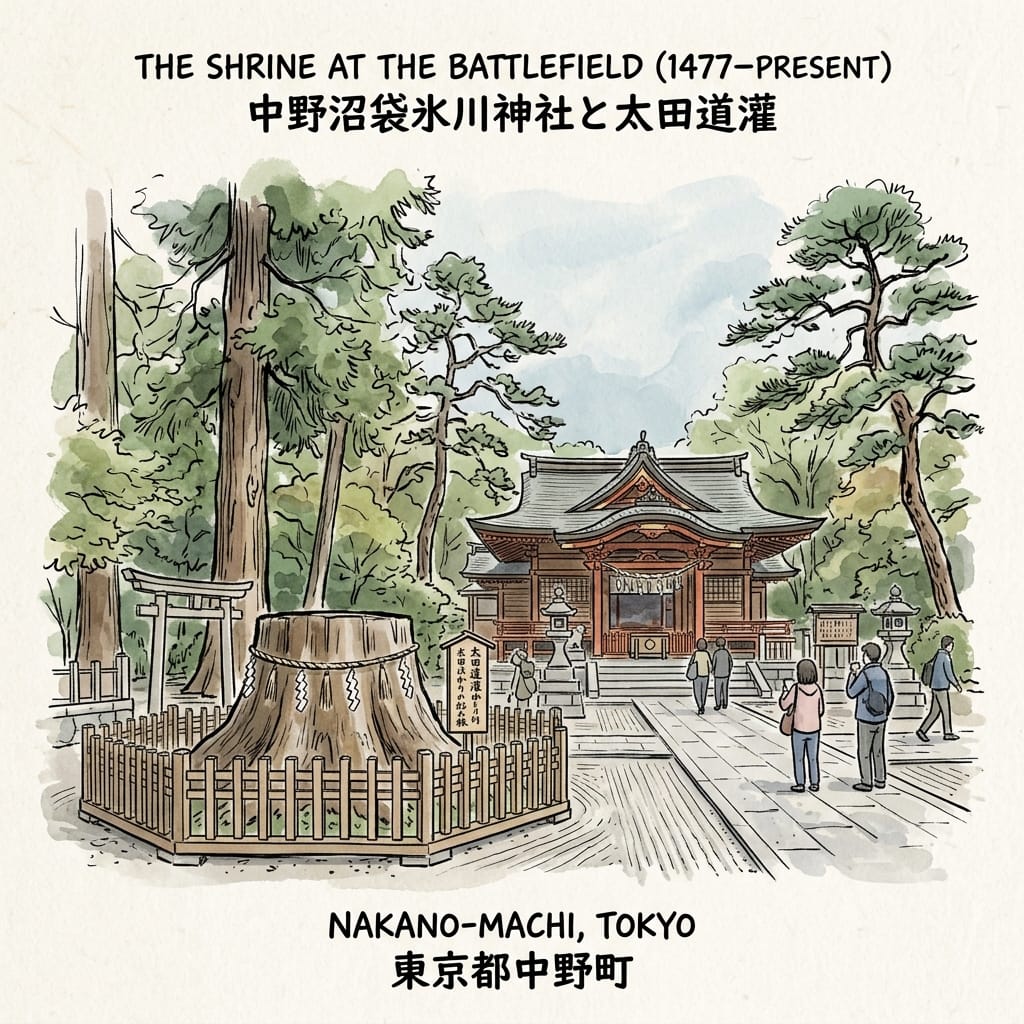
Tradition holds that Nakano-Numabukuro Hikawa Shrine was founded sometime in the mid-fourteenth century, a branch transmission from the great Hikawa Shrine of Ōmiya, enshrining the storm god Susanoo. Its clearest documented moment arrives more than a century later, in 1477, when Ōta Dōkan — the strategist and castle-builder who would go on to found Edo Castle itself — made camp at this shrine while fighting the Battle of Egotagahara against the Toshima clan, part of the long medieval struggle for control of the Musashino plain. Local tradition holds that Dōkan planted a cedar tree here in prayer for victory; the tree, known ever since as the Dōkan-sugi, grew to roughly thirty metres before it died in 1942, and its stump is said to remain on the grounds today.
The Warlord S 500-Year Prayer
Reading it through the tradition it actually belongs to: this is the one site in the whole set where a native religious framework can be applied without any strain — a village chinju, the tutelary shrine of the farming hamlet of Shimo-Numabukuro, absorbing, through one specific chronicled episode, the martial and protective function of an army passing through. That's a well-attested pattern across the Kantō region's sacred geography. The Dōkan-sugi cedar functions, in the vocabulary of the tradition itself, as a living votive object: a tree planted as a single act of prayer, standing afterward as a centuries-long physical extension of that prayer. It's the closest thing in this entire dossier to a documented "alignment" — though it aligns with nothing astronomical, only with a fifteenth-century soldier's intention. The shrine's chinju no mori, its sacred grove, is the real spatial cosmology here: not a mandala, not an axis, just a deliberately preserved ring of trees marking, in Shinto spatial logic, the threshold between ordinary ground and the ground a kami is understood to inhabit — a boundary that has quietly outlasted every regime change around it.
That the cedar happened to die in 1942, at the height of the Pacific War, is a coincidence local chroniclers themselves have simply noted, without claiming it means anything. This piece follows their restraint.
The Resonance Node: A Stone Almost Nobody Stops For
Tucked into a corner of the Tokyo Police Hospital grounds, just off Waseda-dōri, a small, unremarkable stone marker reads "Site of the Army Nakano School," with an inscription by one of the school's own founders, added by a postwar alumni association. Planting half-obscures it. There's no signage pointing the way, no plaque explaining what happened here, nothing to stop the eye. This is the single thinnest point in the whole district — the spot where an organisation that trained people to disappear left behind a memorial that has, quite fittingly, also more or less disappeared. Even the neighbouring military police cadets, at the time, apparently never knew what was next door. The stone is still keeping that secret rather well.
Conclusion: What This Ground Actually Worships
The lazy version of this story reaches for a hidden ley line, a suppressed node of ancient power, the kind of thing no document anywhere actually supports. The real pattern, once you've walked all five sites, is both more modest and considerably more unsettling: this is a district that keeps handing the same patch of ground back to the state, generation after generation, so it can build its next instrument for governing the living. A falconry ground becomes a dog sanctuary. The same toponym, two hundred and fifty years later, becomes a spy school, then a police academy, then a university. A single afternoon's battle turns a farming shrine into a permanent site of martial prayer. A park built on mandala logic to cultivate the mind, and a prison built on the same logic to confine it, go up within a few years of each other and a few kilometres apart.
Inoue Enryō's temple to reason is the one moment this whole district became conscious of itself — a shrine to the exact faculty that every other institution here existed to discipline, conceal, or lock away. Five stories, read together, aren't five unconnected curiosities. They're one argument the land keeps making, in a different vocabulary each time, about what a state actually does with the bodies and minds under its authority.
Historical memory may be the one genuinely durable asset a species gets to keep, regardless of which century's technology happens to be running the world. If walking a city this way — reading its silences instead of its signage — is the kind of thing you want more of, there's a subscription link below; we'll be back in another forgotten district before long.
Getting to the Physical Node
Getting there: Nakano Station sits on the JR Chūō/Sōbu lines and the Tokyo Metro Tōzai Line, roughly five minutes from Shinjuku — the single most convenient starting point for this entire route. Tetsugakudō Park and Numabukuro Hikawa Shrine are both closer to Numabukuro Station on the Seibu Shinjuku Line, a short walk from each other. Heiwa no Mori Park sits roughly between the two clusters and works well as a midpoint stop.
Where to base yourself: Nakano and the neighbouring Shinjuku area have no shortage of business-hotel options and excellent onward transit, making either a sensible base for a one- to two-day walking itinerary through the sites above.
Suggested route: If time allows, follow the sites in something close to their historical order — starting at Nakano Station (the dog compound site, the Army Nakano School marker), continuing to Arai 3-chōme (Heiwa no Mori Park and the surviving prison gate), heading north to Numabukuro (the Hikawa shrine), and finishing at Matsugaoka (Tetsugakudō Park). Budget half a day to a full day. This isn't a sightseeing loop. It's a walk through an argument, laid out one stop at a time.
🔍 🏛️ Frequently Asked Questions: Urban Legends & Geospatial History of Nakano
Q1: Is Nakano Station haunted by Shogun Tsunayoshi's dogs? What is the real history behind Tokyo's "Dog City"?
A1:
The urban legend claiming that thousands of cursed dog spirits bark beneath Nakano Station stems from a historical misunderstanding of Edo-period Tokyo. In 1695, the 5th Tokugawa Shogun, Tsunayoshi, established a massive 250-acre "Dog City" (Inu-yashiki) near present-day Nakano Station under his "Edicts on Compassion for Living Things."
Housing over 80,000 stray dogs cared for by full-time veterinarians and staff, no mass slaughters occurred. Following Tsunayoshi's death in 1709, the compound was dismantled and later planted with peach trees by Shogun Yoshimune, giving rise to the local name "Momozono." The legend reflects how public anxiety over state requisitioning was mythologized into ghost stories.
Q2: Why is Tetsugakudo Park in Tokyo rumored to be haunted, and what is its connection to Dr. Inoue Enryo's "Yokai-gaku"?
A2:
Tetsugakudo Park is frequently misidentified as a haunted site due to its unusual architecture, but its origin is grounded in Meiji-era rationalism. Created in 1904 by Dr. Inoue Enryo—founder of Toyo University and pioneer of "Yokai-gaku" (the scientific study of monsters)—the park was designed to systematically debunk superstitions using scientific inquiry.
Featuring structures like "Shiseido" (Four Saints Hall dedicated to Confucius, Buddha, Socrates, and Kant), its esoteric naming and dense woods were intended as a philosophical training ground to liberate minds from fear, which modern visitors misrecognized as supernatural activity.
Q3: What is the secret history behind the haunted red brick gate at Nakano Central Park and the Army Spy School?
A3:
Haunting rumors around Nakano Central Park stem from decades of classified military operations and political containment. During the early to mid-20th century, the area housed Nakano Prison (confining dissidents like writer Takiji Kobayashi) and the top-secret Imperial Army Nakano School for covert guerrilla warfare.
The mysterious presence of plainclothes operatives with long hair, combined with the imposing Meiji-era red brick gate designed by Keiji Goto, fueled local ghost lore. Rather than supernatural hauntings, these legends embody Nakano's geospatial history as a sanctuary for state discipline, surveillance, and physical containment.
Reference and Further reading
First layer – Main sources of literature and institutions:
- Nakano City official history series, "なかの物語 其の五 徳川将軍家と中野" (city.tokyo-nakano.lg.jp);
- 哲学堂公園公式ホームページ「哲学堂の古建築物」(tetsugakudo.jp);
- Tōyō University Inoue Enryō Philosophy Center (sites.google.com/toyo.jp), including reference to a 2020 documentary produced by Nakano Ward itself;
- Nakano City official walking-tour feature, 「まるっと中野:中野沼袋氷川神社」(city.tokyo-nakano.lg.jp);
- Tokyo Metropolitan Association of Shinto Shrines listing (tokyo-jinjacho.or.jp).
The second layer – secondary academic materials:
- 「犬小屋(江戸幕府)」Wikipedia, citing 常憲院殿御実紀 and 東京市史稿;
- 三井住友トラスト不動産「このまちアーカイブス」town-history series;
- Meiji University historical-research column by Prof. Yamada Akira (山田朗), "明治大学に残る戦争遺跡" (meiji.ac.jp);
- Essay by Shiratsuchi Seiichi in 遅いインターネット (slowinternet.jp);
- 「豊多摩刑務所」and「平和の森公園(中野区)」, Wikipedia;
- Kyoto University of the Arts (correspondence program) graduation research paper, "豊多摩監獄の価値とその遺産" (g.kyoto-art.ac.jp);
- 「氷川神社(中野区沼袋)」, Wikipedia;
- Tesshow.jp, transcribing the Edo-period gazetteer Shinpen Musashi Fudoki Kō (新編武蔵風土記稿) — a valuable primary-adjacent historical text, here quoted at second hand;
- Jinjamemo.com (contemporary pop-culture pilgrimage notes, clearly flagged as such).
Third layer – Supplementary information:
- Kazahana.holy.jp local-history blog;
- Nakano-chokai.jp (Nakano Ward Neighborhood Association Federation);
- Edokara.Tokyo;
- アゴラ (Agora) opinion essay revisiting Tsunayoshi's reputation;
- 「哲学堂公園」and「井上円了」, Wikipedia;
- A personal/family-history blog post (med.miyazaki-u.ac.jp) from a descendant of one of the site's original master carpenters — treated here as supplementary oral/family record, not verified fact;
- Senseki-kikou.net walking-survey blog; teitowalk.blog.jp;
- 東京地評「はたらく仲間」機関紙コラム 第212話;
- Teitowalk.blog.jp (including the "haunted spot" reputation, explicitly local/anecdotal);
- Kur0s1ba-wank0.com war-sites blog.
Historical gap:
- Further archival verification recommended for the precise figures on dog population and annual expenditure, which vary between sources;
- Precise dates of individual facility handovers (army → occupation police reserve → National Police Academy → 2001 relocation to Fuchū → hospital/university redevelopment) vary slightly across sources and would benefit from direct Defense Ministry or Ward archival confirmation.
 Lawrence
 Lawrence
 Lawrence

© Historical Travel Stories | Unraveling Strange Tales Across Dimensions and Time