Totsuka-machi: The Tokyo Town That Lent Its Name Away
The names you read on the map, Waseda and Takadanobaba, were borrowed. What remains of Totsuka-machi itself is a police station, a ward office and a few signs that say “once”. Five little-known histories, beginning with a mountain that was carried away.
 Lawrence
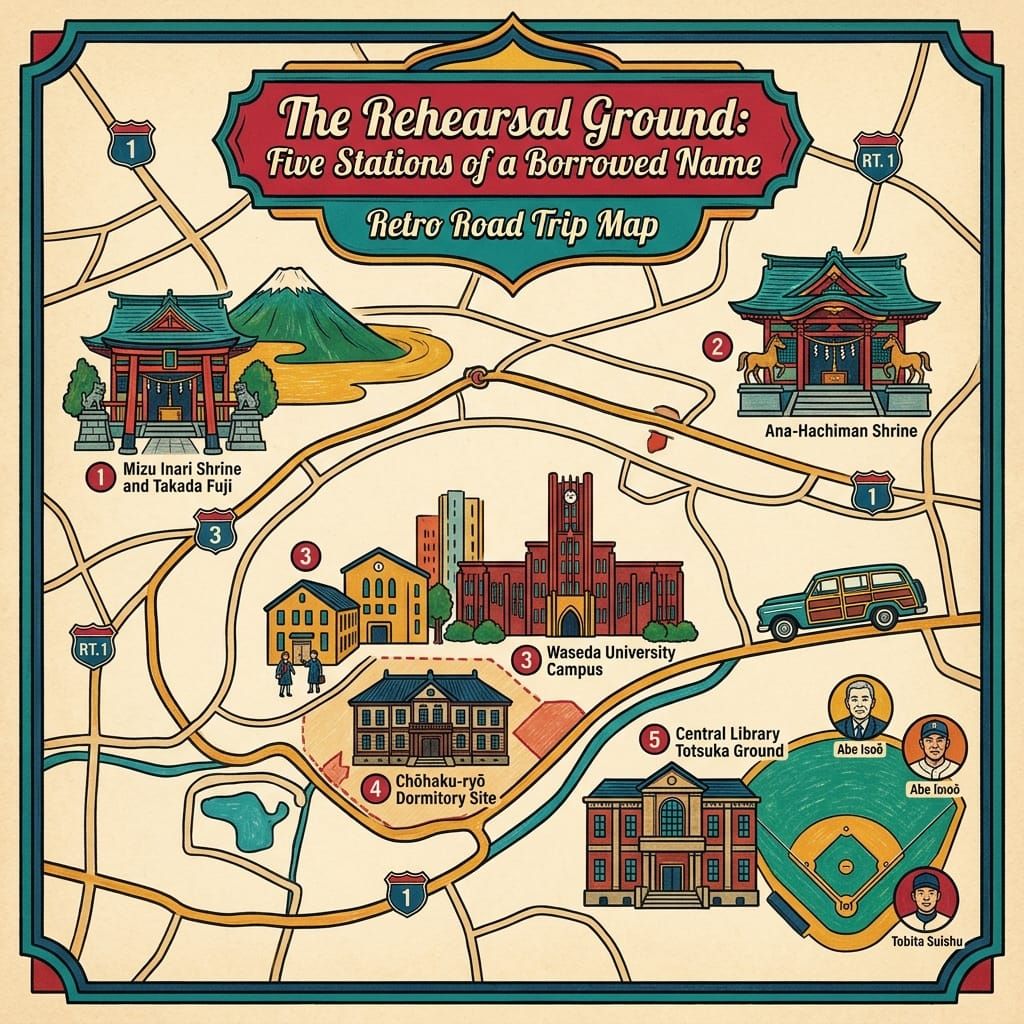
Totsuka-machi was a town in what is now Shinjuku Ward, Tokyo. It held the main campus of Waseda University, the area around Takadanobaba Station and the Edo-period riding ground that gave that station its name. After the address reform of 1975 the town name all but vanished, though it survives in a few official corners. This article follows five documented stories.
💡 Join a community of discerning travelers. Simply enter your email to instantly unlock audio guides and one-day itineraries, and carry our exclusive historical walking maps with you on your journey.
For most of the twentieth century, a letter to Waseda University would have been addressed to Totsuka-machi.
Not Waseda. Waseda was the village next door, and the university had borrowed its name; the ground it stood on belonged to Totsuka. So the town lent its name to nothing, or rather it lent it to everything and was credited with none of it.
At Takadanobaba Station the name is read Takadanobaba, with a voiced da. Hiroshige, who drew the place, recorded the popular reading as Takatanobaba, unvoiced. How the two small dots arrived is still unsettled. What is certain is that when the station opened in September 1910 it stood on Totsuka village land, and Totsuka was the obvious name. But a station called Totsuka had been open on the Tōkaidō Line since 1887.
The name went elsewhere. The station stayed.
1. The Mountain That Was Carried Away
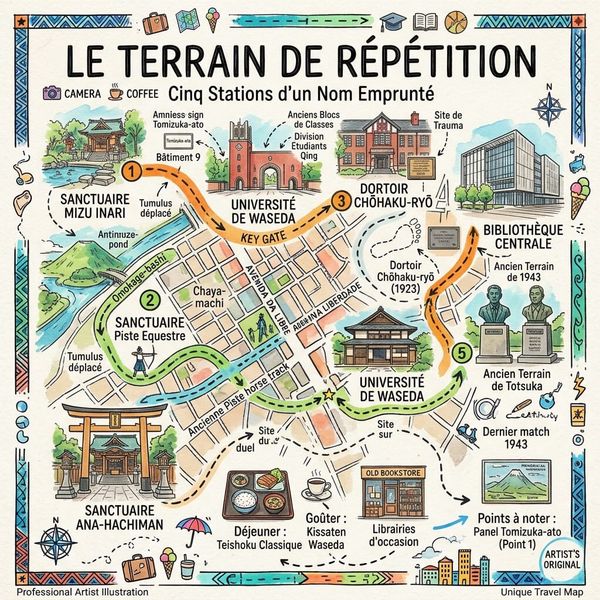
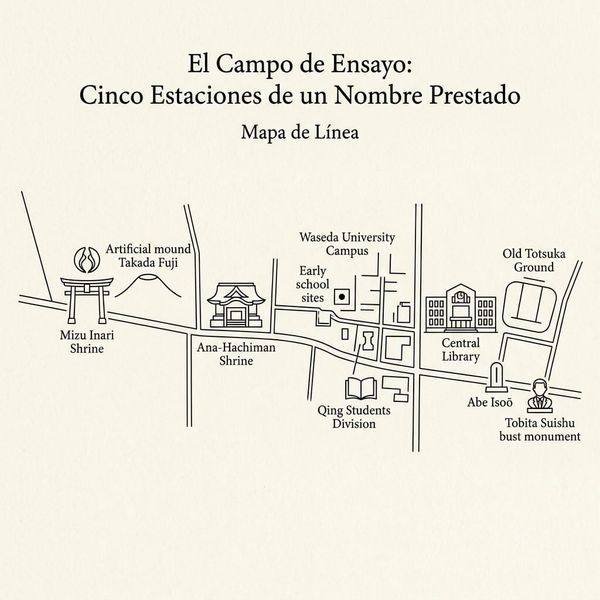
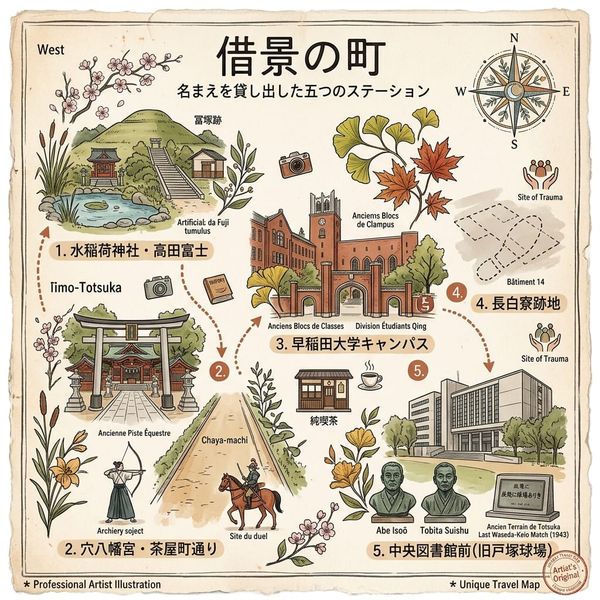
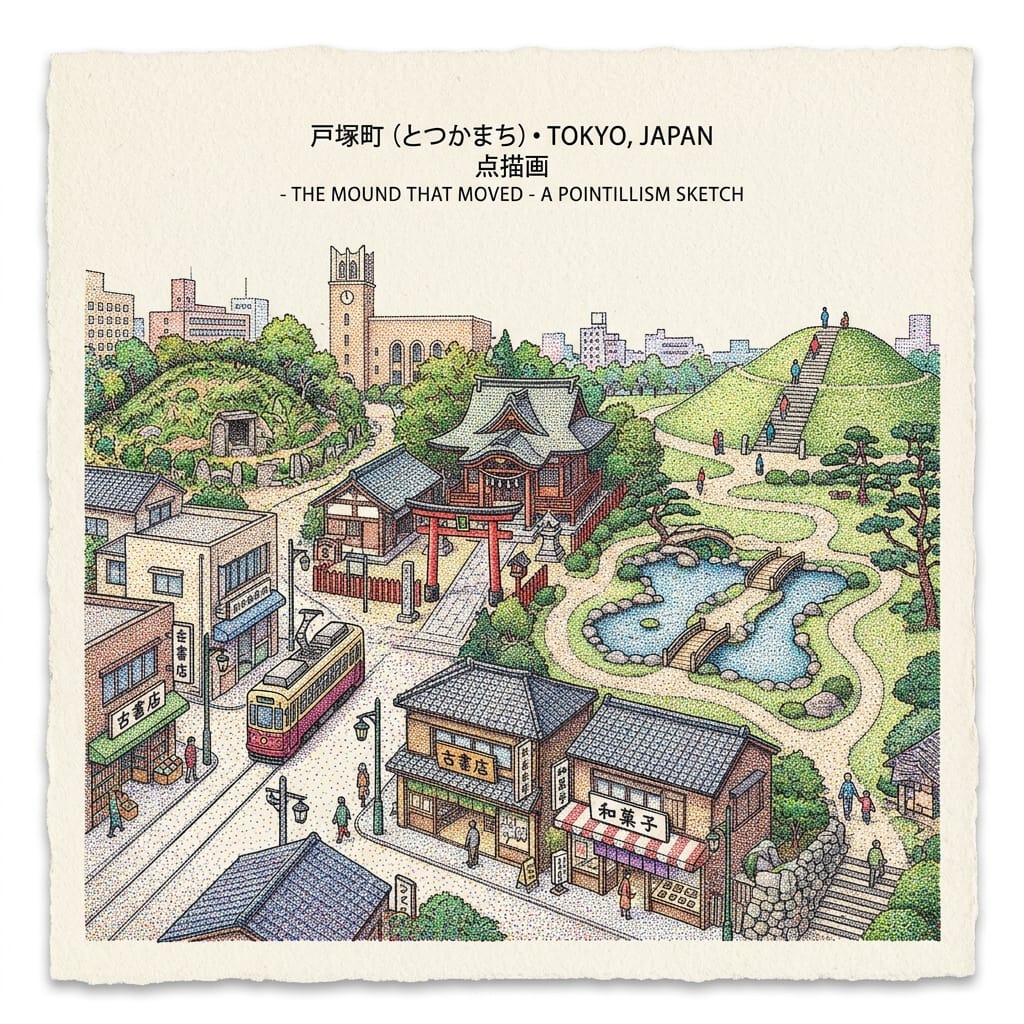
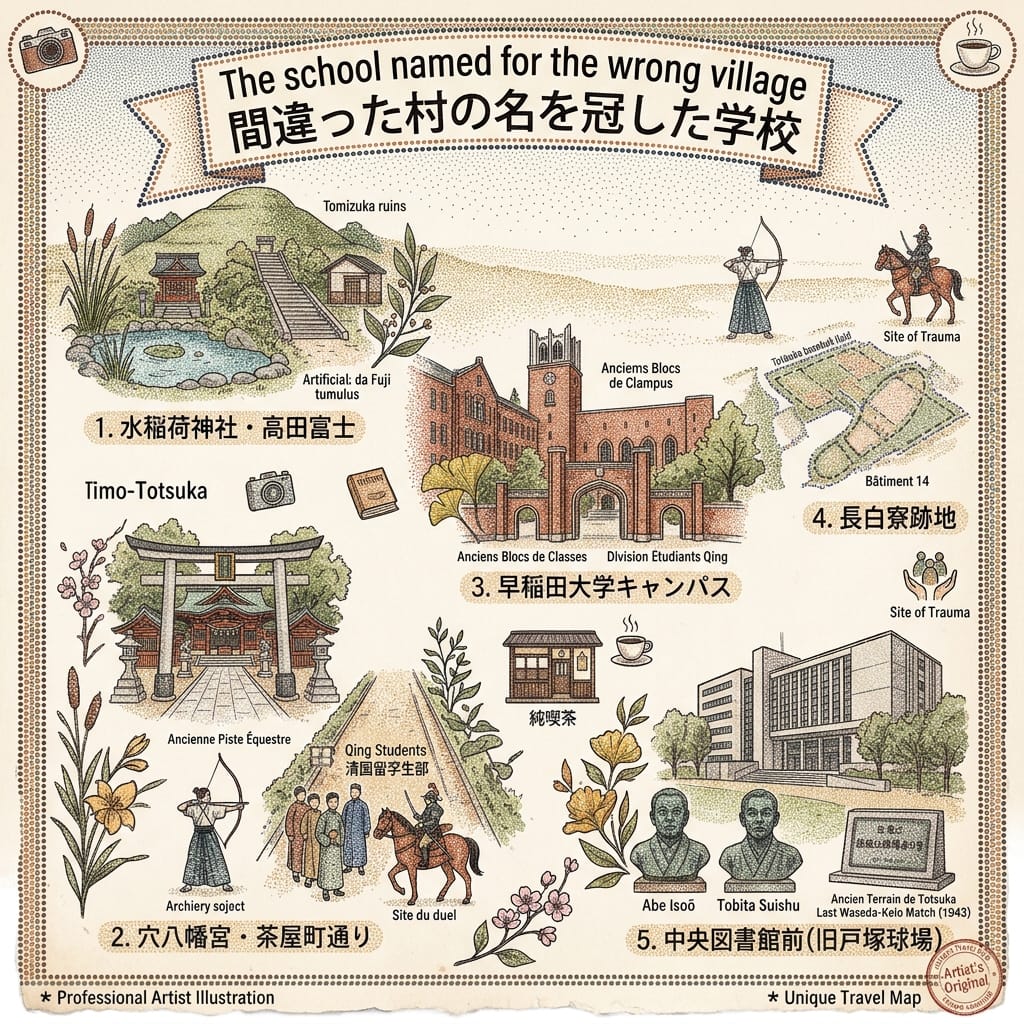
On the west side of Waseda’s Building 9 there is a small sign that reads Tomizuka-ato: “site of the Tomizuka mound”.
There is no mound under it.
There was one. One theory of the place name holds that “Totsuka” comes from a cluster of burial mounds (tsuka), written variously as “ten mounds”, “wealth mound” and finally “door mound”. This is folk etymology, not proof; Yokohama’s Totsuka has almost the same legend, which is a reason for caution.
A shrine came first, on top of the mound. Mizu Inari Shrine’s own tradition says that in 941 the warrior Tawara Tōta Hidesato enshrined the fox-deity Inari there, and that in 1702 a spring rose at the roots of a sacred tree and cured eye disease, which is how it became “Water Inari”. That is shrine tradition, not documented history.
The Mountain Moved For A Classroom
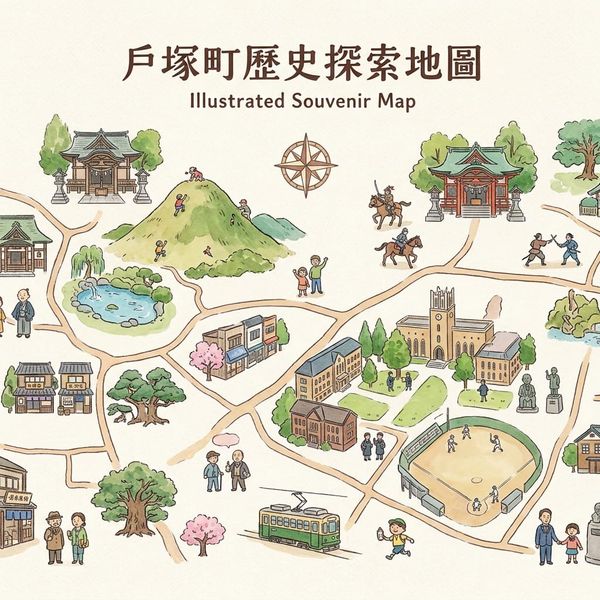
Then, on the front part of the mound, which is said to have been a keyhole-shaped kofun (an ancient tomb), someone built a mountain. In 1780 (some sources say 1779) a leader of the Fuji-kō, the confraternities that climbed Mt Fuji in groups, named Nichigyō Seizan (Takada Tōshirō) raised a ten-metre artificial Fuji, the Takada Fuji. It is counted among the oldest and largest in Edo and appears in the 1861 picture-book Ehon Edo miyage. A fujizuka can be read as a distant sacred mountain shrunk to fit the city; that is an interpretation, not a finding.
Tomb, fox shrine, Fuji. Three faiths on one hump of earth, living side by side for a few hundred years.
In 1963 Waseda, expanding, swapped land with the shrine. Shrine, mound and Fuji were moved next to Kansen-en Park, now Nishi-Waseda 3-chōme. Where they stood is Building 9.
It was an agreed exchange, not a seizure, and that should be said plainly. But a mountain was moved to make room for classrooms, and that sentence needs no adjective.
2. The Riding Ground and the Station
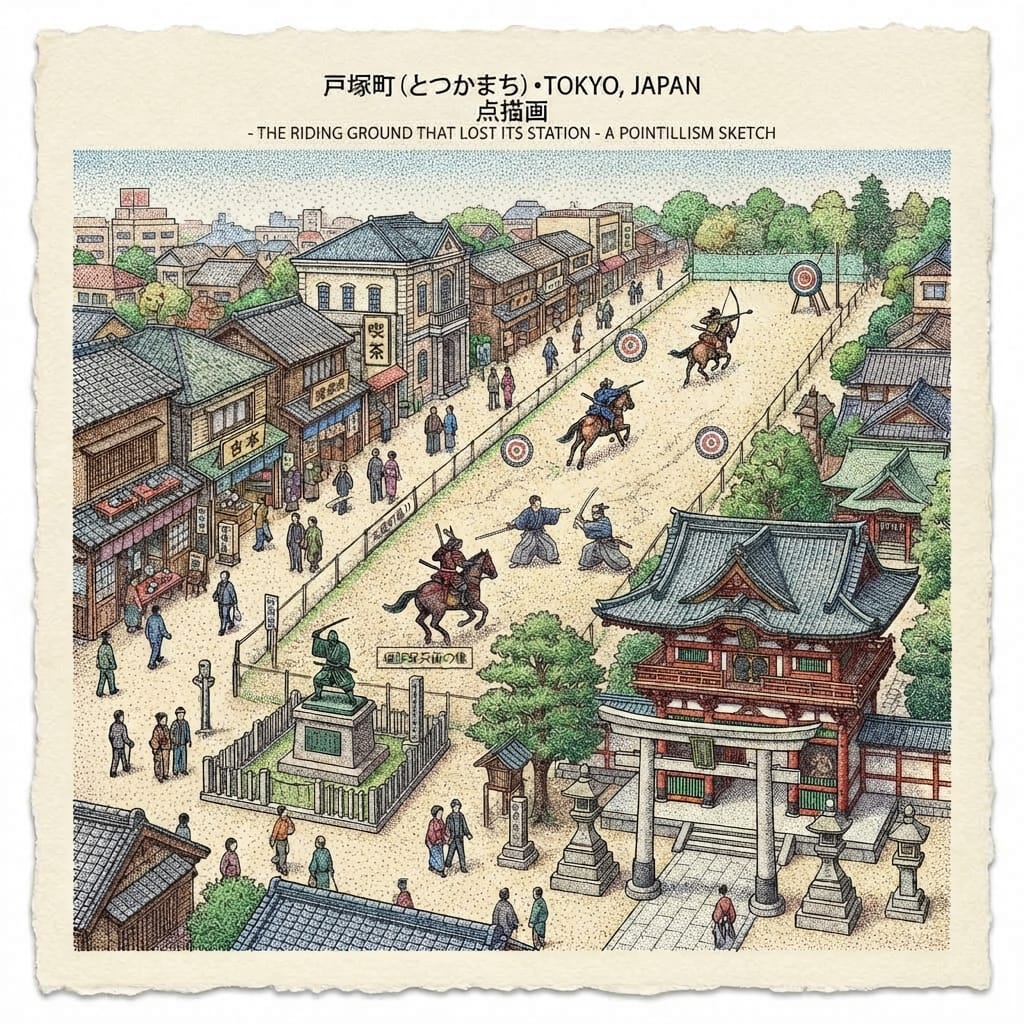
Hiroshige drew it: a long, straight lawn, pines along one side.
Takada-no-baba, tradition says, was laid out in 1636 under the third shogun Iemitsu for the training of hatamoto, the shogun’s direct retainers, and for yabusame, ritual mounted archery. It was about 655 metres long and 55 wide. In 1728 Yoshimune, the eighth shogun, had yabusame dedicated at the neighbouring Ana-Hachiman Shrine to give thanks for his heir’s recovery from smallpox. The ground lay in Shimo-Totsuka village, today’s Nishi-Waseda 3-chōme.
It became famous because of a private fight.
In the first month of 1694 two retainers of the Saijō domain in Iyo, Sugano Rokurōzaemon and Murakami Shōzaemon, quarrelled over drink and agreed to settle it here. A local Saijō account says Murakami brought nearly ten helpers to Sugano’s three. A masterless samurai named Nakayama Yasubei, who had sworn a bond of uncle and nephew with Sugano, drew his sword.
He later married into the Akō domain, took the name Horibe Yasubei, and in the winter of 1702 became one of the Forty-Seven Rōnin.
Kabuki and storytellers swelled the duel into eighteen men cut down by a single sword. One account puts the real number at about three. The duel is fact; the “eighteen” is legend; the count is unsettled. A monument went up in 1910, the same year the station opened.
The Station That Stole A Samurai Legend
Why not “Totsuka”? The name was taken, “Kami-Totsuka” and “Suwa” were floated, and the railway authorities chose the famous Edo sight, which lay a kilometre or so away. Shimo-Totsuka villagers are said to have objected to their historic ground lending its name to a station, and the reading was voiced to Takada. That is a reported explanation, not a settled one.
In 1975 the address reform created Takadanobaba 1- to 4-chōme around the station. The new name does not include the riding ground itself.
Ana-Hachiman still stands south of the old ground. Shrine tradition dates it to 1062 and says a gilt-bronze Amida was found in a cave there in 1641. Each October the Takadanobaba yabusame is held at Toyama Park, a Shinjuku-designated intangible folk-culture property. The ground is gone; the horses ride on elsewhere.
Sensory cue (observable, documented): along the Kanda River near Omokage Bridge, cherry trees are planted on the banks and the stretch is a spring viewing spot. The road there is said to have been the medieval Kamakura Kaidō Nakamichi.
3. The College With a Borrowed Name
In 1932 Tokyo expanded and swallowed its surrounding towns, and a civil servant looked at a map and found a problem.
Waseda University stood in Toyotama District’s Totsuka-machi, Shimo-Totsuka. Its name came from the village over the hill. The city’s own History of the Expansion of the City Limits records that the survey concluded Waseda should be put into Ushigome Ward; but boundary petitions poured in, and the city rejected them all and kept the old lines.
So through most of the twentieth century the university’s address was Totsuka-machi.
The story begins with the Political Crisis of 1881, when Ōkuma Shigenobu was expelled from government, founded a party, and set up a school beside his own villa. Tokyo Senmon Gakkō opened on 21 October 1882. The villa was in Waseda village, the school in Totsuka, so it was called both the “Waseda school” and the “Totsuka school”. It became Waseda University in 1902. The name Totsuka stayed in the address book.
In 1905 the college opened a Qing Students’ Division, set up chiefly by Aoyagi Atsutsune and Takata Sanae. The first year brought 762 students, and over five years more than 2,000. Dormitory meals were Chinese and old menus survive; board and fees were ¥12.50 a month, about a primary-school teacher’s or a policeman’s starting salary. One student, Huang Zunsan, noted in his diary how foreign Japanese food felt on his first day; many were reported to be worn down by the climate and by nervous exhaustion.
The University That Moved A Mountain
Among the Chinese who studied at Waseda in these early years were Song Jiaoren, Li Dazhao, Qian Xuantong, Zhu Xizu and Tang Zengbi. The university’s History Museum holds a letter from Sun Yat-sen to Ōkuma. Among the teachers of Japanese was Tsuda Sōkichi, whose name returns below.
In January 1915 Ōkuma’s cabinet presented China with the Twenty-One Demands.
Both are facts. Put side by side, no footnote reconciles them.
The division’s wooden Western-style building outlived the division. It was moved to Higashi-Fushimi as the “Green House”, later dismantled, and has been rebuilt at a seminar house in Karuizawa.
4. September at the Chōhaku Dormitory
Before dawn on 2 September 1923, the police history of the disaster says, the rumour that Koreans were setting fires first appeared in Totsuka-machi. By the third, vigilante bands were out with swords and guns.
Waseda had been lightly damaged and took in 721 refugees. The university office’s daily log records, for the second, rumours of arson and poisoned wells and staff taking turns on guard; for the third, a request that the Chōhaku Dormitory shelter Korean factory workers from Shitaya.
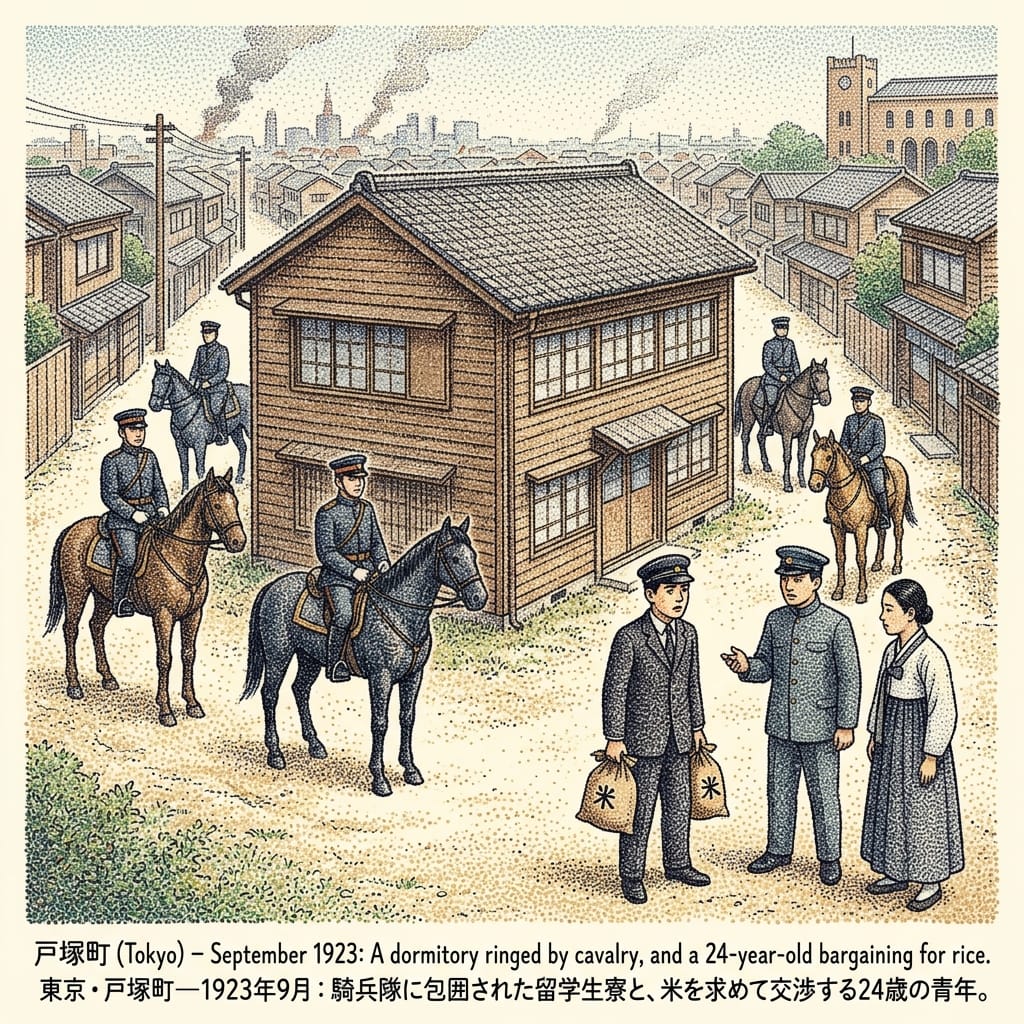
Chōhaku-ryō stood at Shimo-Totsuka 655, roughly where Building 14 is today, and housed poor Korean working students. Its manager was Itō Shichio, twenty-four.
The log for 5 September records a rumour that more than forty Korean students inside, short of food, meant to burn the building and flee in the confusion. Cavalry surrounded it; the archivist suspects the Imperial Guards Cavalry from Toyama. The university staff wrote that they did not believe the rumour.
The 24-Year-Old Who Held Off A 1923 Siege
Itō came from Mizusawa in Iwate, had graduated in politics and economics from Waseda, belonged to the Labour-Farmer Party, and was a friend of the poet Miyazawa Kenji. An anthology of 1924 says he negotiated with the Government-General of Korea’s Tokyo office and the Tokyo prefectural government for food for 54 people; the writer Mori Sōichi, writing later, says he sheltered twenty-odd students without a single death. The numbers differ; perhaps they count different groups.
After the earthquake he went to Germany, fell ill, and recovered on the island of Ōshima, where he founded an agricultural school in April 1931. He died on 13 August that year, aged 32.
One thing must be added. That 1924 anthology, Shinsai bidan, was compiled to promote “Japan–Korea harmony”. Koreans killed in the Kantō region numbered in the thousands, and turning individual kindnesses into edifying tales can be a way of shrinking the whole. A Korean student quoted in the Waseda student newspaper of 15 November 1923 concluded that the Japanese could never be assimilated with the Korean people.
The dormitory was abruptly shut by the Government-General in 1925.
5. The Last Game on Totsuka Ground
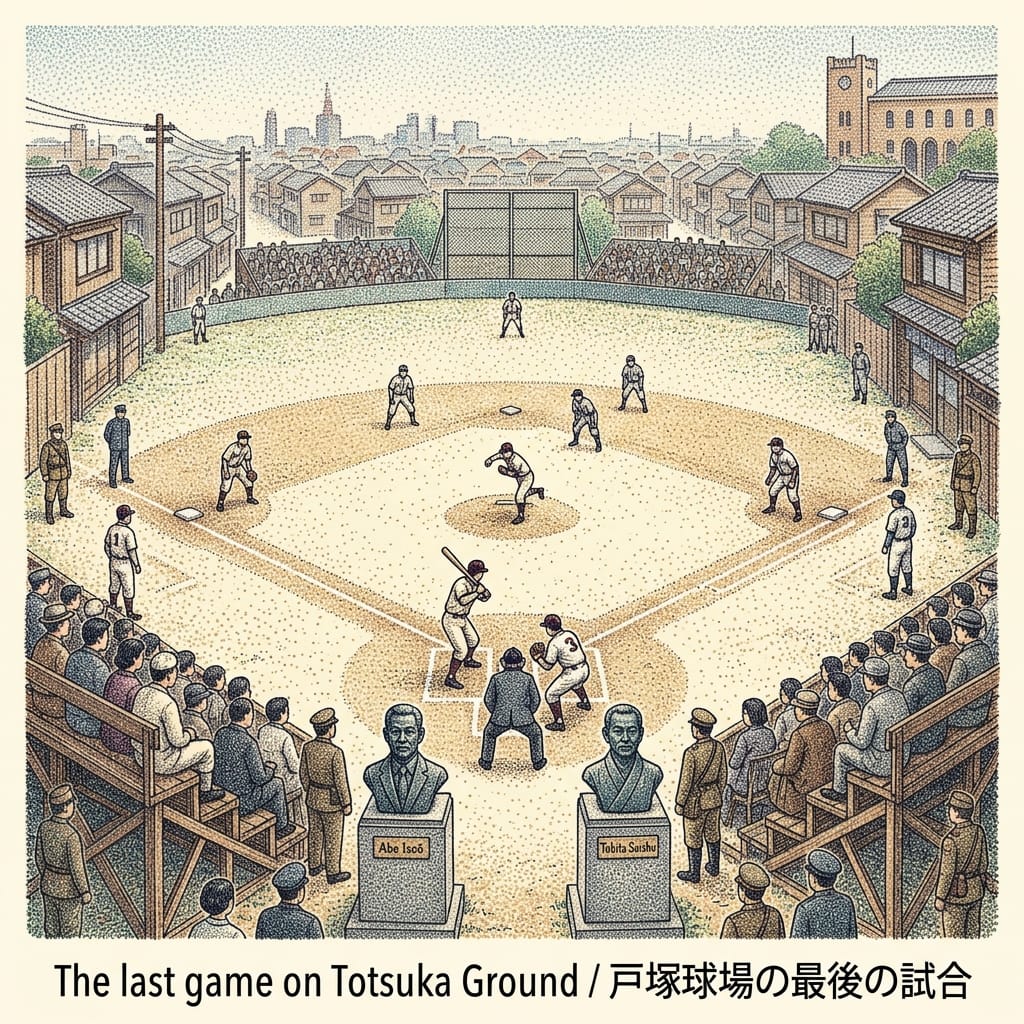
At a corner of Waseda’s Central Library stand two bronze busts, and beside them a stone that begins: “Here once was a baseball field.”
The busts are of Abe Isoo and Tobita Suishū.
Totsuka Ground was built in October 1902 for the college’s twentieth anniversary and opening ceremony, and named for its district. At first it had no stands. Stands were added in 1925 (capacity is given as 10,000 in one source and 25,000 in another, which is unsettled) and the Waseda–Keiō games, suspended for years, resumed. In 1936 the new professional league, unable to get Jingū or Kōrakuen, was lent the ground, and nine games were played; professional ball was still called “trade baseball” and looked down on. In 1941 the ground was renamed Totsuka Dōjō: the name of a martial-arts hall.
On 15 October 1943, at the send-off for student conscripts at Totsuka Dōjō, President Tanaka Hozumi spoke. The university bulletin records him telling students to lay down the pen and take up the sword, and not to expect to come back. A graduate who attended remembered him saying the opposite: come back alive and serve society. Both versions survive.
The Forbidden Farewell Game
The next day, on the same ground, came the “Last Waseda–Keiō Game”.
Keiō’s players had asked for one more game before leaving. Keiō’s president, Koizumi Shinzō, agreed; Tanaka refused; it was played on the baseball club’s own responsibility, led by the club’s adviser Tobita Suishū. Waseda won 10–1.
There was a background to the refusal. Tsuda Sōkichi had resigned his professorship in January 1940, Kyōguchi Motokichi followed the next year, both through Tanaka’s mediation, and the Education Minister had formally warned Tanaka. A researcher suggests this pressure may explain his caution.
Leading off at second base that day was Mori Takeo. On 14 October he wrote in his diary that the university leadership was toadying to the times and should learn from Keiō. On the 17th, after the farewell games, he wrote that he might never hold a ball on Totsuka again. He was sent to Manchuria, interned in Siberia for about two years, and died in 2011 at ninety.
On 25 May 1945 the Yamanote air raid killed more than 3,600 people in the city and burned Ōkuma Hall and the science and engineering buildings; the concrete library Tanaka had pushed for survived.
The ground was renamed Abe Ground in 1949. After the last all-Waseda–Keiō game on 22 November 1987 it closed. The Central Library now stands on the site.
Sensory cue (observable): the two busts and the stone at the corner of the library are the only visible trace of the ground.
The resonance node: two signs that say “once”
The Tomizuka-ato board by Building 9 and the “Here once was a baseball field” stone beside the Central Library stand on the same campus, one for a tomb and one for a ballpark. Chōhaku-ryō stood near Building 14; whether anything marks the spot is for a visit to confirm.
Totsuka today
What remains: Totsuka Police Station; the Totsuka Special Office and Community Centre in Takadanobaba 2-chōme; and a police jurisdiction list that still names “Totsuka-machi 1-chōme”, whose extent needs checking.
What has gone: the real riding ground, the old site of Mizu Inari, Totsuka Ground, and the Toden Totsuka tram line that ran between Waseda and Takadanobaba from 1949 to 1968.
What has changed: after 1945 the Takadanobaba district was recorded by the ward as burnt ground; after 1975 the town name split between Takadanobaba and Nishi-Waseda.
Set the five stories side by side and two things recur. The first is rehearsal: a shrunken Fuji, a ground for practising war, a classroom for a future state, a dormitory kept going under pursuit, a ball game before the front. The second is renaming: the station, the university and the town name have used this land’s name, or taken it. That is one way of reading it, not a conclusion of the sources.
The last image
The ground closed on 22 November 1987. After the crowd had gone, former players were seen gathering soil from the field.
The site is a library now.
Where the soil went is not recorded.
Visiting: Accessing the Physical Node
Please check details before you go.
- Getting there: Takadanobaba Station (JR Yamanote, Seibu Shinjuku, Tokyo Metro Tōzai), Waseda exit; Toden Arakawa Line stops Waseda and Omokage-bashi; Nishi-Waseda on the Fukutoshin Line.
- Totsuka Special Office: Takadanobaba 2-chōme, about three minutes’ walk from the Waseda exit.
- Ana-Hachiman Shrine: Nishi-Waseda 2-chōme, about three minutes from Waseda Station (Tōzai Line).
- Mizu Inari Shrine and Takada Fuji: beside Kansen-en Park, Nishi-Waseda 3-chōme.
- Waseda campus (Building 9, Central Library, History Museum): confirm opening hours and entry with the university; the museum’s closing days follow its official notices.
💡Q&A
Q1 | Does the name Totsuka-machi actually originate from a legend of ten ancient burial mounds? (Folk Etymology vs. Documented Local History [Totsuka-machi / Tomizuka])
A: There is no conclusive historical evidence proving that Totsuka-machi derived its name from a cluster of ten burial mounds. While local tradition suggests the name evolved from terms meaning "ten mounds" (totsuka) or "wealth mound" (tomizuka) due to the area's ancient kofun tombs, historians classify this as unverified folk etymology. Notably, Yokohama's Totsuka district preserves a nearly identical naming legend, indicating that such explanations reflect shared regional folklore and cultural memory of ancient landscapes rather than documented linguistic history.
Q2 | Why was Edo's largest artificial Mount Fuji moved from Waseda University's Building 9? (Sacred Geography & 1963 Campus Expansion [Takada Fuji / Mizu Inari Shrine / Waseda University])
A: The ten-metre artificial mountain known as Takada Fuji, built around 1780 by Fuji-kō leader Nichigyō Seizan atop the Tomizuka mound and Mizu Inari Shrine, was relocated in 1963 due to a negotiated land exchange for Waseda University's campus expansion. Rather than a forced demolition, the university and Mizu Inari Shrine agreed to transfer the shrine, ancient tomb mound, and Edo's oldest and largest fujizuka to a site beside Kansen-en Park in present-day Nishi-Waseda 3-chōme, leaving only a Tomizuka-ato marker beside Building 9.
Q3 | Why is Takadanobaba Station not named Totsuka despite standing on former Totsuka village land? (1910 Railway Naming Conflict & Edo Equestrian Heritage [Takadanobaba Station / Nakayama Yasubei])
A: When the railway station opened in September 1910 on land belonging to Totsuka village in Toyotama District, it could not be named Totsuka because a station with that exact name had already been operating on the Tōkaidō Line since 1887. To prevent railway and postal confusion, officials named the station after Takada-no-baba, the nearby Edo-period equestrian training ground established in 1636 and made famous by samurai Nakayama Yasubei's 1694 duel, leaving Totsuka-machi's own name absent from modern transit maps.
Want to follow the historical routes I’ve selected right from your phone as you walk? Click to join the exclusive Google map of historical tours titled "Historical Travel Stories"—import it to Google Maps on your phone with a single tap and let it guide you as you visit each historical site in person.

📖Reference and Further reading📖
First layer – Main sources of literature and institutions:
- Waseda University History Museum: 森武雄「〔日記〕学徒出陣 1943年10月」 — diary excerpts and the 1943 Last Waseda–Keio Game (2026)
- Waseda University: 早稲田大学の沿革 — Tokyo Senmon Gakkō, the “Totsuka school” name, 1902 renaming
- Waseda University History Museum: 早稲田大学と北京大学1882–1921 (special exhibition) — Chinese students at Waseda, Sun Yat-sen letter
- Shinjuku Ward: 新宿区について(区の歴史) — ward history, 1932 and 1947 mergers, wartime damage
- Shinjuku Ward: 戸塚特別出張所・戸塚地域センター — surviving “Totsuka” office and address
- Tokyo Metropolitan Police: 戸塚警察署 管轄区 — jurisdiction list still naming 戸塚町1丁目
- Yokohama City: 戸塚区のあゆみ — Yokohama’s Totsuka place-name legends, for comparison only
The second layer – secondary academic materials:
- 小薗崇明: 関東大震災下の長白寮~朝鮮人学生を救った伊藤七雄~ (2025) — Waseda History Museum; Chōhaku-ryō and the 1923 rumours
- 廣木尚: 早稲田出身の学長・総長【第2回】田中穂積 (2019) — Tanaka Hozumi, the 1943 send-off, the 1945 air raid
- 袴田郁一: 120年前の留学生の苦悩とは? (2024) — the Qing Students’ Division, numbers, fees, diet
- 望月雅士: 安部球場の85年 (2011) — Totsuka Ground from 1902 to 1987
- 渡邉: 清国留学生部展と北京大学, 早稲田大学史記要 55 — founding of the Division, Ōkuma, Tsuda Sōkichi as teacher
- 中嶋久人: 雉子橋邸を知っていますか 最終回 — Ōkuma after the 1881 crisis and the founding of the school
- 今尾恵介: 『地名散歩』 excerpt, Bunshun Online (2023) — Waseda in Totsuka-machi, 1932 boundaries, 1975 renaming
- 小林明: 高田馬場(JY15), nippon.com (2024) — the riding ground, the station name, the duel (cites Imao Keisuke and Tanikawa Akihide)
- NPB: 球跡巡り・第31回 戸塚球場 (2020) — the ground and the 1936 professional games
- Springer chapter on Japan–China relations and the Twenty-One Demands — Ōkuma’s second cabinet, January 1915
- Waseda Weekly: short note on the Takada Fuji — dates the mound to 1779
Third layer – Supplementary information:
- このまちアーカイブス: 江戸期までの戸塚界隈 — mound etymology, Tomizuka, Takada Fuji, Omokage Bridge (Sumitomo Mitsui Trust Realty)
- このまちアーカイブス: 鉄道の整備 — station name, “Takada” voicing, Toden Totsuka Line
- このまちアーカイブス: 町名の移動と1975年 — how the name Takadanobaba moved
- このまちアーカイブス: 高田馬場・早稲田 (overview) — the 1694 duel
- このまちアーカイブス: 早稲田大学の歴史 — school beside the Ōkuma residence
- Tabi-mag: 高田富士 — Nichigyō Seizan; Hōsenji land claim
- Tabi-mag: 水稲荷神社 — shrine tradition and the 1963 move
- nippon.com: 喜千也「高田の馬場」 — Yoshimune, Chaya-machi Street, the monument
- Toyo Keizai Online: 「たかたのばば」の読み方 — pronunciation and the exaggerated “eighteen men”
- Ana-Hachiman Shrine entry (gltjp.com) — shrine tradition, Ichiyō Raifuku charm, yabusame
- Saijō City (Ehime): local-history note on the 1694 duel — the Saijō-domain view
- 室橋裕和, President Online: Little Yangon in Takadanobaba — the Burmese community and the “Totsuka No. 3” street
- San-tatsu: from Nakai to Takadanobaba — settlement history of the Burmese community
- nippon.com: a Burmese restaurant owner’s account — oral testimony, 1988 uprising
 Lawrence
 Lawrence
 Lawrence