
ROYAL & POLITICAL LONDON 皇室與政治倫敦
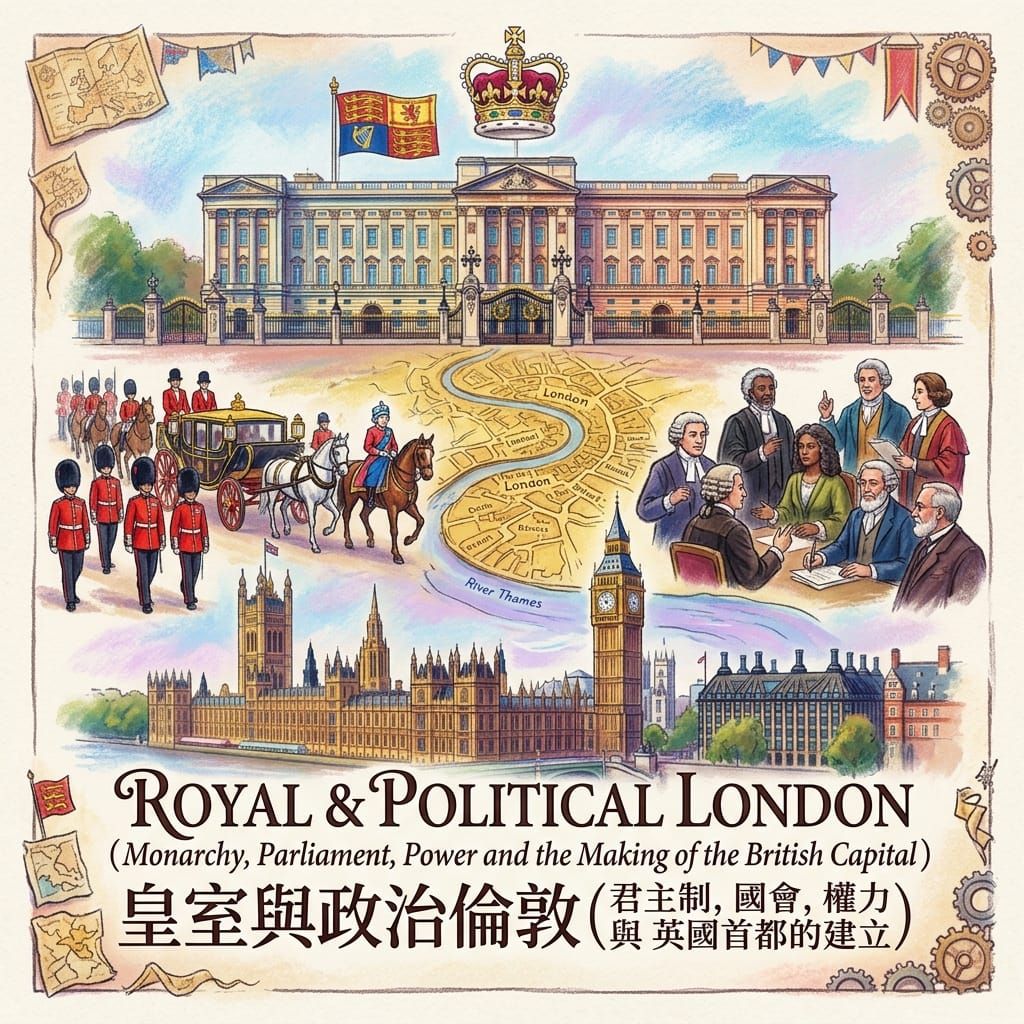
The Complete Authority Guide
Monarchy, Parliament, Power and the Making of the British Capital
London is not simply Britain's capital.
It is a city in which political power has been physically concentrated for almost a thousand years.
Kings came here.
Parliaments met here.
Governments were built here.
Courts administered justice here.
Wars were planned here.
Revolutions were resisted here.
Crowds protested here.
And constitutional government gradually developed within the same geographical landscape.
Yet Royal & Political London is not simply a collection of palaces and government buildings.
Its deeper story is about the changing relationship between:
monarchy + Parliament + religion + law + government + public opinion
The medieval king needed London for its wealth.
The medieval city negotiated privileges with the Crown.
Westminster became the centre of royal government.
The Tower projected military power.
Whitehall became the principal court and administrative complex.
Parliament gradually asserted itself as a political institution.
The Civil War demonstrated that royal authority could be challenged by Parliament.
The execution of Charles I transformed the meaning of monarchy.
The Glorious Revolution established new constitutional principles.
The Victorian state constructed monumental ministries around Whitehall.
And modern Britain continues to conduct much of its political life within the same historic landscape.
This is Royal & Political London.
1. Why London Became the Political Capital
The River, the City and the Crown
London's political importance grew out of its economic importance.
The City was wealthy.
The Thames connected it with the wider country.
Merchants supplied the Crown with money.
The population provided political influence.
The king therefore needed London.
But London also needed the king.
This relationship was never entirely harmonious.
Medieval monarchs repeatedly negotiated with the City over taxes, privileges and political authority.
The result was a distinctive relationship between:
royal power and civic power
The capital was never simply controlled from a palace.
It was negotiated between institutions.
2. Westminster — The Political Landscape Takes Shape
From Royal Residence to Centre of Government
The political London of today has deep medieval roots.
After the Norman Conquest, William the Conqueror inherited Westminster as an important royal centre. His successors developed the palace, abbey and surrounding institutions. William II began constructing Westminster Hall in 1097, and it became an important ceremonial and governmental building. (parliament.uk)
Westminster gradually became more than a royal residence.
The institutions of government increasingly settled there.
The Exchequer moved from Winchester to Westminster during the reign of King John.
Administrative power followed.
By the thirteenth century, Westminster was becoming one of the principal centres of government in England. (parliament.uk)
The significance of Westminster therefore lies not simply in its buildings.
It lies in the institutional continuity embedded in the place.
3. Westminster Hall — The Oldest Political Building in Modern London
Nine Centuries of Power in One Structure
Westminster Hall is the oldest surviving building on the Parliamentary estate.
The original hall was begun by William II in 1097 and completed around 1099. It became a centre for royal ceremonies, law courts and government. (parliament.uk)
Over the centuries, Westminster Hall witnessed:
- Royal banquets
- Parliamentary activity
- Major trials
- State ceremonies
- Constitutional crises
- Lying-in-state ceremonies
- Addresses by major political figures
Its significance comes partly from continuity.
Buildings changed around it.
Political institutions evolved.
The constitutional system transformed.
Yet Westminster Hall remained.


That makes it one of the clearest physical links between medieval government and the modern British state.
4. Westminster Abbey — Where Monarchy Becomes Ceremony
The Sacred Geography of Royal Power
Westminster Abbey represents another dimension of political London.
It connects:
monarchy + religion + ceremony + national memory
The present Gothic abbey developed largely under Henry III during the thirteenth century.
Westminster Abbey has been the setting for every English and British coronation since 1066, with the exception of Edward V and Edward VIII, who were not crowned. (westminster-abbey.org)
The abbey also contains the tombs and memorials of kings, queens, statesmen, writers, scientists and other national figures.
Its political significance therefore goes beyond coronation.
The building became a repository of national memory.


The relationship between Westminster Abbey and the monarchy has continued for almost a millennium. (westminster-abbey.org)
5. The Tower of London — Power by Fear
Fortress, Palace and Prison
The Tower of London represents a very different form of royal authority.
William the Conqueror began constructing the stone fortress in the 1070s, establishing a powerful symbol of Norman control over London. Historic Royal Palaces describes the Tower as simultaneously a fortress, royal palace and prison. (hrp.org.uk)
For centuries, the Tower represented the Crown's ability to control the capital.
It housed:
- Royal residents
- Prisoners
- Royal treasure
- The Royal Mint
- Armouries
- Military facilities
It was also a visible psychological statement.
William the Conqueror had recently conquered England.
The Tower demonstrated that the new monarchy intended to remain.


The modern City of London surrounds the fortress with glass towers.
That contrast is one of the strongest visual expressions of London's political history:
medieval royal power inside the modern financial city.
6. The Crown and the City — Two Powers Living Beside Each Other
London Was Never Politically Simple
The monarchy controlled the kingdom.
The City controlled its own civic institutions and commercial privileges.
This created a relationship that could be cooperative, competitive and occasionally confrontational.
The City's wealth made it valuable to monarchs.
Its political traditions gave it leverage.
The Crown required taxation.
Merchants wanted protection for trade.
The city expected recognition of its liberties.
Royal authority and civic authority therefore evolved together.
This relationship is still reflected in the peculiar institutional status of the City of London.
Modern political London cannot be understood simply through Westminster.
The City remains a different historical centre of power.
7. Whitehall — The Palace That Became the State
From Royal Residence to Government Street
The political landscape of Whitehall is one of the most revealing places in London.
What appears today as a succession of government ministries was once the immense Palace of Whitehall.
Henry VIII acquired York Place, the London residence of Cardinal Wolsey, and transformed it into a major royal palace from 1530. Whitehall became the principal London residence of the monarch and court until the late seventeenth century. (historicengland.org.uk)
At its height, Whitehall Palace contained around 1,500–2,000 rooms and included gardens, courts, royal apartments and specialized buildings. (historicengland.org.uk)
Much of it disappeared after the palace was destroyed by fire in 1698.
But its political geography survived.
Government offices gradually occupied the former royal landscape.
Whitehall therefore offers a remarkable historical transformation:
palace → administration → modern government


The modern street of Whitehall is essentially a political palimpsest.
8. Banqueting House — The Day Monarchy Was Put on Trial
Charles I and the Transformation of Political Authority
The Banqueting House is the most important surviving fragment of Whitehall Palace.
Designed by Inigo Jones and completed in 1622, it was created for royal entertainment and ceremony. (hrp.org.uk)
But its greatest historical significance came in 1649.
King Charles I was executed on a scaffold outside the Banqueting House after being convicted by Parliament's court.
The event abolished the monarchy for eleven years.
It represented an extraordinary reversal of the medieval political order:
the king was no longer unquestionably above the law.
The building therefore became a physical witness to one of the most dramatic constitutional crises in English history.


The Banqueting House embodies the transition from royal absolutism toward parliamentary sovereignty.
9. The English Civil War — When Parliament Challenged the Crown
Political London Becomes a Battlefield
The conflict between Charles I and Parliament was not simply a military struggle.
It was a constitutional crisis.
Who possessed ultimate authority?
The monarch?
Parliament?
The law?
The people?
The Civil War eventually brought fighting into London's political world.
Parliament became the centre of opposition to Charles.
London's merchants and political communities played important roles.
The king was eventually captured, tried and executed.
The monarchy was abolished.
England became a republic, the Commonwealth, before the Restoration of Charles II in 1660.
The political landscape of London therefore contains physical reminders of a question that still defines constitutional government:
Where does political authority ultimately come from?
10. The Restoration — Monarchy Returns to London
Charles II and the Return of the Court
The monarchy returned in 1660.
Charles II resumed royal government.
The political culture of London changed again.
Whitehall became a centre of court life.
Royal ceremonies returned.
The monarchy once again occupied a central place in national political identity.
Yet the Civil War had permanently changed the political imagination.
The Crown had been challenged.
The king had been tried.
Parliament had demonstrated extraordinary power.
The Restoration therefore did not simply restore the old political system.
It restored monarchy within a political landscape that had been transformed by conflict.
11. The Glorious Revolution — A New Constitutional Settlement
When the Crown Became More Constrained
The events of 1688–89 created another decisive turning point.
James II was replaced by William III and Mary II.
The Bill of Rights 1689 established important constitutional limits on royal authority and strengthened Parliament's position.
London was again at the centre of the political transformation.
The monarchy survived.
But the relationship between monarch and Parliament had changed.
Political authority increasingly operated through constitutional institutions rather than purely through hereditary royal power.
This was one of the foundations of the system that later developed into Britain's constitutional monarchy.
12. St James's Palace — The Tudor Court Survives
From Henry VIII to the Modern Monarchy
St James's Palace provides another layer of royal London.
Henry VIII acquired the site of a former hospital and developed a royal palace there in the 1530s.
For centuries, St James's served as one of the principal royal residences in London.
Even after Buckingham Palace became the monarch's main residence, St James's retained important ceremonial functions.
Its significance lies partly in its survival.
A Tudor palace remains embedded within modern Westminster.
It demonstrates how royal geography accumulates rather than simply replacing itself.
13. Kensington Palace — The Royal Court Moves West
London Expands Around the Monarchy
The monarchy's geography continued to evolve.
William III acquired Kensington Palace in 1689 and commissioned Christopher Wren to expand it. The palace became a favourite royal residence for successive sovereigns until the death of George II in 1760. (royal.uk)
Queen Victoria was born and raised there.
It was at Kensington Palace that she learned in 1837 that she had become queen.
Yet Victoria soon moved to Buckingham Palace.
This reveals another important theme:
royal geography follows the changing needs of the monarchy.
Residences become institutions.
Institutions create political districts.
Political districts eventually become part of the ordinary urban landscape.
14. Buckingham Palace — The Modern Working Monarchy
From Private Mansion to National Stage
Buckingham Palace was originally Buckingham House, but its political role changed dramatically in the nineteenth century.
Queen Victoria became the first reigning monarch to make Buckingham Palace her official residence in 1837. (royal.uk)
The palace became a working centre of the monarchy.
Audiences.
State occasions.
Diplomatic receptions.
Investitures.
National celebrations.
The palace therefore represents a new form of royal power.
The medieval monarch ruled through castles and travelling courts.
The modern monarch operates within a constitutional system but remains a visible symbol of the state.
Buckingham Palace therefore represents monarchy transformed rather than monarchy simply preserved.
15. Whitehall — From Royal Court to Modern Government
The State Moves Into the Palace's Shadow
The disappearance of Whitehall Palace did not diminish Whitehall's political importance.
Instead, the area became increasingly dominated by government departments.
The Treasury.
The Foreign Office.
The War Office.
The Admiralty.
The Home Office.
The Cabinet Office.
Historic England notes that Whitehall's government buildings evolved from the eighteenth century onward into increasingly monumental architecture designed to express the seriousness and authority of the modern state. (historicengland.org.uk)

The street became a physical representation of the British state.
The palace disappeared.
The bureaucracy remained.
16. Parliament — From Royal Council to Modern Democracy
The Political Institution Outgrows the Palace
Parliament's history stretches back to medieval assemblies.
The Palace of Westminster became one of the most important centres of parliamentary life.
The present building followed the catastrophic fire of 1834, which destroyed most of the old palace.
Sir Charles Barry designed the new Palace of Westminster, with Augustus Pugin responsible for much of its Gothic detail and interiors.
Historic England describes the complex as embodying the history of one of the world's ancient parliamentary monarchies. (historicengland.org.uk)
The new palace was not simply a replacement building.
It was deliberately monumental.
Its architecture expressed:
- Constitutional monarchy
- National history
- Parliamentary government
- Medieval continuity
- Imperial confidence
17. The Fire of 1834 — Parliament Rebuilds Its Image
A New Palace for a New Political Age
The old Palace of Westminster burned in 1834.
The fire destroyed much of the complex.
The surviving Westminster Hall became one of the most important links to the medieval parliamentary past.
The new Palace of Westminster was constructed between 1835 and 1860. (historicengland.org.uk)
The decision to build in a Gothic style was politically meaningful.
The new Parliament was modern.
But it deliberately looked medieval.
This was not accidental nostalgia.
Architecture was being used to communicate legitimacy.
The message was essentially:
modern parliamentary government is the heir to the ancient institutions of the nation.
18. Big Ben and the Theatre of Government
When Political Power Became a National Image
The Palace of Westminster transformed political government into visual spectacle.
Its towers dominated the skyline.
The clock became internationally recognizable.
The Great Bell known as Big Ben first struck in 1859. (parliament.uk)
The building became one of the most recognizable symbols of Britain.
This reveals something important about modern political power.
Government does not operate only through laws.
It also operates through symbols.
Architecture.
Ceremony.
Processions.
Flags.
Royal openings.
National rituals.
The political capital therefore became a kind of theatre.
19. Whitehall and the Rise of the Modern Bureaucratic State
Government Becomes an Urban Machine
The nineteenth century transformed government itself.
Britain required increasingly sophisticated administration.
Empire.
Defence.
Public health.
Transport.
Finance.
Education.
Trade.
Local government.
The state needed ministries, civil servants, archives and specialist departments.
Whitehall became the physical home of this expanding bureaucracy.
Historic England notes that the grand government architecture of Whitehall expressed the growing power, authority and imperial status of the state. (historicengland.org.uk)
The modern state therefore inherited the geography of the old royal court.
20. Royal London and the British Empire
Monarchy as Imperial Symbol
During the nineteenth century, the monarchy became increasingly connected with Britain's imperial identity.
Queen Victoria became associated with an empire that stretched across the world.
Royal ceremonies were projected internationally.
London became the stage from which imperial power was represented.
This relationship was complicated.
The monarchy could symbolize continuity and national identity.
But royal imagery was also incorporated into an imperial political system whose consequences extended far beyond Britain.
A sophisticated study of Royal & Political London therefore has to connect:
Buckingham Palace + Westminster + Whitehall + Empire
rather than treating royal history as purely domestic.
21. Parliament and Protest
Political London Is Also a City of Dissent
Power attracts opposition.
The streets around Parliament, Whitehall and Westminster have repeatedly hosted demonstrations and political movements.
This is one of the most important characteristics of London's political landscape.
The same spaces used by governments to exercise authority also become spaces where citizens challenge that authority.
Historic England identifies the Palace of Westminster as a major focus for protest, political change and the development of democratic institutions. (historicengland.org.uk)
London's political history therefore cannot be written only from inside palaces.
It must also be written from the streets.
22. Women and the Expansion of Political Participation
Parliament's Geography Meets the Politics of Protest
The struggle for women's political rights created new forms of political activity around Westminster.
Parliament became a target of protest as well as a place where legislation was debated.
Historic England highlights Emily Wilding Davison's 1911 protest within the Palace of Westminster as part of the building's history of political dissent. (historicengland.org.uk)
This is historically important because it changes the meaning of Parliament.
It was no longer enough to ask:
Who governs?
The political question became:
Who is allowed to participate in government?
Royal & Political London therefore includes the long expansion of political participation.
23. Political London During War
Westminster Under Pressure
The political centre was not immune from war.
The Palace of Westminster suffered bomb damage during the Second World War.
The building survived.
Westminster Hall survived.
Parliament continued functioning.
The continuity mattered symbolically.
The same buildings that represented constitutional government also became symbols of national endurance.


Political architecture therefore became part of the mythology of wartime Britain.
24. Royal & Political London After 1945
From Imperial Capital to Constitutional State
The twentieth century transformed Britain.
The empire declined.
The welfare state expanded.
The monarchy became constitutional and increasingly ceremonial.
Parliament remained the central legislative institution.
Whitehall became the administrative centre of a modern democratic state.
Buckingham Palace remained the symbolic and working centre of the monarchy.
London therefore shifted from:
imperial capital
to
constitutional and democratic capital
The physical geography remained remarkably stable.
The political meaning changed.
25. Royal & Political London Today
The Old Institutions Inside a Modern City
Today, a remarkably small area of London contains an extraordinary concentration of state institutions.
Buckingham Palace
The working residence of the monarch and a major site of royal ceremony. (royal.uk)
Westminster Abbey
The coronation church and a repository of royal and national memory. (westminster-abbey.org)
Palace of Westminster
The centre of Parliament and a symbol of constitutional government. (parliament.uk)
Whitehall
The administrative heart of the British government.
Tower of London
A surviving expression of medieval royal power and authority. (hrp.org.uk)
Together they form a political landscape rather than a collection of attractions.
26. Royal & Political London Walking Routes
Route 1 — The Medieval Foundations of Power
Tower of London → London Wall → Thames → Westminster
Historical focus:
Norman conquest, royal authority, medieval government and the growth of London as the capital.
Route 2 — The Royal London Axis
Buckingham Palace → St James's Palace → The Mall → Westminster Abbey
Historical focus:
Tudor monarchy, constitutional monarchy, coronation and royal ceremony.


Route 3 — The Political State
Westminster Abbey → Westminster Hall → Palace of Westminster → Parliament Square → Whitehall
Historical focus:
monarchy, Parliament, law and the development of the British state.
Route 4 — From Royal Palace to Government Street
Banqueting House → Whitehall → Horse Guards → Downing Street → Treasury
Historical focus:
Tudor monarchy, Stuart politics, Civil War, modern government and bureaucracy.
Route 5 — Power and Protest
Parliament Square → Parliament → Whitehall → Trafalgar Square
Historical focus:
political participation, protest, democracy, state power and public space.
27. Royal & Political London Across the Authority Graph
Royal & Political + Ancient & Medieval London
The institutions of medieval monarchy and government created the political geography inherited by modern London.
 Lawrence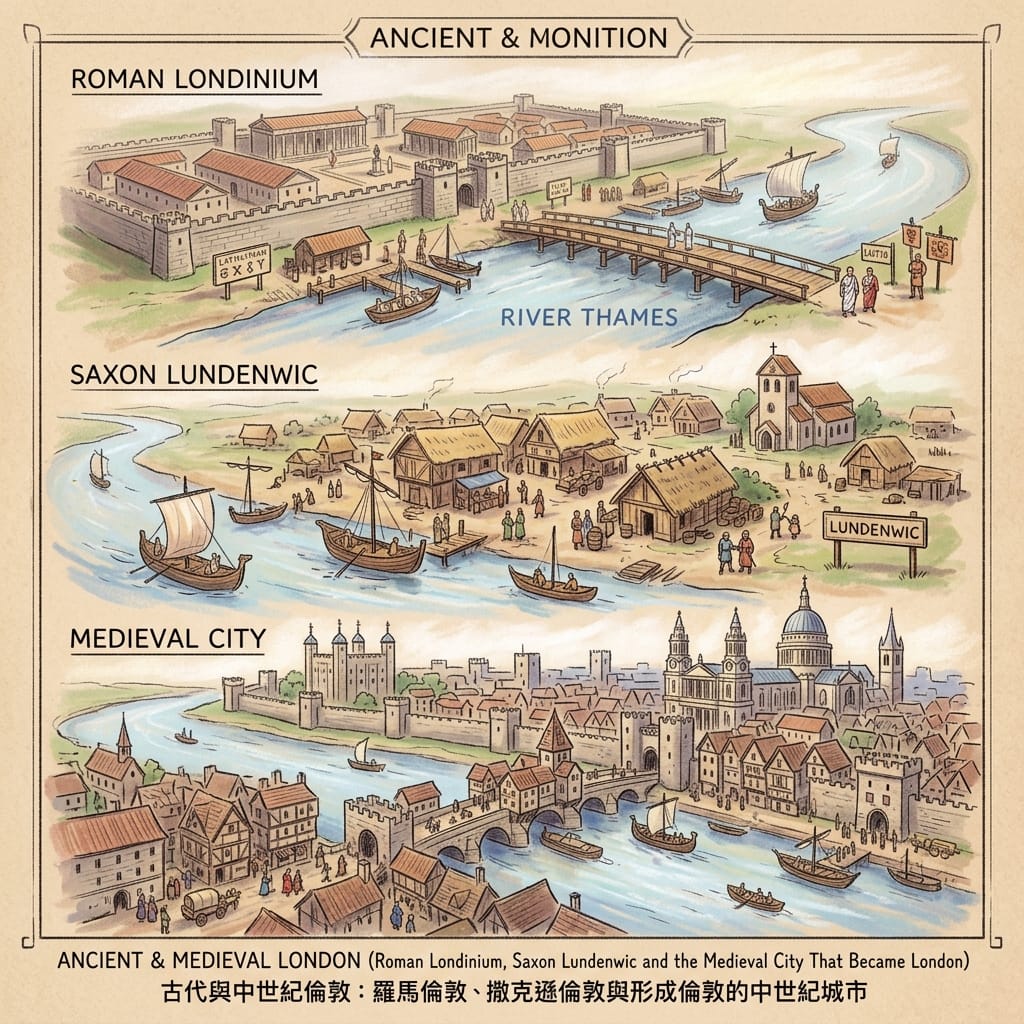
Royal & Political + Sacred London
Westminster Abbey and other religious institutions demonstrate how monarchy and religion were historically intertwined.
 Lawrence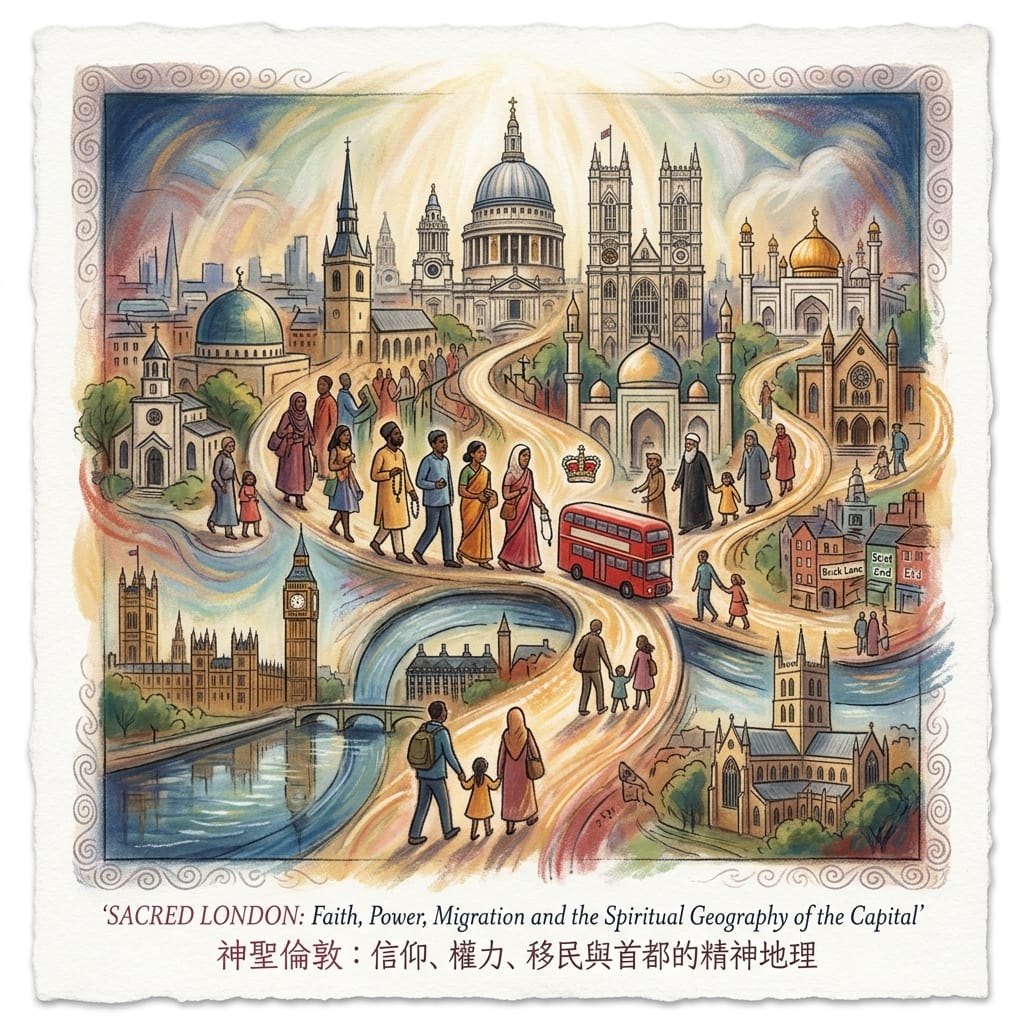
Royal & Political + Commercial & Industrial London
The monarchy and state depended upon London's commercial wealth, while political decisions profoundly influenced trade, empire and industrial development.
 Lawrence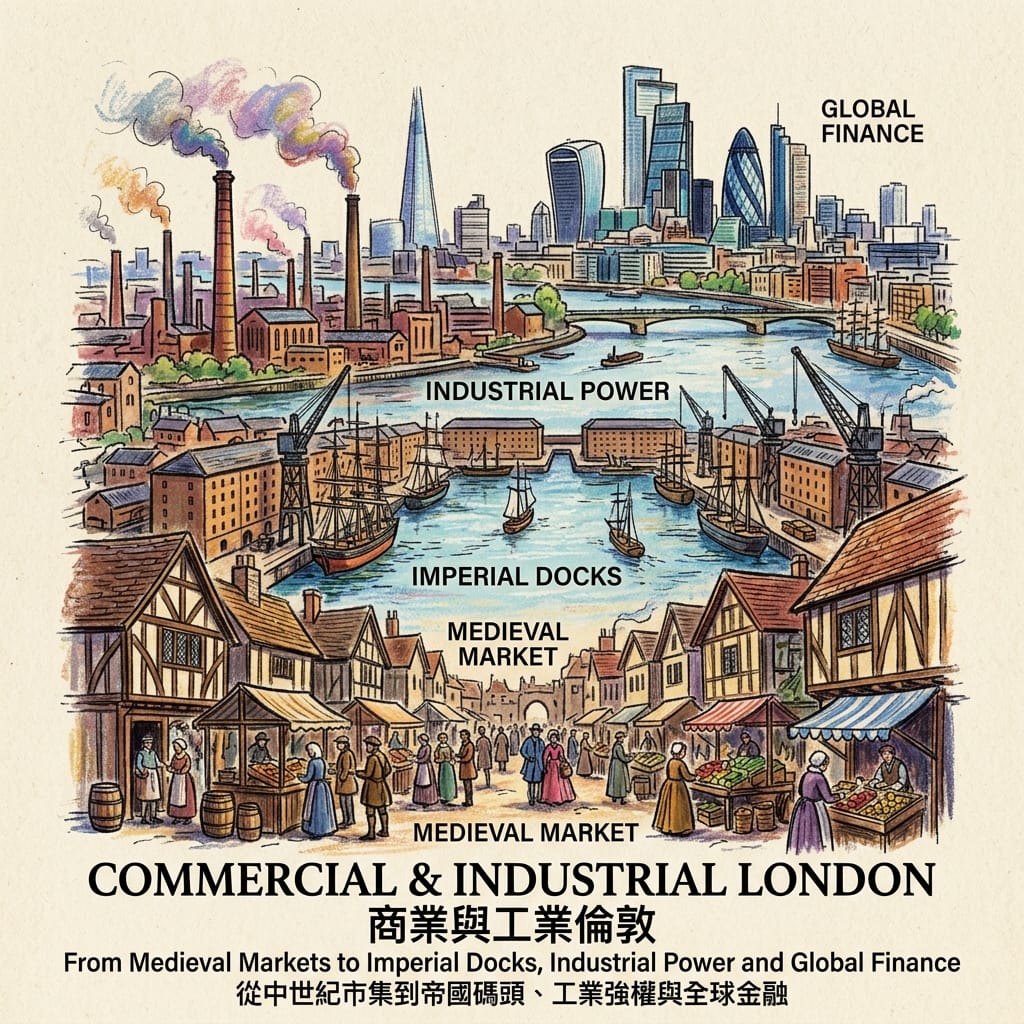
Royal & Political + Modern London
The political capital survived fire, revolution, industrialization, war, decolonization and the transformation of Britain into a modern constitutional democracy.
 Lawrence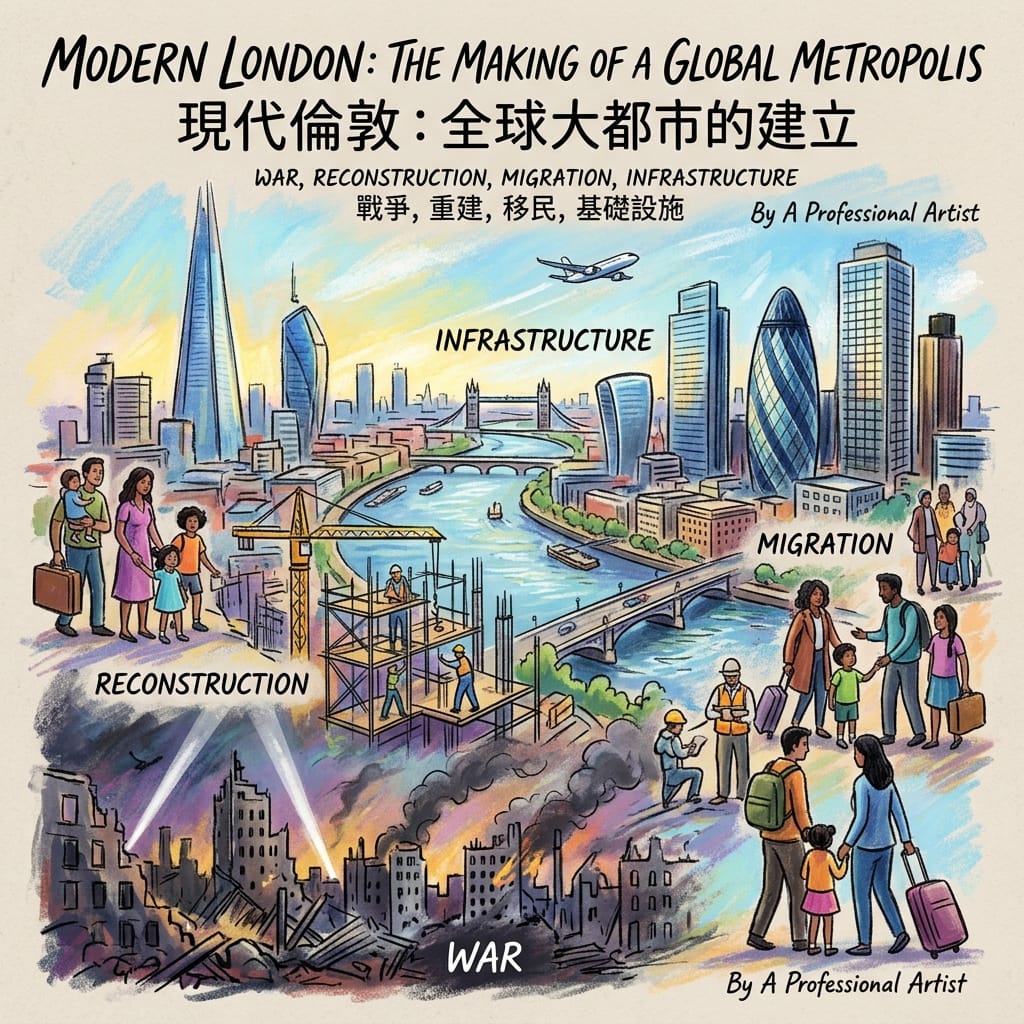
Royal & Political + Hidden London
Behind the monumental landscape are lost palaces, archaeological remains, forgotten government sites, old courtyards and political spaces that have disappeared from the modern map.
 Lawrence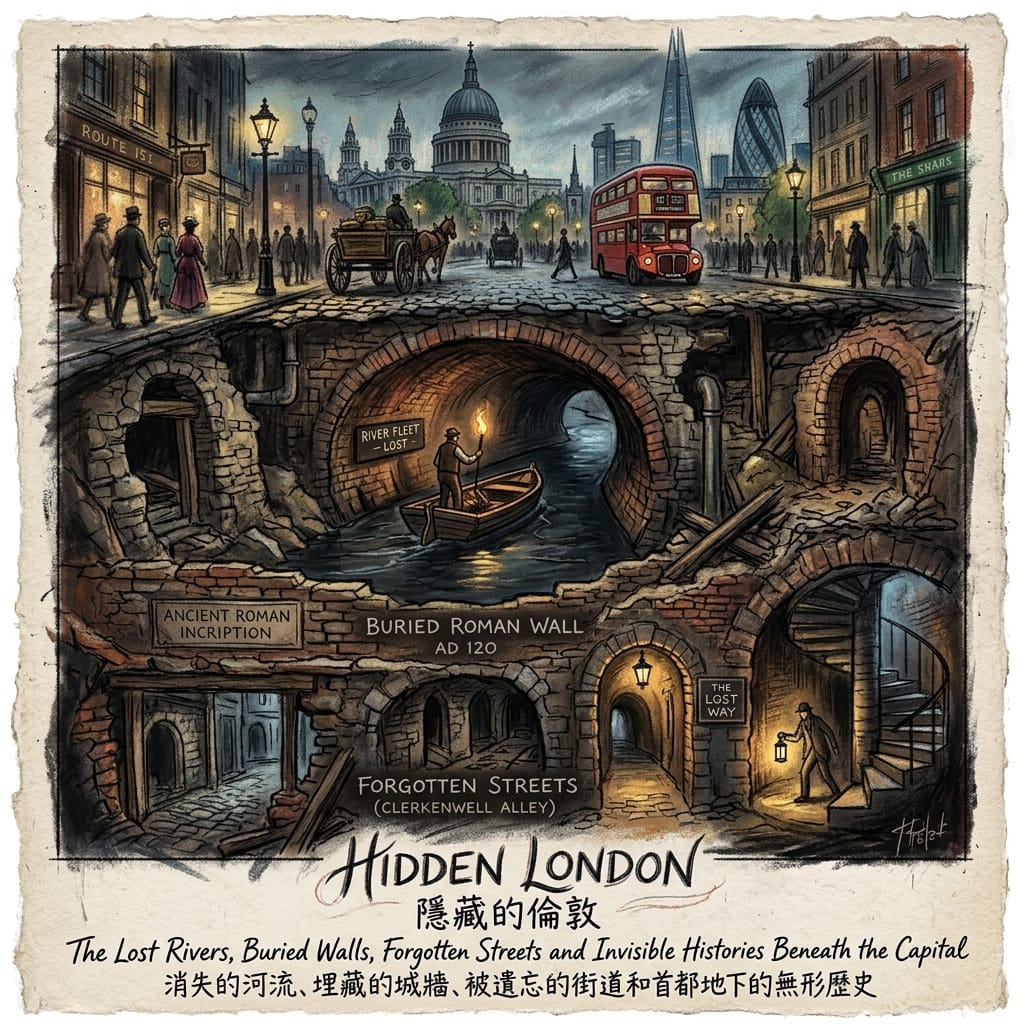
28. The Geography of British Power
Royal & Political London can ultimately be understood through five places.
The Tower
Power imposed
Fortress, conquest and royal authority.
Westminster Abbey
Power sanctified
Coronation, religion and monarchy.
Westminster Hall
Power institutionalized
Law, government and Parliament.
Whitehall
Power administered
Cabinet government, ministries and bureaucracy.
Buckingham Palace
Power represented
The modern constitutional monarchy.
Together:
Tower → Abbey → Parliament → Whitehall → Palace
These places tell the story of how British political power changed over almost a thousand years.
29. Why Royal & Political London Matters
The history of London's political landscape is ultimately a history of changing ideas about authority.
Medieval London
The king rules.
Magna Carta and medieval constitutional development
The king is subject to law and negotiation.
Civil War
Parliament can challenge the Crown.
1649
A king can be tried and executed.
Restoration
The monarchy returns.
1688–89
Royal power becomes constitutionally constrained.
Nineteenth century
Parliamentary government expands.
Twentieth century
Political participation becomes increasingly democratic.
Contemporary London
Monarchy, Parliament, government and public opinion coexist within a constitutional system.
The buildings of London make this political evolution visible.
Final Reflection — The City Where Power Became Geography
London's political history is not contained in a textbook.
It is built into the landscape.
The Tower tells us about conquest.
Westminster Abbey tells us about sacred monarchy.
Westminster Hall tells us about law and government.
Parliament tells us about constitutional power.
Whitehall tells us about bureaucracy.
Buckingham Palace tells us about the transformation of monarchy.
The streets between them tell another story.
Protest.
Celebration.
Procession.
Public opinion.
Political struggle.
The remarkable thing is how closely these different histories remain physically connected.
Within a relatively small part of London, England and Britain moved from:
medieval monarchy → royal government → parliamentary conflict → constitutional monarchy → modern democracy
The buildings remained.
The political meanings changed.
That is why Royal & Political London is not simply a journey through palaces.
It is a journey through the changing definition of power itself.
London was not merely the place where Britain was governed.
London was one of the places where the meaning of government was repeatedly contested, redesigned and made visible.
Historical Sources & Further Reading
UK Parliament
The UK Parliament's Living Heritage resources provide a detailed chronology of Westminster from the medieval period to the present, including Westminster Hall, the development of Parliament and the rebuilding of the Palace after the 1834 fire. (parliament.uk)
Historic England
Historic England provides authoritative material on Westminster, Whitehall, government buildings, constitutional history, political protest and the architectural development of London's political landscape. (historicengland.org.uk)
Westminster Abbey
Westminster Abbey's historical archive is essential for coronations, royal history, Westminster's medieval development and the relationship between monarchy and religion. (westminster-abbey.org)
Historic Royal Palaces
Historic Royal Palaces provides authoritative historical material on the Tower of London and its changing functions as fortress, royal palace, prison and state institution. (hrp.org.uk)
Royal Family / Royal Archives
The official Royal Family archive is particularly useful for royal residences, constitutional monarchy, coronations and the modern role of the Crown. (royal.uk)
Further Research
Particularly valuable themes for future Royal & Political London articles include:
- Norman conquest and royal fortifications
- Westminster Palace
- Westminster Hall
- Magna Carta
- Parliamentary origins
- Tudor monarchy
- Whitehall Palace
- Civil War
- Charles I's execution
- Restoration
- Glorious Revolution
- Bill of Rights 1689
- Georgian monarchy
- Victorian constitutional government
- Whitehall ministries
- Women's suffrage
- Political protest
- Royal ceremonies
- The constitutional monarchy
- Political London during wartime
Continue Exploring London
LONDON — The Complete Authority Guide
→ Ancient & Medieval London — Roman Londinium, medieval commerce and the foundations of the city
→ Royal & Political London — Monarchy, Parliament and the architecture of power
→ Sacred London — Churches, abbeys, belief and religious transformation
→ Commercial & Industrial London — Markets, Thames trade, docks, factories and finance
→ Modern London — Fire, railways, war, reconstruction, migration and reinvention
→ Hidden London — Archaeology, lost landscapes and forgotten political histories
ROYAL & POLITICAL LONDON
A fortress.
A palace.
An abbey.
A parliament.
A government street.
A constitutional monarchy.
A democracy.
All occupy the same city.
London did not simply house Britain's political power.
It became the physical landscape through which Britain repeatedly redefined what political power meant.